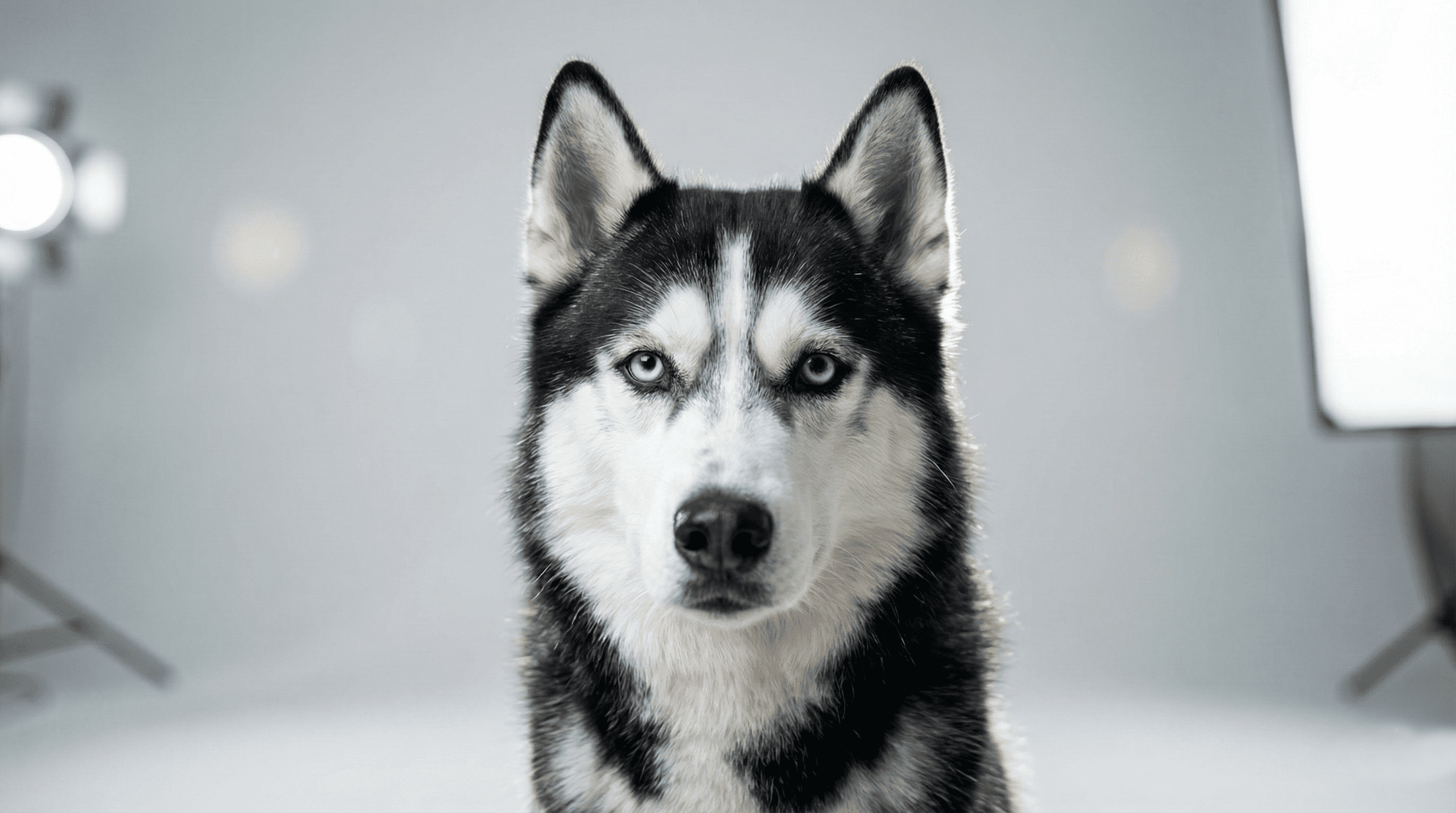
Siberian Husky at a glance
| Lifespan |
12 to 15 years |
| Adult weight |
16 to 27 kg |
| Exercise |
At least 90 minutes a day |
| Shedding |
Heavy, with a full coat “blow” about twice a year |
| Lifetime cost |
About $29,600 to $41,900 over 12 years (calculator below) |
| Main health risks |
Hip dysplasia, hypothyroidism, eye disease including progressive retinal atrophy and cataracts |
Can Huskies live in Australia’s heat?
Yes, with care. The double coat insulates against heat as well as cold, so never shave a Husky. Exercise only in the early morning or evening in summer, provide shade, water and a cool indoor space, and watch for heavy panting or weakness. A cooling mat helps on hot days.
Before you get a Husky
Huskies are friendly and sociable, but they are escape artists with a strong urge to run and a high prey drive, and most cannot be trusted off lead. They need secure, high fencing, a lot of exercise and company. Bored or lonely Huskies dig, howl and destroy things. They suit active owners who enjoy running, hiking or dog sports.
An Arctic sled dog in an Australian climate
The Siberian Husky was developed by the Chukchi people of north-eastern Siberia to pull light loads over long distances in extreme cold, on minimal food. It is one of the most efficient endurance animals in the domestic dog, and almost everything that makes it difficult in Australian suburbia is a direct consequence of that job.
This is a breed that is very frequently bought on appearance and very frequently surrendered on behaviour. Before anything else, three things need to be honest.
1. Recall is unreliable, and this is not fixable by training
The Husky was bred to run away from a handler for hours at a time. It has a strong prey drive and an extraordinary tolerance for distance. A loose Husky does not come back — it keeps going, and dogs are routinely found tens of kilometres from home.
Plan for a dog that lives on lead or in secure fencing, permanently. And “secure” means genuinely secure: Huskies are accomplished climbers, diggers and gate-openers. This is the most common reason Huskies end up in Australian pounds.
2. The prey drive is real
Cats, rabbits, poultry and small dogs are at genuine risk. Some Huskies live successfully with cats they were raised alongside; many cannot. This needs to be planned around, not hoped about.
3. The trainability score is 3, and that is accurate
Huskies are intelligent and entirely capable of learning. They are simply not biddable in the way a retriever or shepherd is — they were selected to make independent decisions on the trail, not to look to a handler. They will weigh your instruction against what they would rather do. Reward-based, interesting, varied training works. Repetition and pressure do not.
Ninety minutes of daily exercise is the specification and it is a real number. An under-exercised Husky digs, escapes and howls. They are also genuinely vocal — Huskies rarely bark but they howl and “talk”, which carries a long way in a townhouse.
Heat: the Australian constraint
This is the point that matters most and is most often mishandled.
The Husky’s double coat is a sophisticated insulating system: a dense woolly undercoat trapping air beneath a longer weather-resistant guard coat. It insulates in both directions — keeping cold out in Siberia and keeping heat out in Australia.
Do not shave a Husky for summer. It is intuitive and it is wrong. Removing the coat destroys the insulating layer, exposes pale skin to sun, and leaves the dog hotter rather than cooler. It can also permanently damage the coat’s regrowth. What actually helps is thorough removal of the dead undercoat by brushing, so air can move through the coat as designed.
Beyond that, the standard summer discipline applies with more force than for most breeds: exercise early morning or after dusk only, provide deep shade and constant water, and consider cooling mats and fans indoors. Huskies do adapt to warmer climates — many live perfectly well across Australia — but they do so with an owner actively managing the environment, not by acclimatising away their biology.
Coat and shedding
Huskies shed constantly and then, twice a year, they “blow coat” — the entire undercoat comes away in sheets over a week or two, in quantities that genuinely surprise first-time owners.
Brush two or three times a week as routine and daily during a blow, with an undercoat rake rather than a slicker. On the positive side, Huskies are unusually clean dogs with little odour and they groom themselves fastidiously, so bathing is rarely needed.
Health — a robust breed, with specific eye issues
Huskies are generally healthier than many pedigree breeds, having been selected for hard function rather than appearance for most of their history. At 12 to 15 years the lifespan is good for the size.
Eyes are the notable exception. Progressive retinal atrophy occurs in the breed, including an X-linked form specific to Siberian Huskies, and is DNA-testable — ask a breeder for both parents’ results. Juvenile cataracts and corneal dystrophy also occur, so ask about current eye certification for the parents rather than a general assurance.
Hip dysplasia is screened radiographically; ask for scores. The incidence in Huskies is comparatively low, but screening still matters.
Hypothyroidism presents as weight gain, lethargy, coat thinning and recurrent skin problems. Blood test, inexpensive treatment.
Zinc-responsive dermatosis is worth knowing about as a breed-specific issue: crusting and hair loss around the muzzle, eyes and ears caused by impaired zinc absorption rather than dietary deficiency. It responds well to supplementation once correctly diagnosed, so persistent facial crusting in a Husky deserves a proper work-up rather than repeated allergy treatment.
Ownership in Australia
In Victoria, microchipping and council registration are required from three months of age under the Domestic Animals Act 1994, renewing annually on 10 April. Desexed registration across the Victorian councils in our fee survey ranged from about $19.50 to $93.30 a year.
Two final practical notes. Keep microchip details current — this is one of the breeds most likely to turn up at a pound several suburbs away. And if you are considering a Husky primarily because of how it looks, spend a day with an adult one first. The dogs are extraordinary; the mismatch between the photograph and the reality is where the surrender statistics come from.
Registration is set by your local council. In Victoria, registering a desexed Siberian Husky costs between $19.50 and $93.30 a year depending on where you live, and roughly three times that if the dog is not desexed. See every Victorian council’s 2026–27 fee, or compare registration costs in every state.
Large dogs carry more load through their joints for longer. If you are choosing gear for a Siberian Husky, see our orthopaedic bed comparison for large breeds and our large-breed dog food comparison.
Related breeds
The Siberian Husky, originating from Russia, belongs to the Working Dogs group and is a purebred breed classified as medium-sized with a weight range of 16 to 27 kg. These dogs have a health complexity score of 2.0 and rank 45th in intelligence. Known for their thick double coat, they are not hypoallergenic and exhibit a high shedding level, necessitating weekly grooming and high grooming needs. With a lifespan of 12 to 15 years, they are friendly, alert, gentle, and mischievous. They are highly energetic, requiring 90 minutes of daily exercise. Siberian Huskies display high sociability towards children and other pets. They are moderately prone to separation anxiety and obesity. Key health concerns include Hip Dysplasia, Progressive Retinal Atrophy, and Hypothyroidism. suitability with children is high and moderate separation anxiety should be factored into their care. The annual veterinary cost is approximately $1740.00, excluding contingency funds. Breeds that tend to roam benefit from a GPS tracker; the Tractive DOG 6 GPS tracker is reviewed here.
Given the breed's health complexity, routine veterinary check-ups are vital to monitor for hereditary conditions such as Hip Dysplasia, Progressive Retinal Atrophy, and Hypothyroidism. Early detection and management of these conditions can significantly impact overall health and longevity.
Daily care for a Siberian Husky includes 90 minutes of vigorous exercise to manage their high energy levels. Coat maintenance involves weekly grooming due to their thick double coat, which sheds heavily. Regular monitoring of their diet is essential to mitigate the moderate risk of obesity. Foods suited to large, heavy dogs are compared in our guide to the best dog food for large breeds.