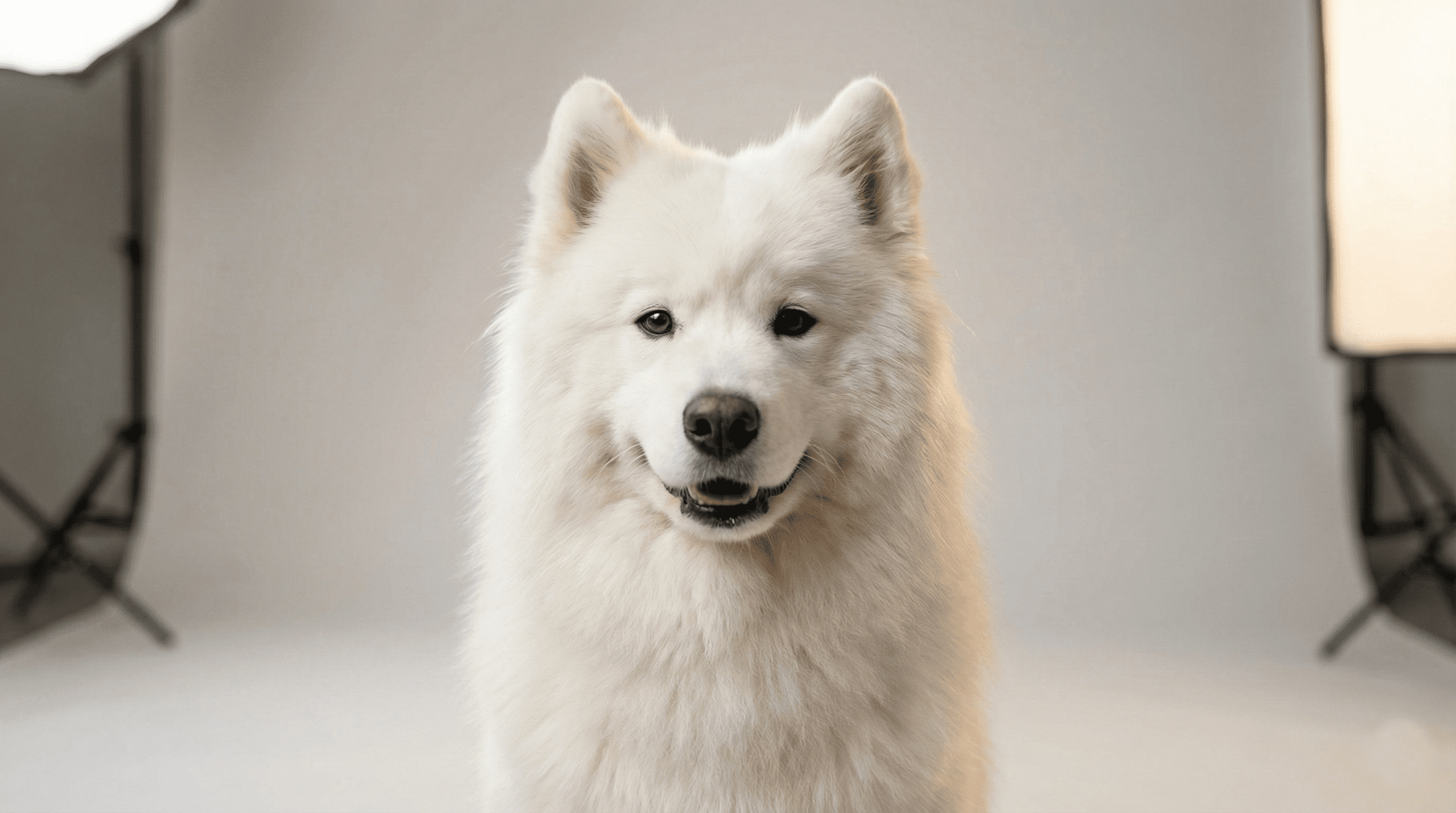
Samoyed at a glance
| Lifespan |
12 to 14 years |
| Adult weight |
16 to 30 kg |
| Exercise |
About 90 minutes a day |
| Coat |
Thick double coat that sheds heavily |
How long do Samoyeds live?
Most live 12 to 14 years. Hip dysplasia and an inherited kidney disease (hereditary glomerulopathy) are the main risks, so ask a breeder for hip scores and health history for both parents.
How big do Samoyeds get?
Medium to large: adults usually weigh 16 to 30 kg, with males at the heavier end. The thick white coat makes them look bigger still. They need a house with a yard and plenty of exercise rather than an apartment.
A Siberian working dog that lived in the tent
The Samoyed was developed by the Samoyedic peoples of Siberia to herd reindeer, haul sledges and hunt — and, crucially, to sleep alongside the family for shared warmth. That last detail explains the temperament. Unlike most northern spitz breeds, the Samoyed was selected for close human contact, and the result is a genuinely friendly, gentle, people-oriented dog rated excellent with children.
It is also a working dog with a working dog’s requirements. Ninety minutes of daily activity is the specification, and it is real. The trainability score of 3 reflects spitz independence rather than incapacity — a Samoyed will consider your instruction and then decide. Reward-based, varied, interesting training works; repetition does not.
Two things to know before you buy. Samoyeds are vocal, with a carrying bark they use freely, which matters in a townhouse or with close neighbours. And they are poor guard dogs precisely because they like everyone — the famous “Sammy smile” is offered to burglars too.
Samoyed hereditary glomerulopathy
This is the condition specific to the breed and the one most owners have never heard of. It is an inherited kidney disease affecting the glomeruli — the filtering units of the kidney — and it is X-linked, which produces an unusual and important pattern of inheritance.
Affected male dogs develop progressive kidney failure, typically becoming apparent within the first year or two of life and progressing rapidly. Female carriers generally develop a much milder form and often live normal lives, but they pass the gene on.
The practical consequences are specific:
- Ask any breeder directly about the condition and what testing or line history they can show you. A serious Samoyed breeder will know exactly what you are asking about.
- In a young male Samoyed, increased drinking and urinating, poor growth, weight loss or lethargy warrants prompt investigation of kidney function rather than a wait-and-see.
- A urine protein to creatinine ratio (UPC) detects protein loss through the kidneys before clinical signs appear, and is worth including in routine health checks.
Diabetes mellitus
The Samoyed is among the breeds most predisposed to diabetes. The early signs are easy to check and easy to attribute to something else: drinking noticeably more, urinating more, and weight loss despite a good appetite. Mention any of those to your vet rather than waiting for the next annual visit. Diagnosed early, it is very manageable.
Hips and eyes
Hip dysplasia is screened radiographically — ask for the parents’ actual scores. Progressive retinal atrophy occurs in the breed and is DNA-testable; ask for both parents’ results.
The coat: high maintenance and non-negotiable
The Samoyed carries one of the most demanding coats in dogs — a long, straight, weather-resistant topcoat over a dense, soft, insulating undercoat. Our specification table rates both grooming and shedding high, and that is accurate.
Samoyeds shed constantly and then, twice a year, blow their entire undercoat over a week or two in quantities that genuinely shock first-time owners. Brush several times a week as routine and daily during a blow, using an undercoat rake to lift the dead coat — a slicker alone works the topcoat and leaves the problem underneath. Neglected undercoat felts against the skin, traps moisture and causes skin infection.
Do not shave a Samoyed for summer. This is the most common and most damaging mistake made with the breed in Australia. A double coat insulates in both directions — it keeps heat out as well as in. Removing it exposes pale skin to sun, leaves the dog hotter rather than cooler, and can permanently damage the coat’s regrowth. What actually helps is thorough removal of the dead undercoat by brushing, so air can circulate through the coat as designed.
On the positive side, Samoyeds are notably clean, low-odour dogs and the coat is somewhat dirt-shedding, so bathing is needed less often than the white colour suggests.
Australian conditions
This is a Siberian breed and Australian summers are the honest constraint. Beyond not shaving the coat: exercise only in the early morning or after dusk through the warmer months, provide deep shade and constant water, and consider cooling mats and indoor airflow. Samoyeds do live perfectly well across Australia — but with an owner actively managing the environment, not by acclimatising away their biology.
Secure fencing matters too. Samoyeds are capable diggers and escape artists with a herding heritage and real curiosity.
Ownership in Australia
In Victoria, microchipping and council registration are required from three months of age under the Domestic Animals Act 1994, renewing annually on 10 April. Desexed registration across the Victorian councils in our fee survey ranged from about $19.50 to $93.30 a year.
Budget for grooming honestly. Whether you do it yourself with proper tools and several hours a week, or pay a professional every six to eight weeks, the coat is the defining ongoing commitment of this breed. Everything else about living with a Samoyed is a pleasure.
Registration is set by your local council. In Victoria, registering a desexed Samoyed costs between $19.50 and $93.30 a year depending on where you live, and roughly three times that if the dog is not desexed. See every Victorian council’s 2026–27 fee, or compare registration costs in every state.
Large dogs carry more load through their joints for longer. If you are choosing gear for a Samoyed, see our orthopaedic bed comparison for large breeds and our large-breed dog food comparison.
Related breeds
The Samoyed is a purebred spitz breed originating in Siberia, developed for herding reindeer and hauling sledges. Adults weigh 16 to 30 kg and live 12 to 14 years. The defining practical feature is the coat: a long straight topcoat over a dense soft undercoat, shedding heavily year-round and very heavily during seasonal moults. It requires line brushing to the undercoat two to three times weekly, and daily during a moult — surface brushing is not sufficient and mats trap moisture against the skin, causing underlying disease. Exercise demands are substantial at around 90 minutes daily; an under-exercised Samoyed is typically a vocal and destructive one. Temperament is friendly, social and notably poor at being left alone, with a high tendency toward separation anxiety. Health monitoring should focus on Samoyed hereditary glomerulopathy — an X-linked progressive kidney disease affecting males from a few months of age — along with hip dysplasia, diabetes mellitus and progressive retinal atrophy. Heat tolerance is poor and heatstroke is a genuine risk in Australian summers.
Routine veterinary review should include screening for Samoyed hereditary glomerulopathy, an X-linked kidney disease in which affected males show protein in the urine from around three months and can progress to renal failure within the first two years — early urinalysis is worthwhile in male puppies from untested lines. Also monitor for hip dysplasia, diabetes mellitus, progressive retinal atrophy and cataracts. Watch for signs of overheating in summer, as heatstroke presents rapidly in double-coated breeds.
Daily care for a Samoyed is grooming-intensive. Line brush to the undercoat two to three times weekly, daily during moults, using a slicker and undercoat rake rather than surface brushing. Provide around 90 minutes of daily activity across walks, running and mental work. Never shave the coat — it insulates against heat as well as cold. Manage temperature actively through summer: exercise in the cool parts of the day and provide shade, water and indoor cooling.