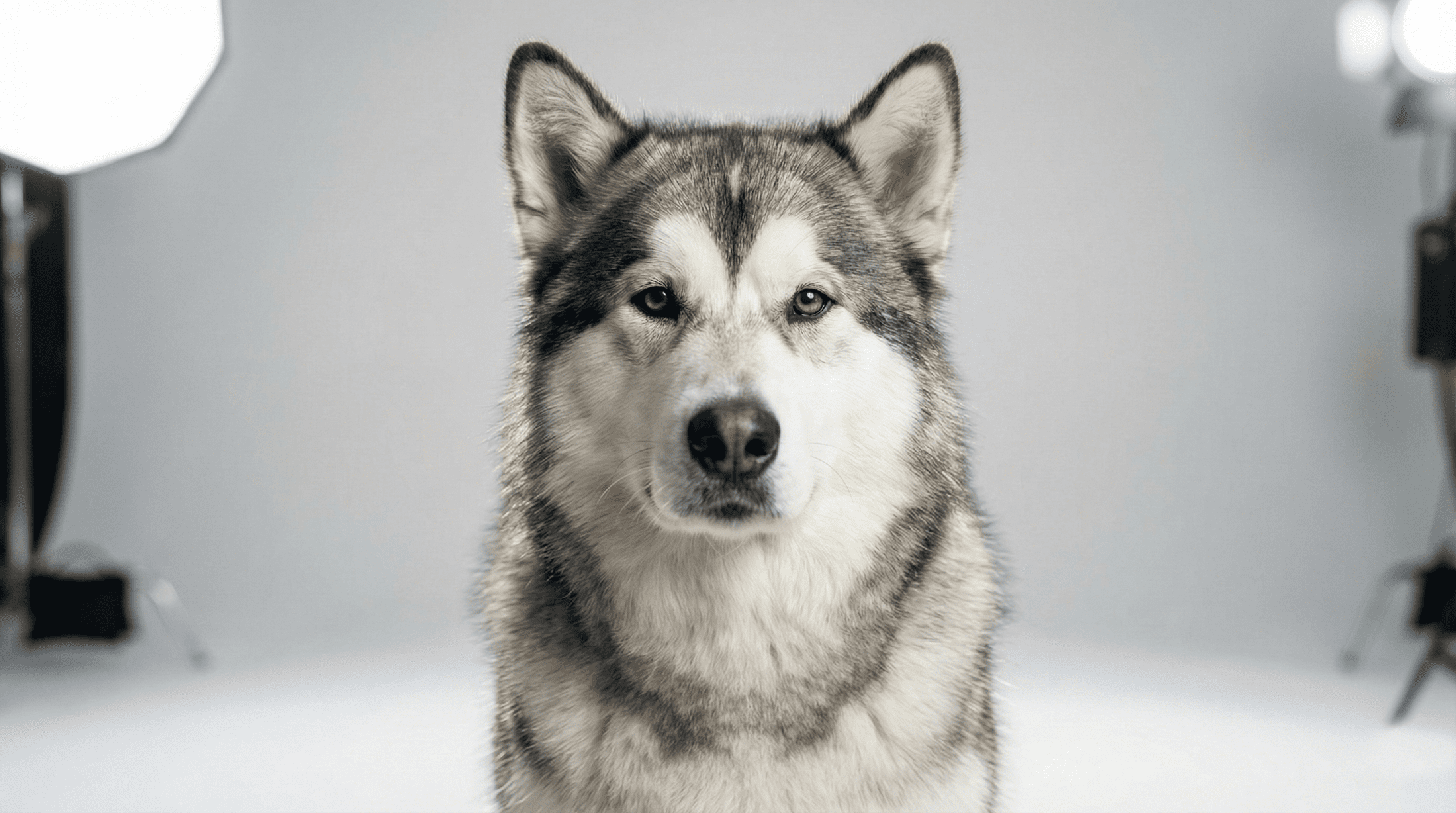
A freight dog, not a bigger Husky
The Alaskan Malamute is regularly confused with the Siberian Husky, and the distinction is functional rather than cosmetic. The Husky was bred to pull light loads fast over long distances. The Malamute was bred by the Mahlemiut people of north-western Alaska to haul heavy freight slowly. It is the larger, heavier, stronger animal — 34 to 45 kilograms of power built for pulling.
That difference shows in temperament too. Malamutes are affectionate, playful and notably loyal to their households, but they are also more independent and more inclined to test boundaries than most working breeds. The trainability score of 3 is honest: a Malamute understands perfectly well what you have asked and will decide whether it agrees.
Ninety minutes of daily activity is the specification and it is not padded. This is a dog engineered to work all day. An under-exercised Malamute digs craters, dismantles fencing, and applies 40 kilograms of strength to whatever is nearest.
Three things to be honest about before buying
1. Digging and escaping
Malamutes dig with real commitment — it is instinctive, it is not boredom alone, and it will happen to your lawn. Fencing needs to be high, sound and dug in at the base. A designated digging pit is a genuine solution rather than a joke.
2. Prey drive
The prey drive is strong and it is not reliably trainable away. Cats, poultry, rabbits and small dogs are at real risk. Some Malamutes live with cats they were raised alongside; many cannot. This needs planning around rather than hoping about.
Same-sex dog intolerance is also common in the breed and is worth taking seriously in a multi-dog household.
3. Strength and pulling
A Malamute was bred to lean into a harness and pull. Loose-lead walking must be taught early and properly, while the dog is still manageable, because an adult Malamute that pulls can move most adults. On the positive side, canicross, scootering and cart-pulling are ideal outlets and available through clubs in parts of Australia — they satisfy the dog exactly and turn the trait into an asset.
Heat: the honest Australian constraint
This is an Arctic freight dog with one of the heaviest coats in dogs, and Australia is not the Arctic. Malamutes do live successfully across Australia, but with owners actively managing the environment rather than assuming the dog will adapt.
Do not shave the coat for summer. This is the most common and most damaging mistake made with double-coated breeds. The coat insulates in both directions — a dense undercoat trapping air beneath a coarse guard coat keeps heat out as well as in. Shaving removes that protection, exposes skin to sun, leaves the dog hotter rather than cooler, and can permanently damage the coat’s regrowth.
What actually works is thorough removal of the dead undercoat by brushing, so air can circulate through the coat as designed. Beyond that: exercise only in the early morning or after dusk through the warmer months, provide deep shade and constant water, use cooling mats and indoor airflow, and be conservative. A large dog with a heavy coat has a poor surface-area-to-mass ratio for shedding heat.
The coat
Grooming and shedding are both rated high, and that is accurate. Malamutes shed constantly and then blow their entire undercoat twice a year over a week or two, in quantities first-time owners find genuinely startling.
Brush several times a week as routine and daily during a blow, using an undercoat rake rather than a slicker — a slicker works the topcoat and leaves the dead undercoat where it is, which then felts against the skin and causes infection.
The compensation is that Malamutes are clean, low-odour dogs that need bathing rarely.
Health
Bloat is the emergency to know. As a large, deep-chested breed the Malamute is at real risk of gastric dilatation-volvulus — a hard distended abdomen with repeated unproductive retching and rapid decline, fatal within hours untreated. Know your after-hours clinic in advance, feed two smaller meals rather than one, and discuss preventive gastropexy with your vet at desexing.
Hip dysplasia is screened radiographically; ask for the parents’ actual scores, and keep the dog lean through the first two years while growth plates are open.
Eyes. Progressive retinal atrophy and hereditary cataracts both occur in the breed. PRA is DNA-testable — ask for both parents’ results — and ask about current eye certification.
Hypothyroidism presents as weight gain, lethargy, coat thinning and recurrent skin infections. Straightforward blood test, inexpensive lifelong treatment.
Chondrodysplasia, a form of dwarfism affecting limb development, is a recognised inherited condition in Alaskan Malamutes and one that responsible breeders track through pedigrees. It is worth asking about by name.
Ownership in Australia
In Victoria, microchipping and council registration are required from three months of age under the Domestic Animals Act 1994, renewing annually on 10 April. Desexed registration across the Victorian councils in our fee survey ranged from about $19.50 to $93.30 a year.
Keep microchip details current. Between the digging, the fencing challenges and the prey drive, this is one of the breeds most likely to turn up at a pound. And if you are drawn to the Malamute by photographs, spend a day with an adult one first — preferably in summer.
Registration is set by your local council. In Victoria, registering a desexed Alaskan Malamute costs between $19.50 and $93.30 a year depending on where you live, and roughly three times that if the dog is not desexed. See every Victorian council’s 2026–27 fee, or compare registration costs in every state.
Large dogs carry more load through their joints for longer. If you are choosing gear for a Alaskan Malamute, see our orthopaedic bed comparison for large breeds and our large-breed dog food comparison.
Related breeds
The Alaskan Malamute, originating from the United States, belongs to the working dog group and is classified as a purebred. This breed has a health complexity score of 2.0 and a life expectancy ranging from 10 to 14 years. It weighs between 34 to 45 kilograms, fitting into the large mass classification. The coat is a double layer, dense and coarse, necessitating high grooming needs with weekly maintenance at home. It has a high shedding level and is not hypoallergenic. With a temperament described as friendly, affectionate, loyal, playful, independent, and protective, the breed has a moderate trainability score and a high energy level. Daily exercise requirements are approximately 90 minutes. It exhibits a good compatibility with children and a moderate compatibility with other pets. However, there is a moderate risk of separation anxiety and obesity. Key health concerns to monitor include hip dysplasia, cataracts, hypothyroidism, progressive retinal atrophy, and gastric torsion. The intelligence ranking is 50, and the breed is popular in Australia, ranking within the top 60. Financial considerations include an estimated first-year puppy cost of $3000 and an annual veterinary cost of $2100. A contingency fund of $1600 is recommended. Breeds that tend to roam benefit from a GPS tracker; the Tractive DOG 6 GPS tracker is reviewed here.
With a health complexity score of 2.0, Alaskan Malamutes require regular veterinary checkups to monitor for hereditary conditions such as hip dysplasia, cataracts, hypothyroidism, progressive retinal atrophy, and gastric torsion. Early diagnosis and treatment plans are crucial for maintaining health and quality of life.
Daily care for an Alaskan Malamute includes 90 minutes of exercise to meet high energy levels. Weekly coat maintenance is required to manage the dense double coat and prevent matting. Nutritional management is essential to avoid obesity. Socialisation should start early to ensure good behaviour with other pets and children. Foods suited to large, heavy dogs are compared in our guide to the best dog food for large breeds.