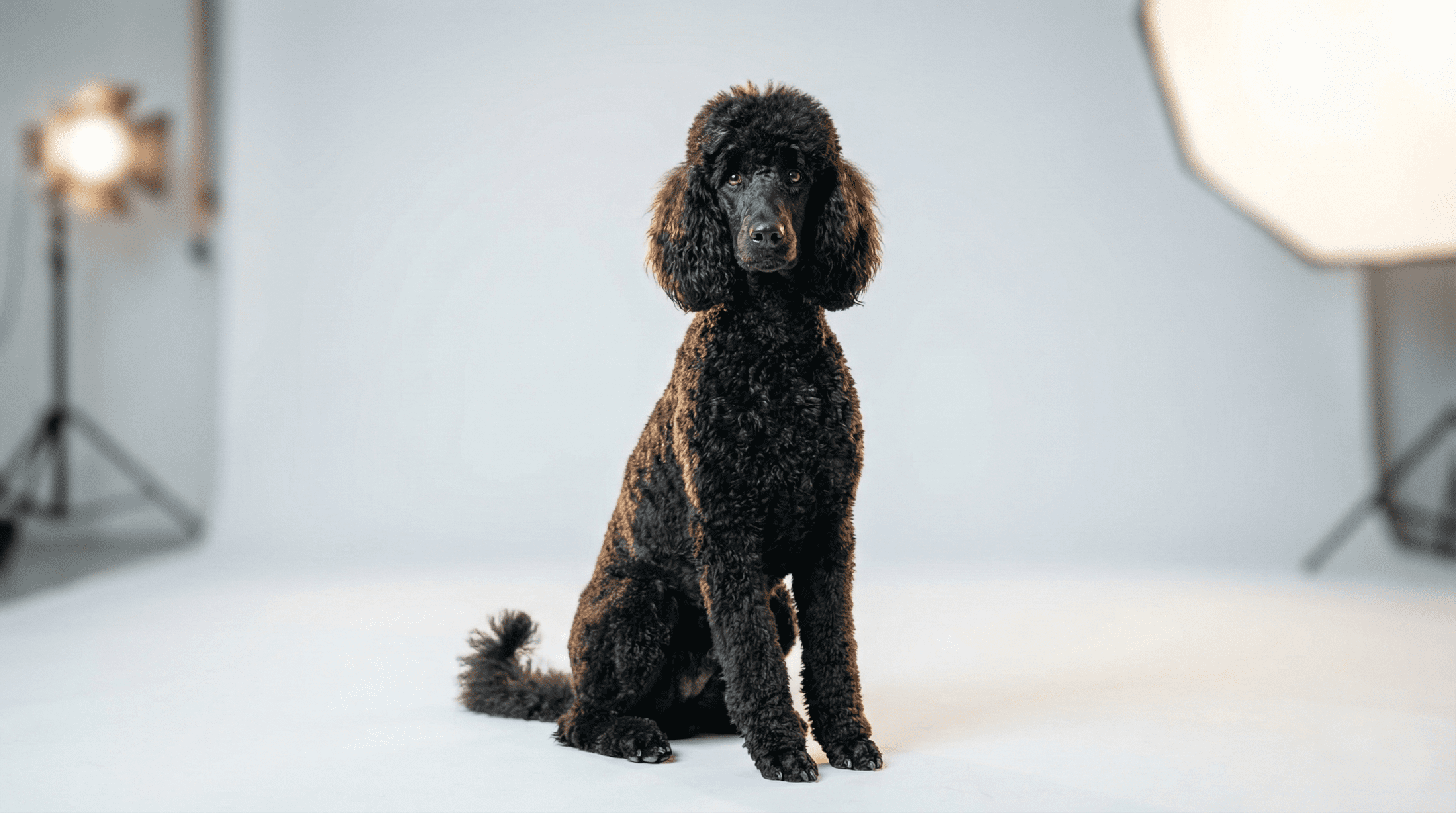
Standard Poodle at a glance
| Lifespan |
12 to 15 years |
| Adult weight |
20 to 32 kg |
| Height (breed standard) |
Over 38 cm at the shoulder; most stand well above that |
| Grooming |
A professional clip about every six weeks (around $130 a session) |
| Lifetime cost |
About $36,000 to $48,700 over 12 years (calculator below) |
| Main health risks |
Hip dysplasia, bloat, Addison’s disease, sebaceous adenitis |
How long do Standard Poodles live?
Most Standard Poodles live 12 to 15 years, which is long for a dog of their size. Bloat (a twisted stomach) is the most urgent risk in this deep-chested breed: learn the signs, which include a swollen belly, retching without bringing anything up and restlessness, and treat them as an emergency. Addison’s disease is also more common than in most breeds and needs lifelong medication once diagnosed.
Poodle sizes in Australia
| Size |
Height at the shoulder |
Typical weight |
| Standard |
Over 38 cm |
20 to 32 kg |
| Miniature |
28 to 38 cm |
About 5 to 9 kg |
| Toy |
Under 28 cm |
About 2 to 4 kg |
All three are the same breed under the standard used in Australia; only the size differs. The Standard is the most athletic of the three and needs about an hour of exercise a day.
A water retriever, not a show dog
The Standard Poodle is the original of the three Poodle varieties and it is a working gundog. The name comes from the German pudeln, to splash, and the breed was developed to retrieve waterfowl. Even the famous clip is functional in origin — hair left over the joints and chest for insulation in cold water, the rest shorn for mobility.
That matters because the Standard Poodle’s reputation as an ornamental dog is close to the opposite of what it is. This is a 20 to 32 kilogram athlete with an intelligence ranking of 2 — second only to the Border Collie — and it needs an hour of daily activity with a substantial mental component.
A Standard Poodle that is physically exercised but mentally idle will find its own project, and it is intelligent enough to be genuinely inventive about it. Retrieve with rules, scent work, agility, obedience and trick training all suit the breed exceptionally. So does swimming, which it will do at every opportunity and which is excellent low-impact exercise.
Temperamentally it is active, proud, sensitive and often reserved with strangers. It is not a boisterous dog; it tends toward dignified. It responds poorly to harsh handling and very well to being asked interesting questions.
Health
Bloat — the emergency to know
The Standard Poodle is deep-chested and at real risk of gastric dilatation-volvulus. The stomach distends with gas and can rotate on its own axis, cutting off its blood supply, and it is fatal within hours untreated.
The presentation is a hard, distended abdomen, repeated retching that produces nothing, restlessness and pacing, drooling, and rapid deterioration. Learn it now, and know which emergency clinic near you opens after hours before you need it. Feed two smaller meals rather than one large one, avoid hard exercise either side of eating, and discuss preventive gastropexy with your vet at the time of desexing.
Addison’s disease
Hypoadrenocorticism — too little cortisol — is notably associated with Standard Poodles, and it is one of the great imitators in veterinary medicine. It presents vaguely: intermittent lethargy, poor appetite, vomiting or diarrhoea, and a dog that seems repeatedly unwell without an obvious cause, often appearing to recover between episodes.
It can also present as sudden collapse, which is a medical emergency. If your Standard Poodle has a pattern of unexplained off-days, ask your vet about Addison’s specifically rather than accepting the pattern. It is diagnosable on blood testing and very manageable once identified.
Sebaceous adenitis
An immune-mediated destruction of the skin’s oil glands, and the Standard Poodle is the breed most associated with it. It produces dry scaly skin, hair loss along the topline and neck, a musty odour and secondary infection. It is diagnosed on skin biopsy, and it is worth investigating properly rather than treating repeatedly as a generic skin complaint or an allergy.
Eyes, joints and thyroid
Progressive retinal atrophy is DNA-testable via the prcd mutation — ask a breeder for both parents’ results, since a simple test makes this entirely avoidable in a planned litter. Hip dysplasia is screened radiographically; ask for the actual scores. Hypothyroidism presents as weight gain, lethargy and coat thinning, and is a straightforward blood test.
The coat is the largest ongoing cost
The Poodle’s dense curly single coat sheds very little, which is why the breed is so often described as allergy-friendly. It is not hypoallergenic — no dog is. The proteins people react to are in dander, saliva and urine rather than hair; a low-shedding coat simply circulates less of that material through a home. Some allergy sufferers do cope better, but it is a difference of degree, not a guarantee.
Low shedding has a direct and permanent cost. Hair that does not fall out mats instead, and on a 30-kilogram dog that is a very large surface area. An unattended Poodle coat felts against the skin, which is painful and can only be resolved by shaving off.
Brush thoroughly through the week — right down to the skin, not over the surface — and expect a professional groom every four to six weeks for the dog’s whole life. On a Standard, that is a large-dog grooming fee at short intervals, and it is the expense owners most consistently underestimate. Over fifteen years it will substantially exceed the food bill.
Ears need attention too: Poodles grow hair inside the ear canal, and combined with drop ears and a dog that loves water, otitis is a recurring theme. Have the ears checked at every groom and dried thoroughly after every swim.
Australian conditions and ownership
In summer, ask your groomer to leave enough coat on the back and shoulders for sun protection — a closely clipped Poodle has very little, and the skin beneath is pale. Exercise early or late, carry water, and take advantage of swimming as the ideal Australian summer exercise for this breed.
In Victoria, microchipping and council registration are required from three months of age under the Domestic Animals Act 1994, renewing annually on 10 April. Desexed registration across the Victorian councils in our fee survey ranged from about $19.50 to $93.30 a year.
The honest summary: one of the most capable dogs available, and one of the most demanding to maintain. If you want the intelligence without the grooming bill, this is not the breed to compromise on — the coat is not optional.
Registration is set by your local council. In Victoria, registering a desexed Poodle (Standard) costs between $19.50 and $93.30 a year depending on where you live, and roughly three times that if the dog is not desexed. See every Victorian council’s 2026–27 fee, or compare registration costs in every state.
Large dogs carry more load through their joints for longer. If you are choosing gear for a Poodle (Standard), see our orthopaedic bed comparison for large breeds and our large-breed dog food comparison.
Related breeds
The Standard Poodle is a purebred of the Non-Sporting group, developed as a water retriever and now ranked second globally for working intelligence. Adults weigh between 20 and 32 kg and typically live 12 to 15 years. The coat is curly, dense and single-layered, shedding very little but growing continuously — a combination that makes it low-allergen yet genuinely high-maintenance. Daily brushing is required to prevent matting, with professional clipping every six to eight weeks. Energy demands are substantial at around 60 minutes of daily activity, and simple leash walking is rarely sufficient; retrieving, swimming and agility work suit the breed far better. Temperament is active, proud and highly responsive to training. Health monitoring should focus on gastric dilatation-volvulus (bloat), Addison’s disease, hip dysplasia, progressive retinal atrophy and hypothyroidism. In the Australian climate the dense coat requires attention during summer; clipped coats still provide sun protection and should not be shaved to the skin.
Routine veterinary review should monitor for gastric dilatation-volvulus (bloat), Addison’s disease, hip dysplasia, progressive retinal atrophy and hypothyroidism. Bloat is an emergency presentation in deep-chested breeds: owners should recognise unproductive retching and abdominal distension and seek immediate care. Hip scoring of breeding parents and DNA testing for PRA are advisable. Maintain vaccination and parasite prevention, and monitor thyroid function in adults showing coat or weight changes.
Daily care for a Standard Poodle centres on coat and exercise. Brush thoroughly each day to prevent matting in the continuously growing curly coat, and book professional clipping every six to eight weeks. Provide at least 60 minutes of daily activity combining physical exertion and problem-solving work — retrieving, swimming and agility are well matched to the breed. Brush teeth at least three times weekly. Feed measured portions across two meals and avoid vigorous exercise immediately after eating, given the breed’s bloat risk.