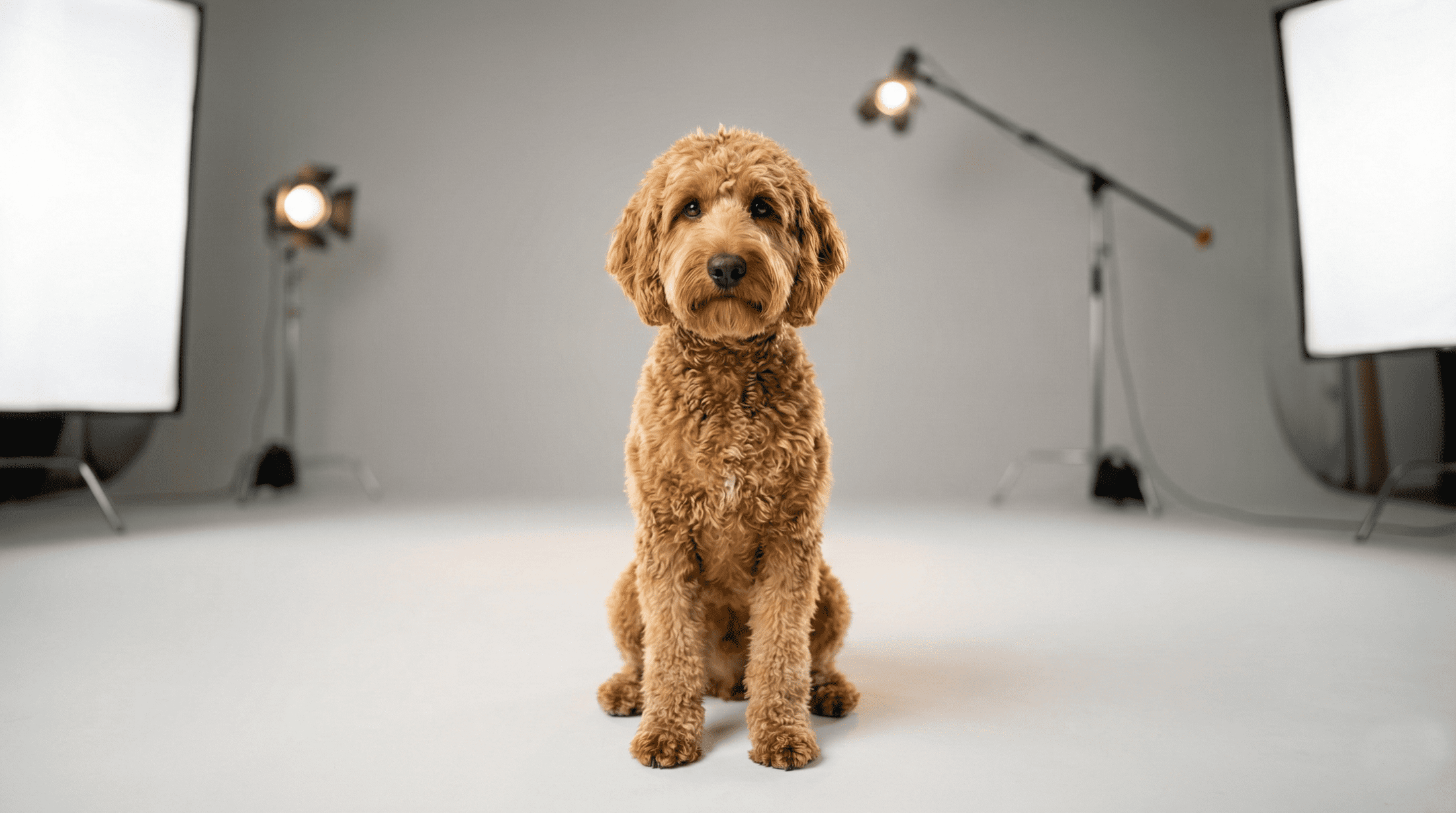
Labradoodle at a glance
| What it is |
A Labrador Retriever crossed with a Poodle, first bred in Victoria in 1989 |
| Lifespan |
12 to 14 years |
| Adult weight |
23 to 29 kg for a standard Labradoodle. Miniature and medium sizes are smaller |
| Lifetime cost |
About $39,100 over 12 years in our standard scenario (calculator below) |
| Main health risks |
Hip and elbow dysplasia, ear infections, exercise-induced collapse, Addison’s disease, progressive retinal atrophy |
| Shedding |
Low to moderate, and not hypoallergenic |
How long do Labradoodles live?
Most Labradoodles live 12 to 14 years. The best ways to reach the upper end of that range are choosing a puppy from hip- and elbow-scored, DNA-tested parents and keeping your dog lean, because the Labrador side brings a big appetite and a tendency to gain weight.
Labradoodle or Australian Labradoodle?
The first Labradoodles were bred in Victoria in 1989 by Wally Conron at the Royal Guide Dog Association of Australia, who was looking for a guide dog that might suit a person with allergies. A plain Labradoodle is a Labrador crossed with a Poodle. An Australian Labradoodle is a separate, multi-generation breeding program that also includes other breeds such as the Cocker Spaniel, and generally has a more predictable coat. Neither is guaranteed to be hypoallergenic.
How much does a Labradoodle cost?
Our cost model puts the lifetime cost of a standard Labradoodle at about $39,100 over 12 years in our standard scenario. That covers food, vet care, regular professional grooming (about every eight weeks), registration and supplies. Puppy prices vary widely between breeders, so check current prices with several of them and enter your figure in the calculator below.
Labradoodle health issues
| Condition |
Comes from |
Can the parents be screened? |
| Hip and elbow dysplasia |
Both |
Yes, by hip and elbow X-rays |
| Exercise-induced collapse |
Labrador |
Yes, DNA test |
| Progressive retinal atrophy |
Both |
Yes, DNA test |
| Addison’s disease (adrenal glands) |
Poodle |
No. Diagnosed with blood tests |
| Ear infections |
Both (drop ears and hair in the canal) |
No. Managed with regular cleaning and drying |
An Australian invention, and its creator’s verdict on it
The Labradoodle began in 1989 at the Royal Guide Dog Association of Australia, now Guide Dogs Victoria. Breeding manager Wally Conron had a specific problem to solve: a vision-impaired woman in Hawaii needed a guide dog, and her husband had a severe allergy to the standard guide breeds. Conron assessed thirty-three Standard Poodles for guide work and found none suitable, so he crossed a Standard Poodle with a Labrador Retriever — the Labrador for temperament and trainability, the Poodle for a low-shedding coat.
It worked, and the cross became one of the most commercially successful dogs in the world. Conron himself has been unequivocally negative about that outcome. Asked whether he was proud of it, he said he was not in the slightest, that he had done considerable harm to purebreeding, and that the breed’s popularity had enriched people breeding from untested parents with poor temperaments and producing puppies with genetic disease and behavioural problems.
We include that not to disparage the dog — a well-bred Labradoodle is an excellent family animal — but because it identifies precisely where the risk sits with this cross. The risk is not the genetics of Labrador plus Poodle. It is the breeder.
What to ask a Labradoodle breeder
Both parent breeds have well-established, widely available screening. There is no technical reason for an unscreened Labradoodle litter to exist, which makes the absence of paperwork a decision rather than an oversight.
- Hip and elbow scores for both parents, as actual numbers from a radiographic scheme — not “the parents are healthy”.
- prcd-PRA DNA status for both parents. Progressive retinal atrophy is recessive and DNA-testable, which means it is entirely avoidable in a planned litter.
- Exercise-induced collapse (EIC) DNA status on the Labrador side. Affected dogs are normal at rest but can collapse after several minutes of strenuous, excited activity. It is recessive and testable.
- Eye examination certificates dated within the last twelve months.
Ask for these by name, in writing, before you pay a deposit. A breeder who health-tests will produce them immediately and will usually be pleased you asked.
Conditions to know about as an owner
The Poodle line contributes a predisposition to Addison’s disease (hypoadrenocorticism), which is notoriously vague in presentation — intermittent lethargy, poor appetite, vomiting, a dog that seems repeatedly unwell without an obvious cause. It is diagnosable with a blood test and very manageable once identified, so it is worth raising with your vet rather than accepting a pattern of unexplained off-days.
Bloat and gastric dilatation-volvulus is a risk in any deep-chested medium-to-large dog. A distended abdomen with unproductive retching is an immediate emergency, measured in hours, not overnight.
Ear infections are near-universal in this cross: drop ears, hair growing in the canal, and a dog that likes water. Dry the ears after every swim and bath, and have them checked at each groom.
The coat, and the hypoallergenic claim
The Labradoodle coat varies considerably even within a litter — some are fleecy and wavy, some tightly curled, some closer to a Labrador’s straight coat with a noticeably higher shedding rate. A first-generation cross does not produce a uniform result, whatever the advertisement implies.
No dog is hypoallergenic. The proteins people react to are in dander, saliva and urine, not hair; a low-shedding coat simply distributes less of that material through a house. Some allergy sufferers do genuinely tolerate these dogs better, but it is a difference of degree and it is not predictable from the parents. If allergy is your reason for choosing this breed, spend real time with the individual puppy first.
Low shedding also has a direct cost. Hair that does not fall out mats instead, and on a 25-kilogram dog that is a great deal of coat. Brush through the week and expect a professional groom every six to eight weeks. Grooming is usually the largest recurring expense for this breed — larger than food — and it is worth budgeting before purchase.
Exercise, temperament and Australian conditions
Around an hour of daily activity suits a Labradoodle, and it should not all be walking. This cross sits near the very top of working-intelligence rankings, with two working parents behind it, and a dog that is physically exercised but mentally idle will find its own project. Retrieve with rules, scent games, short training sessions and food puzzles are more effective per minute than added distance.
Both parent breeds also incline strongly to obesity, and in a dog with dysplastic risk in the hips and elbows, excess weight is not cosmetic. Keeping this dog lean, particularly through the first two years while growth plates are open, is the single most useful long-term health decision an owner makes.
In Victoria, microchipping and council registration are required from three months of age under the Domestic Animals Act 1994, renewing annually on 10 April. Desexed registration across the Victorian councils in our fee survey ranged from about $19.50 to $93.30 a year. For summer, apply the usual Australian rules for a heavy-coated water-loving dog: exercise early or late, carry water, and test the pavement temperature with the back of your hand before you set out.
Registration is set by your local council. In Victoria, registering a desexed Labradoodle costs between $19.50 and $93.30 a year depending on where you live, and roughly three times that if the dog is not desexed. See every Victorian council’s 2026–27 fee, or compare registration costs in every state.
Large dogs carry more load through their joints for longer. If you are choosing gear for a Labradoodle, see our orthopaedic bed comparison for large breeds and our large-breed dog food comparison.
Related breeds
The Labradoodle is a designer hybrid breed from Australia, classified within the Hybrid/Designer group. They have a moderate health complexity score of 1.8. Labradoodles weigh between 23 to 29 kg and enjoy an average lifespan of 12 to 14 years. Characterized by curly or wavy coat types, they are partially hypoallergenic with low to moderate shedding levels. Weekly coat maintenance protocols are recommended, classifying their grooming needs as moderate. Labradoodles demonstrate high sociability, making them highly compatible with children and other pets. Behavioral assessments reveal a trainability score of 4 and energy levels ranging from moderate to high, necessitating approximately 60 minutes of daily exercise. Health monitoring should focus on potential issues like Hip Dysplasia, Progressive Retinal Atrophy (PRA), Ear Infections, Allergies, and Elbow Dysplasia. Estimated initial year puppy costs are $3500, with an annual veterinary cost of $1602. The breed is popular in Australia, ranking within the top 30.
Given the breed's susceptibility to conditions like Hip Dysplasia, Progressive Retinal Atrophy (PRA), and Allergies, routine veterinary check-ups should include screenings for these issues. Biannual veterinary visits are advisable to manage early detection and intervention of hereditary ailments.
Daily care for a Labradoodle involves a minimum of 60 minutes of exercise, divided between physical and mental stimulation activities. Coat maintenance protocols require brushing once a week, focusing on preventing mattings such as behind the ears and elbows. Nutritionally balanced diet plans are critical for optimal health outcomes.