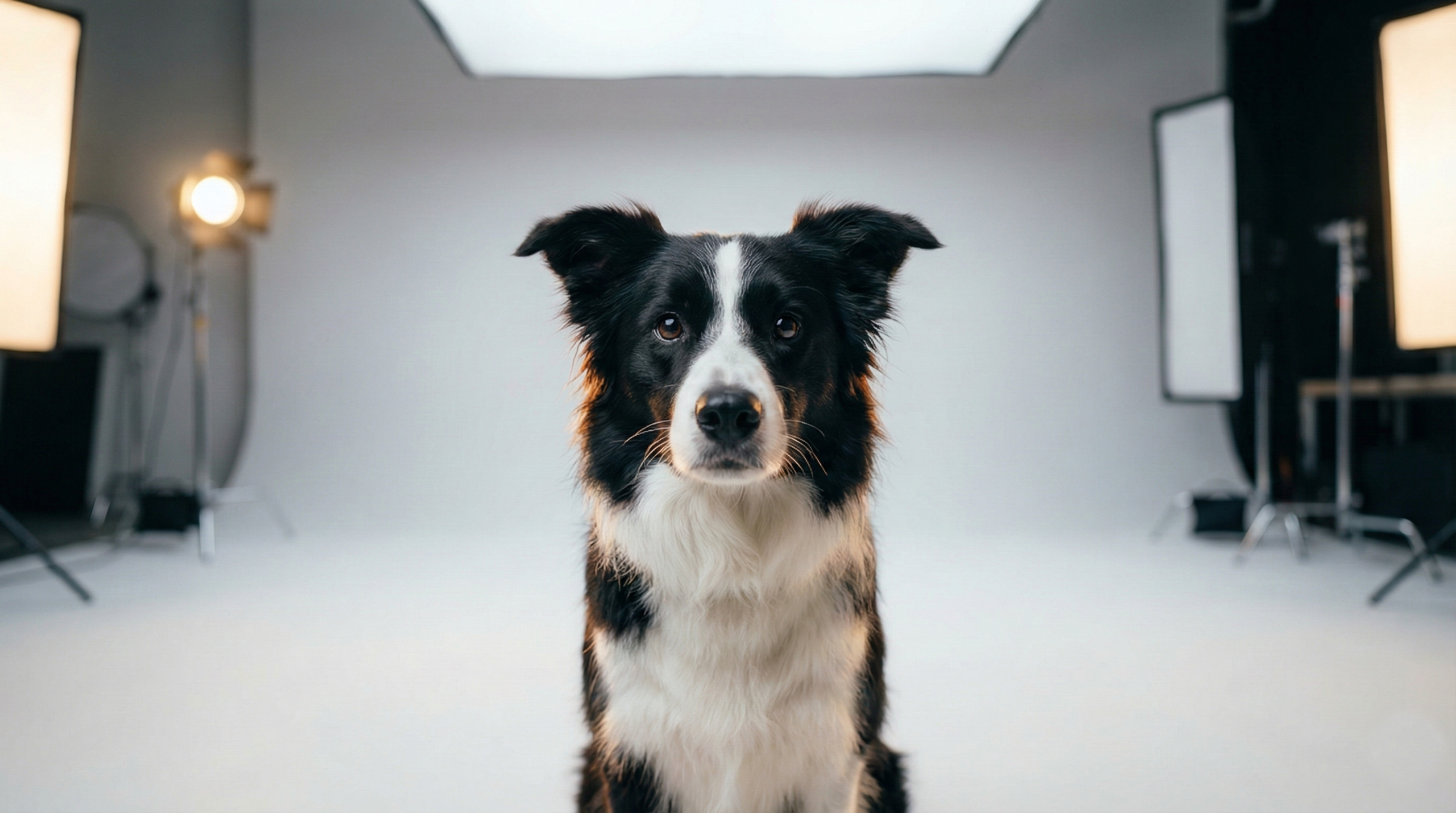
The most intelligent dog breed — and why that is a warning as much as a recommendation
The Border Collie ranks first on working-intelligence assessments and carries the maximum trainability score on our scale. It is, by most measures, the most capable domestic dog there is.
That is precisely the problem. Intelligence is not a convenience feature. A Border Collie was bred over generations to make continuous independent judgements about moving livestock across open country — reading stock, anticipating movement, adjusting without instruction, for hours. That machinery does not switch off because the dog now lives in a courtyard in Northcote.
Our specification table asks for two hours of daily activity, which is the highest requirement of any breed on our register. It is not an exaggeration, and it is also not the whole answer, because physical exhaustion alone does not produce a settled Border Collie. A dog that runs fifteen kilometres and then has nothing to think about is simply a fitter dog with the same unmet need.
What under-stimulation actually looks like
The failure modes in this breed are consistent and well documented, and several are compulsive rather than disobedient:
- Obsessive chasing of shadows, reflected light, water from a hose, cars and bicycles
- Fence-running, often wearing a bare track into the ground
- Compulsive herding of children, other pets and moving objects, sometimes with heel-nipping
- Noise sensitivity that can develop into a genuine phobia of thunder, fireworks or vacuum cleaners
Shadow and light chasing in particular can become a true compulsive disorder that is difficult to reverse. It is far easier to prevent than to treat, and prevention means never starting the game — no laser pointers, ever, for this breed.
What works instead
Structured problem-solving with rules. Herding trials or treibball where you can access them, agility, obedience, scent work, trick training, and retrieve with a formal start and finish. Fifteen to twenty focused minutes of that settles a Border Collie more reliably than an hour of loose-lead walking. Food puzzles and scatter feeding are free daily additions.
The right owner for this breed is someone who wants a training project. Given that, it is an extraordinary dog. Given a suburban routine and a walk around the block, it is one of the most reliably surrendered breeds in Australia.
Health: four DNA tests to ask about by name
The Border Collie is unusually well served by genetic screening, which means an informed buyer can eliminate most of the serious inherited disease from consideration.
Collie eye anomaly (CEA/CH)
A developmental defect of the choroid, the vascular layer that supplies the retina. Severity ranges from mild and non-progressive to retinal detachment and blindness. Recessive and DNA-testable.
Trapped neutrophil syndrome (TNS)
An immune defect in which the bone marrow produces neutrophils but cannot release them into the bloodstream, leaving affected puppies vulnerable to repeated infection and failure to thrive. It is autosomal recessive, it occurs across all Border Collie lines rather than being confined to one, and in an Australian study of 6,439 Border Collies tested for TNS, about 22 per cent were carriers (Soh et al., Scientific Reports, 2021). That is high enough that testing breeding dogs is not optional.
Neuronal ceroid lipofuscinosis (NCL5)
A lysosomal storage disorder causing progressive degeneration of the brain and eyes, severe impairment and early death. The causative mutation in Border Collies is a nonsense mutation in exon 4 of the CLN5 gene on chromosome 22. Rare, recessive, and entirely avoidable through testing.
MDR1 drug sensitivity
The multidrug resistance mutation impairs transport of certain drugs out of the brain, allowing toxic accumulation. It affects ivermectin-class parasiticides and a range of common medications including some sedatives, anti-diarrhoeals and chemotherapy agents. It is semi-dominant — a single copy confers clinical sensitivity — so unlike the recessive conditions above, one carrier parent is enough to matter.
If your Border Collie’s MDR1 status is unknown, test the dog itself. It is inexpensive, it is a one-off, and it changes what your vet can safely prescribe for the rest of the dog’s life. Record the result in the dog’s file and tell every vet who treats it.
Not DNA-testable
Hip dysplasia is screened radiographically — ask for the parents’ actual scores. Idiopathic epilepsy also occurs in the breed, typically first appearing between one and five years; most affected dogs are well controlled on medication.
Coat and Australian conditions
Border Collies come in rough and smooth coats, both double, both shedding moderately year-round with heavier seasonal moults. Brush weekly as routine and daily during a moult, with attention to the feathering behind the ears and legs on rough coats. Do not clip the coat — it insulates against heat as well as cold.
Australian heat needs active management, and the reason is behavioural rather than physical. A Border Collie in drive will keep working long past the point at which it should stop — it will chase a ball into heat stress. The dog will not self-regulate, so the break is entirely your decision. Exercise early morning or after dusk in summer, carry water, provide shade, and stop the game before the dog wants to.
Snake awareness matters too for a dog that works long grass in an Australian summer.
Ownership in Australia
In Victoria, microchipping and council registration are required from three months of age under the Domestic Animals Act 1994, renewing annually on 10 April. Desexed registration across the Victorian councils in our fee survey ranged from about $19.50 to $93.30 a year. If your dog is a genuine working dog on rural property, several Victorian councils offer a reduced rate on proof — check your own council’s concession list.
At 12 to 15 years with a strong health profile when properly screened, this is a long, generally robust commitment. The question is never whether the Border Collie is capable of what you want. It is whether you can supply what the Border Collie needs.
Registration is set by your local council. In Victoria, registering a desexed Border Collie costs between $19.50 and $93.30 a year depending on where you live, and roughly three times that if the dog is not desexed. See every Victorian council’s 2026–27 fee, or compare registration costs in every state.
Large dogs carry more load through their joints for longer. If you are choosing gear for a Border Collie, see our orthopaedic bed comparison for large breeds and our large-breed dog food comparison.
Related breeds
The Border Collie, hailing from the United Kingdom, is a purebred working dog classified under the Working Dogs group. With an average lifespan of 12 to 15 years and a weight range between 14 and 20 kg, this medium-mass breed boasts either a smooth or rough double coat. Border Collies are very good with children and strong pet sociability. Their energy levels are exceptionally high, necessitating a minimum of 120 minutes of daily exercise to maintain optimal health and behavior. Despite their high intelligence ranking (#1 in Stanley Coren's working and obedience intelligence ranking), they show moderate propensity towards separation anxiety and obesity. Veterinary oversight is essential due to their predisposition to key health issues such as Hip Dysplasia, Progressive Retinal Atrophy (PRA), and Collie Eye Anomaly (CEA). This breed requires a moderate level of coat maintenance, involving weekly grooming to manage shedding and care for their non-hypoallergenic coat. Understanding their needs and investing in structured training can maximize the utility and well-being of the Border Collie in Australian environments. Toys and puzzles for clever, energetic breeds are compared in our guide to eco-friendly dog toys. The West Paw Zogoflex toys are durable, non-toxic toys that suit energetic breeds that love fetch.
Due to the breed's health complexity, routine veterinary check-ups are imperative. Owners should monitor for Hip Dysplasia, Progressive Retinal Atrophy (PRA), and Collie Eye Anomaly (CEA). Preventative healthcare includes vaccinations, dental care, and weight management to mitigate the moderate risk of obesity.
Daily care for a Border Collie includes 120 minutes of structured exercise and mental stimulation activities. Weekly coat maintenance is essential, involving thorough brushing, particularly for the rough coat variant, to manage shedding. Balanced diets and hydration are crucial given their very high energy levels. Regular socialization and training further optimize their well-being.