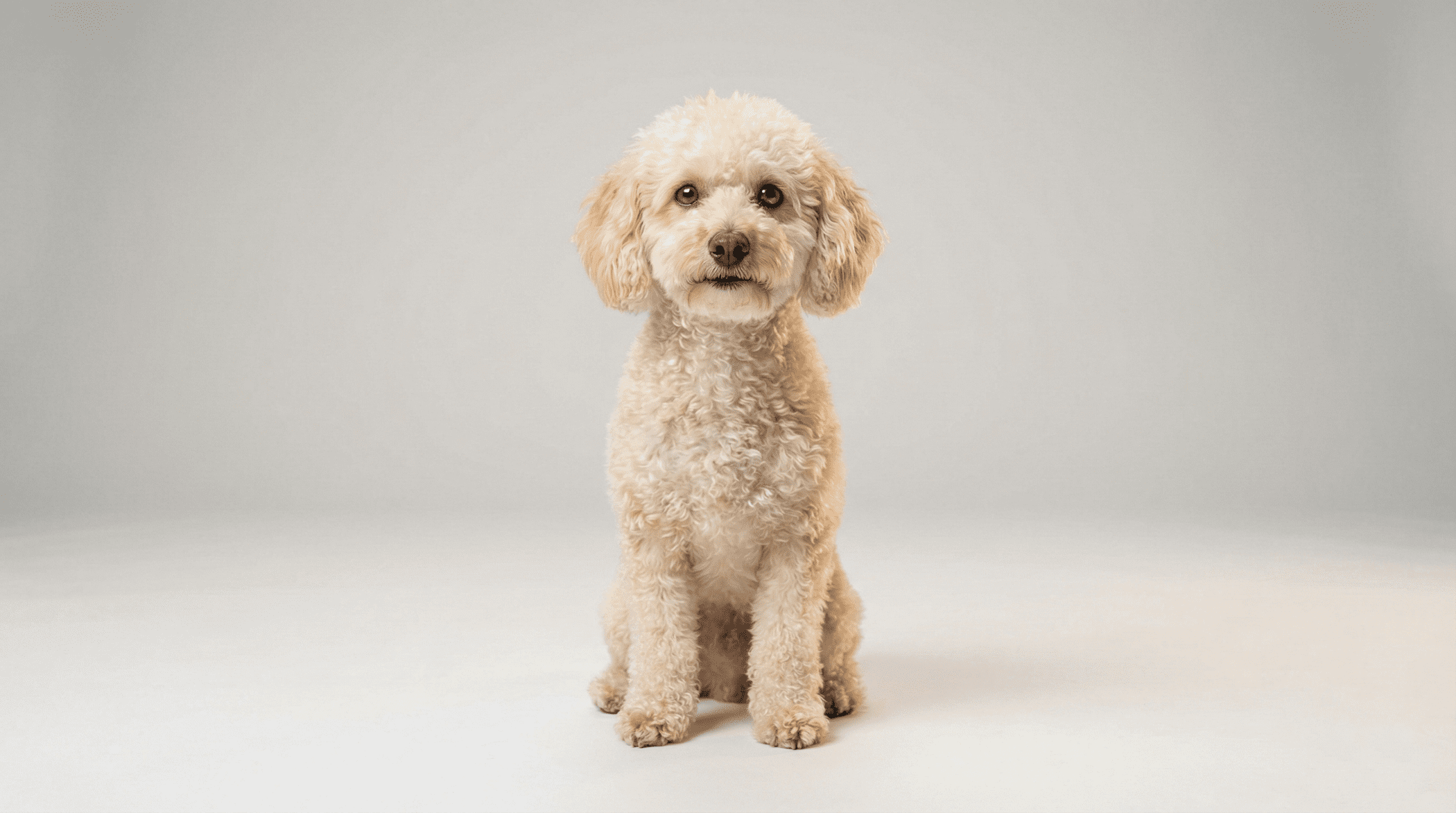
The second most trainable dog on our register, in a small frame
The Poodle is a water retriever, not a lapdog, and the Miniature is a size variety of that working breed rather than a different animal. That distinction explains most of what surprises new owners.
With an intelligence ranking of 2 and the maximum trainability score on our scale, the Miniature Poodle is one of the most capable dogs available in a 4 to 8 kilogram package. It learns quickly, generalises well, and — this is the part people underestimate — it keeps learning whether or not you are teaching. A Miniature Poodle with an hour of walking and nothing to think about will study the household instead, and it is very good at working out how doors, latches, bins and routines function.
An hour of daily activity is the baseline, and a meaningful portion of it should be mental. Trick training, scent games, obedience, agility and food puzzles all suit the breed and cost little. This is a dog that genuinely enjoys being asked to do things.
It is also long-lived. At 14 to 18 years, the Miniature Poodle has one of the longest lifespans on our register, which makes it a substantially longer commitment than most breeds of comparable size.
Endocrine disease — the theme to watch across a long life
Poodles are over-represented for hormonal disorders, and because these develop gradually in middle age they are frequently mistaken for ageing. Over a sixteen-year lifespan, knowing what to look for matters.
Cushing’s disease (hyperadrenocorticism)
Excess cortisol production, usually from a pituitary tumour. The signs accumulate slowly: drinking and urinating markedly more, increased appetite, a pot-bellied appearance, thinning coat or symmetrical hair loss along the flanks, and thin skin that bruises easily. Owners often report the dog is “just getting old”. It is diagnosable on blood testing and manageable with medication.
Addison’s disease (hypoadrenocorticism)
Effectively the opposite — too little cortisol — and notoriously vague. It presents as intermittent lethargy, poor appetite, vomiting or diarrhoea, and a dog that seems repeatedly unwell without an obvious cause, often improving between episodes. It can also present as sudden collapse, which is a medical emergency. If your Poodle has a pattern of unexplained off-days, ask your vet about Addison’s specifically rather than accepting the pattern.
Epilepsy
Idiopathic epilepsy occurs in the breed, typically first appearing between one and five years. A first seizure warrants veterinary assessment; a seizure lasting more than five minutes, or clusters of seizures, is an emergency. Most epileptic dogs are well controlled on medication and live normal lifespans.
Eyes and knees
Progressive retinal atrophy is DNA-testable via the prcd mutation — ask a breeder for both parents’ results, because a straightforward genetic test makes this entirely avoidable in a planned litter. Patellar luxation is graded I to IV; grades II and above often need surgery, and discouraging jumping down from furniture helps protect the joint.
Sebaceous adenitis, an immune-mediated destruction of the skin’s oil glands, is also documented in Poodles. It produces dry scaly skin, hair loss along the topline and a musty odour, and is diagnosed on skin biopsy — worth investigating properly rather than treating repeatedly as a generic skin complaint.
The coat is the real cost of ownership
The Poodle’s dense curly coat sheds very little, which is why the breed is so often described as allergy-friendly. It is not hypoallergenic — no dog is. The proteins people react to are in dander, saliva and urine rather than hair; a low-shedding coat simply circulates less of that material through a home. Some allergy sufferers do cope better, but it is a difference of degree, not a guarantee.
Low shedding has a direct and permanent cost. Hair that does not fall out mats instead, and a Poodle coat left unattended will felt against the skin. Brush thoroughly through the week — right down to the skin, not just over the surface — and expect a professional groom every four to six weeks for life.
That is the highest recurring grooming requirement of any breed on our register, and it is the expense owners consistently underestimate. Over sixteen years it comfortably exceeds what you will spend on food. Factor it in before you buy, not after.
Ears need attention too: Poodles grow hair inside the ear canal, and combined with drop ears that makes otitis a recurring theme. Have the ears checked at every groom and dried thoroughly after swimming.
Registration is set by your local council. In Victoria, registering a desexed Miniature Poodle costs between $19.50 and $93.30 a year depending on where you live, and roughly three times that if the dog is not desexed. See every Victorian council’s 2026–27 fee, or compare registration costs in every state.
Ownership in Australia
In Victoria, microchipping and council registration are required from three months of age under the Domestic Animals Act 1994, renewing annually on 10 April. Desexed registration across the Victorian councils in our fee survey ranged from about $19.50 to $93.30 a year.
In summer, a clipped Poodle has far less sun protection than its full coat suggests — ask your groomer to leave enough length on the back and shoulders through the warmer months. And as with any small dog walking close to hot ground, test the pavement with the back of your hand before you set out.
Related breeds
Originating from Germany, the Miniature Poodle is a purebred, classified under the Toy group. The breed has a moderate-high energy level and requires approximately 60 minutes of exercise daily. It weighs between 4 to 8 kg and has a curly, dense coat type, making it low-shedding with low shedding levels. This breed demonstrates very good with children and sociable with other pets. Noteworthy for its trainability (score of 5), the Miniature Poodle also ranks second in intelligence. Primary health concerns include Patellar Luxation, Progressive Retinal Atrophy (PRA), Epilepsy, Cushing's Disease, and Addison's Disease. The breed's susceptibility to separation anxiety and obesity are moderate. With an average lifespan of 14 to 18 years, the Miniature Poodle is well-suited for the Australian environment given its balanced need for physical activities and high grooming requirements.
Regular veterinary check-ups, at least twice a year, are critical to monitor hereditary conditions such as Patellar Luxation, Progressive Retinal Atrophy (PRA), Epilepsy, Cushing's Disease, and Addison's Disease. Early detection and management can mitigate long-term health expenses.
Daily care for a Miniature Poodle includes approximately 60 minutes of exercise and weekly coat maintenance protocols. Given their high grooming needs, regular professional grooming sessions are essential. The breed exhibits moderate-high energy levels and requires mental and physical stimulation.