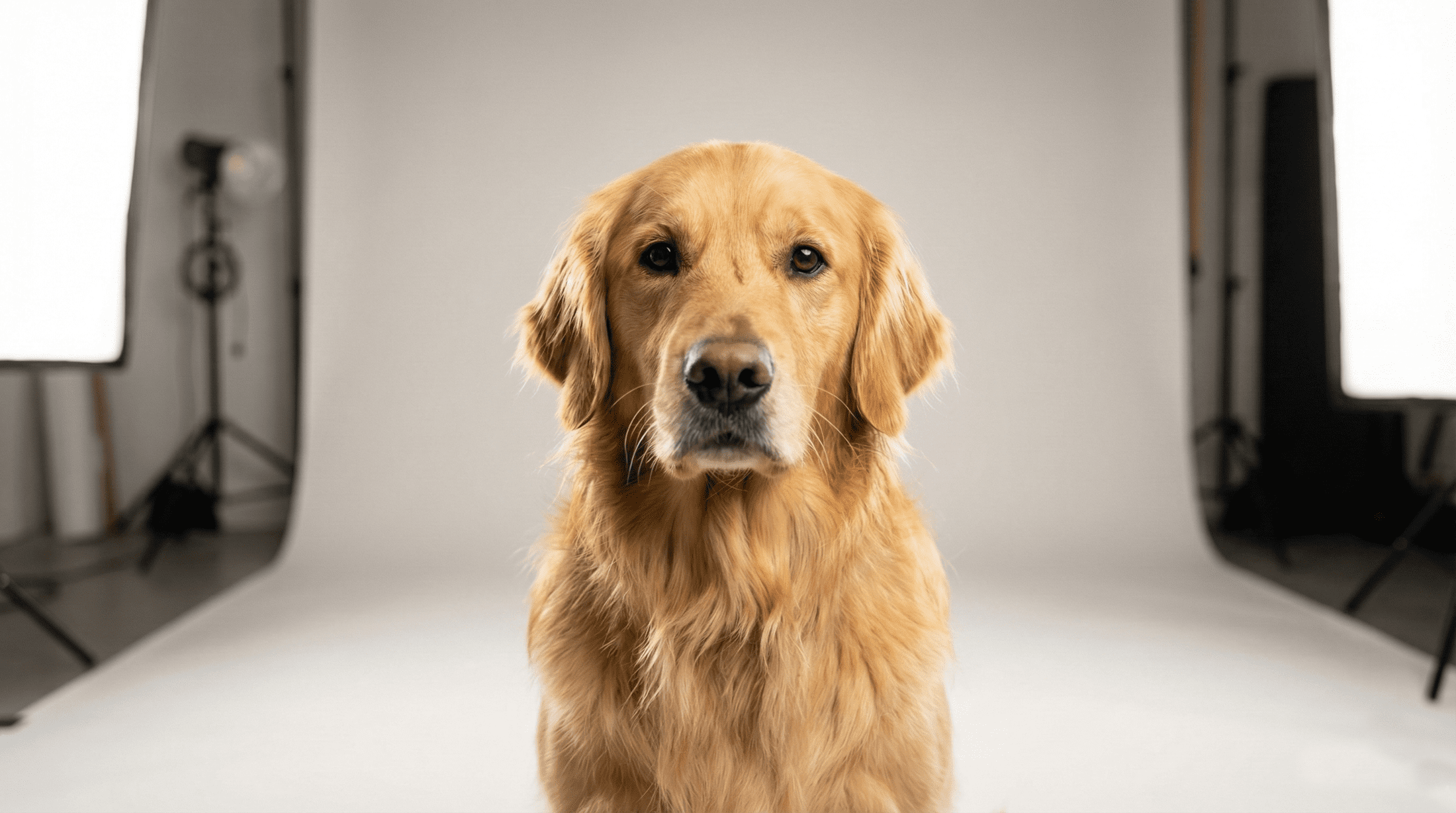
Golden Retriever at a glance
| Lifespan |
10 to 12 years |
| Adult weight |
25 to 34 kg |
| Height (breed standard) |
Males 56 to 61 cm, females 51 to 56 cm at the shoulder |
| Main health risks |
Cancer (including haemangiosarcoma, lymphoma and mast cell tumours), hip and elbow dysplasia, hypothyroidism, progressive retinal atrophy |
| Shedding |
High, especially at seasonal moults |
How long do Golden Retrievers live?
Most Golden Retrievers live 10 to 12 years. Cancer is the most common cause of death in the breed, so the biggest difference you can make is catching problems early: have any new lump checked by a vet promptly, and book check-ups twice a year once your dog is about eight. Keeping your Golden lean also matters, because extra weight puts more strain on hips and elbows that are already prone to dysplasia.
Males and females have a similar life expectancy. Weight, genetics and early detection of illness make far more difference than sex.
Golden Retriever health issues
| Condition |
What it does |
Can the parents be screened? |
| Haemangiosarcoma and lymphoma |
Cancers of the blood vessels and lymph system |
No. Regular vet checks help catch them early |
| Mast cell tumours |
The most common skin cancer in dogs; Goldens are a predisposed breed |
No. Have any new lump checked by a vet promptly |
| Hip and elbow dysplasia |
Malformed joints, leading to arthritis and pain |
Yes, by hip and elbow X-rays |
| Hypothyroidism |
An underactive thyroid: weight gain, low energy, poor coat |
No. Diagnosed with a blood test; treated with daily tablets |
| Progressive retinal atrophy |
Gradual loss of sight |
Yes, DNA test |
The Golden Retriever breed standard
Under the breed standard used in Australia, males stand 56 to 61 cm at the shoulder and females 51 to 56 cm. The coat can be any shade of gold or cream, and is flat or wavy with good feathering. The standard does not set a weight; healthy adults typically weigh 25 to 34 kg.
Comparing breeds? See Labrador vs Golden Retriever, compared side by side on size, cost and health, or what popular breeds cost.
The family dog benchmark — with one serious caveat
The Golden Retriever was developed in the Scottish Highlands in the second half of the nineteenth century as a gundog for retrieving from both land and water. Everything the breed is known for as a family dog — the tolerance, the biddability, the soft mouth, the desire to carry things to people — comes directly from that job.
With an intelligence ranking of 4 and the maximum trainability score, it is one of the easiest breeds to teach and among the most reliable with children. Its reputation is deserved.
The caveat is cancer, and it deserves to be stated with the actual evidence rather than as a vague warning.
The Golden Retriever Lifetime Study
The Morris Animal Foundation has been running a prospective cohort study since 2012, following thousands of Golden Retrievers from puppyhood with owner questionnaires, veterinary examinations, sample collection and genetic sequencing. It is the most substantial long-term dataset on any single breed.
What it has found is stark. In the tracked cohort, roughly three-quarters of deaths to date have been cancer-related, and haemangiosarcoma is the most common of the cancers the study tracks, with 223 cases against 124 for lymphoma (Morris Animal Foundation 10-year update). The four most common cancers in the breed are haemangiosarcoma, lymphoma, osteosarcoma and high-grade mast cell tumours.
That is a US cohort and it does not translate directly into an individual Australian dog’s odds. But it is a real and well-measured signal, and no honest profile of this breed should leave it out.
What an owner can actually do about it
The useful response is not anxiety — it is knowing what to act on.
Haemangiosarcoma is a cancer of blood vessel lining, most often in the spleen or heart, and its defining feature is that it presents without warning. A mass ruptures and bleeds internally. The signs are sudden weakness or collapse, pale gums, laboured breathing, or a visibly distended abdomen in a dog that seemed fine an hour earlier. In a middle-aged or older Golden Retriever, that is an emergency requiring immediate veterinary attention, not something to observe overnight. Recognising it fast is the only thing that changes the outcome.
Lumps. Learn what is normal on your dog by running your hands over it regularly. Any new lump, or an existing one that changes in size or texture, should be checked rather than watched. Mast cell tumours in particular can look like an innocuous fatty lump.
Lameness in an older large dog that does not resolve deserves imaging rather than an assumption about arthritis — osteosarcoma typically presents as persistent lameness with localised swelling.
The rest of the health picture
Hip and elbow dysplasia are both screened radiographically. Ask for the parents’ actual scores, and keep the dog lean through the first two years while the growth plates are open — that does more for long-term joint health than anything you can buy.
Progressive retinal atrophy occurs in the breed and is DNA-testable; ask for both parents’ prcd results. Hypothyroidism is usually autoimmune and presents as unexplained weight gain, lethargy, coat thinning and recurrent skin or ear infections — a straightforward blood test and inexpensive lifelong medication.
As a deep-chested breed the Golden is also at risk of gastric dilatation-volvulus. A hard distended abdomen with unproductive retching is a surgical emergency measured in hours.
Weight is the health issue owners most control
Golden Retrievers are strongly food-motivated, which is part of why they train so well and part of why obesity is so common in the breed. Excess weight worsens dysplastic joints, increases anaesthetic risk, and shortens life independently of anything else.
You should be able to feel the ribs easily under a thin layer of covering, and see a waist from above. Weigh food rather than eyeballing it, count treats as part of the daily total, and use portions of the dinner ration for training rather than adding to it. This is unglamorous and it is the most effective health intervention available to you.
Coat and grooming
The medium-length double coat sheds heavily, year-round, with dramatic seasonal moults. Brush two or three times a week as routine and daily during a moult, using an undercoat rake to lift the dead undercoat — a slicker alone works the topcoat and leaves the problem in place.
Pay attention to the feathering on the ears, chest, legs and tail, where mats form, and to the ears themselves: drop ears plus a dog that will enter any water it finds makes otitis externa a recurring theme. Dry the ears properly after every swim and bath. Do not clip the coat — it insulates in both directions.
Exercise and Australian conditions
An hour a day, with a real mental component. This is a retriever: formal retrieve work, scent games, obedience and gundog-style training satisfy it far more efficiently than distance walking. A Golden with an unmet mental load becomes mouthy and destructive rather than disobedient.
In Australian summers, a heavy double-coated dog that loves water needs sensible management. Exercise early morning or after dusk, carry water, provide shade, and check the pavement with the back of your hand before you set out. Swimming is excellent exercise for this breed and gentle on joints — just dry the ears afterwards, every time.
Ownership in Australia
In Victoria, microchipping and council registration are required from three months of age under the Domestic Animals Act 1994, renewing annually on 10 April. Desexed registration across the Victorian councils in our fee survey ranged from about $19.50 to $93.30 a year.
One point on timing that is worth discussing with your vet rather than deciding by default: research on large breeds has examined the relationship between the age at desexing and the risk of joint disorders and certain cancers, and the findings differ by breed and sex. It is a genuine conversation to have with a veterinarian who knows your individual dog, rather than a decision to make from a general rule.
Registration is set by your local council. In Victoria, registering a desexed Golden Retriever costs between $19.50 and $93.30 a year depending on where you live, and roughly three times that if the dog is not desexed. See every Victorian council’s 2026–27 fee, or compare registration costs in every state.
Large dogs carry more load through their joints for longer. If you are choosing gear for a Golden Retriever, see our orthopaedic bed comparison for large breeds and our large-breed dog food comparison.
Related breeds
Golden Retrievers, originating from Scotland, are purebred gundogs falling under the large mass classification. They exhibit a medium-length double coat with high shedding, requiring considerable grooming attention. They possess a health complexity score of 1.8, indicating moderate veterinary needs, but are prone to conditions like Hip Dysplasia, Elbow Dysplasia, Hemangiosarcoma, Progressive Retinal Atrophy, and Hypothyroidism. Their temperament is defined by high sociability (friendly), high intelligence (trainability score of 5), and moderate-high energy levels. These traits render them highly compatible with paediatric and multi-pet households. Average lifespan ranges from 10 to 12 years, with a significant risk for obesity requiring daily exercise of approximately 60 minutes. Though not hypoallergenic, their gregarious nature and low-reactivity make them a popular choice in Australia (ranked 3rd in popularity). They come with substantial first-year (approx. $5000) and annual medical costs ($1692), excluding dietary and maintenance expenses. The West Paw Zogoflex toys are durable, non-toxic toys that suit energetic breeds that love fetch.
Given their susceptibility to conditions like Hip Dysplasia, Elbow Dysplasia, Progressive Retinal Atrophy, and Hypothyroidism, regular veterinary checkups are crucial for early detection and management. An annual comprehensive health screening, including blood tests and X-rays, is advisable.
A Golden Retriever requires daily exercise of about 60 minutes to maintain optimal health and mitigate obesity risk. Weekly brushing is recommended to manage their medium-length double coat, with increased grooming during heavy shedding periods. Regular dental care and nail trimming should also be part of the maintenance regimen. Foods suited to large, heavy dogs are compared in our guide to the best dog food for large breeds. The Advance Large Breed dry food is a good-value option for large dogs.