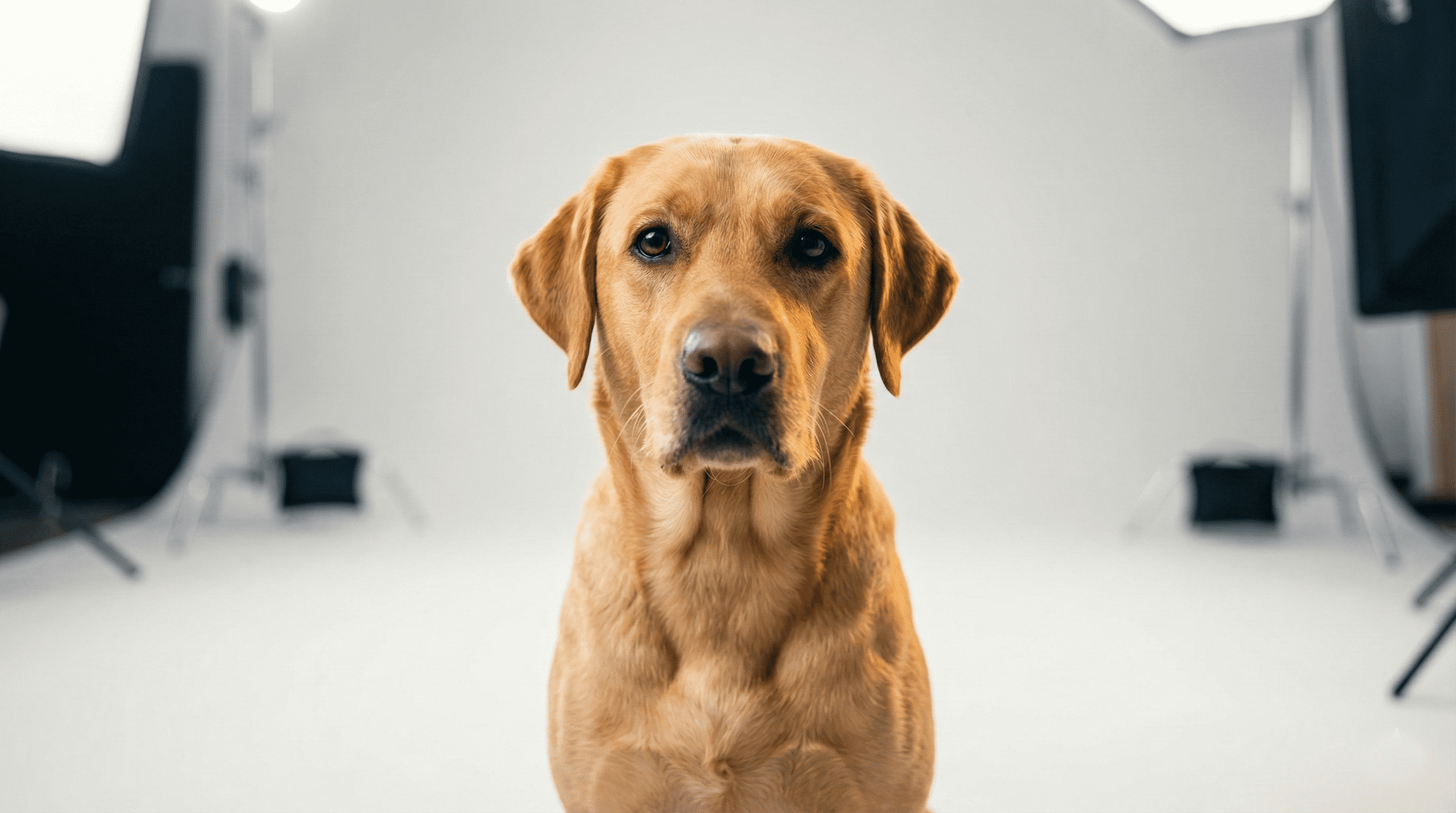
Labrador Retriever at a glance
| Lifespan |
10 to 12 years |
| Adult weight |
25 to 36 kg |
| Height (breed standard) |
Males 56 to 57 cm, females 55 to 56 cm at the shoulder |
| Food cost |
About $84 to $134 a month on a premium dry food |
| Lifetime cost |
About $36,000 over 10 years in our standard scenario (calculator below) |
| Main health risks |
Obesity, hip and elbow dysplasia, cruciate ligament rupture, progressive retinal atrophy |
How much does a Labrador cost in Australia?
The puppy is the smallest part of the bill. Our cost model puts the lifetime cost of a Labrador at about $26,500 in a low-cost scenario and about $36,300 in our standard scenario, over a 10-year life. That covers food, vet care, grooming, registration and supplies. Food alone runs about $84 to $134 a month.
Puppy prices vary a lot between breeders, so check the current price with several registered breeders, and expect the best-health-tested litters to cost more. You can enter your own puppy price in the calculator below to see your first-year total.
How long do Labradors live?
Most Labradors live 10 to 12 years, and weight is the factor owners control most. Labradors are unusually food-driven, and about a quarter carry a gene variant (in the POMC gene) linked to stronger hunger. In a well-known lifetime study, Labradors kept lean lived about two years longer, on average, than their heavier littermates. Measure meals, count treats and aim to be able to feel the ribs easily.
Labrador health issues
| Condition |
What it does |
Can the parents be screened? |
| Obesity |
Shortens life and worsens joint disease |
No. Managed with portion control |
| Hip and elbow dysplasia |
Malformed joints, leading to arthritis and pain |
Yes, by hip and elbow X-rays |
| Cruciate ligament rupture |
Knee ligament tear, often needing surgery |
No. Keeping the dog lean lowers the risk |
| Progressive retinal atrophy |
Gradual loss of sight |
Yes, DNA test |
| Exercise-induced collapse |
Weakness and collapse after intense exercise |
Yes, DNA test |
Comparing breeds? See Labrador vs Golden Retriever, compared side by side on size, cost and health, or what popular breeds cost.
Australia’s most owned dog, and the one most often owned badly
The Labrador Retriever was developed in Newfoundland and refined in Britain as a water retriever, working alongside fishermen hauling nets and later as a gundog. Everything the breed is loved for — the tolerance, the biddability, the soft mouth, the willingness to carry things to people — comes from that job.
It ranks seventh for working intelligence with the maximum trainability score on our scale, which is why Labradors dominate assistance, detection and guide dog work worldwide. It is rated excellent with children. Its reputation is earned.
What that reputation obscures is that this is a high-energy working breed. An hour of structured daily activity is the baseline, not an ambitious target, and a Labrador that does not get it does not become calm — it becomes mouthy, destructive and overweight. The gap between “easy family dog” and “high-drive gundog that happens to be friendly” is where most Labrador problems begin.
The obesity gene — and why willpower is not the issue
This is the most useful thing an owner of this breed can know, and it is genuinely a piece of science rather than a general caution about overfeeding.
Researchers at the University of Cambridge identified a 14 base-pair deletion in the POMC gene in Labrador Retrievers. POMC is involved in the pathway that signals satiety — the sense of having eaten enough. The deletion disrupts the coding sequences for β-MSH and β-endorphin, and it is associated with higher body weight, greater adiposity, and measurably greater food motivation.
Around a quarter of Labradors carry the mutation. It is significantly more common in Labradors selected as assistance dogs than in pets — the same food motivation that makes a dog easy to train also makes it hard to keep lean. Among other breeds it has been found only in the closely related Flat-Coated Retriever, where roughly two-thirds carry it.
What to do with that information
A Labrador carrying this deletion is not greedy in a moral sense. It is receiving a weaker satiety signal than other dogs, and no amount of discipline on the dog’s part changes that. The management burden sits entirely with the owner:
- Weigh the food. Do not estimate with a scoop. This single habit does more than anything else on this list.
- Count treats within the daily total rather than adding to it. Use part of the dinner ration for training.
- Brief everyone in the household, and visitors. A Labrador will convince any individual person that it has not been fed.
- Assess body condition monthly by feel, not appearance. You should be able to feel the ribs easily under a thin layer, and see a waist from above.
- Secure the bins and the pantry. Dietary indiscretion leading to obstruction or pancreatitis is a recurring emergency in this breed.
This matters beyond appearance. Excess weight worsens dysplastic joints, substantially raises the risk of cruciate ligament rupture, increases anaesthetic risk, and independently shortens life.
Health
Joints
Hip and elbow dysplasia are the conditions most associated with the breed, and both are screened radiographically. Ask any breeder for the parents’ actual scores rather than an assurance that they are healthy — a dog that has not been scored has not been screened.
Cranial cruciate ligament rupture deserves specific mention because it is very common in Labradors and because it is the injury most directly linked to body weight. It presents as sudden hind-limb lameness, often after a twist or a jump, and usually requires surgery. Keeping the dog lean is the most effective prevention available.
Keep body condition lean through the first two years while growth plates are open, and avoid forced repetitive exercise, long runs and stair work in a growing puppy.
Exercise-induced collapse
A recessive, DNA-testable condition in which affected dogs are entirely normal at rest but can collapse after five to fifteen minutes of strenuous, excited activity — typically a wobbly, weak hind end, sometimes progressing to full collapse, with recovery over some minutes.
Because two clear parents cannot produce an affected dog, this is entirely avoidable in a planned litter. Ask for both parents’ EIC results by name, and if your own dog’s status is unknown and it has ever collapsed during hard play, test it.
Eyes
Progressive retinal atrophy is DNA-testable via the prcd mutation — ask for both parents’ results. Retinal dysplasia and cataracts also occur, so ask about current eye certification rather than a general assurance.
Bloat
As a deep-chested breed the Labrador is at risk of gastric dilatation-volvulus. A hard distended abdomen, repeated retching that produces nothing, restlessness and rapid decline is a surgical emergency measured in hours. Know your nearest after-hours clinic before you need it, and feed two smaller meals rather than one large one.
Coat and Australian conditions
The short, dense, water-resistant double coat is rated high for shedding, and that surprises people who assume short means low. Labradors shed constantly and then heavily twice a year. Brush weekly as routine and several times a week during a moult, using an undercoat rake — a slicker alone works the topcoat and leaves the dead undercoat in place. Do not clip the coat; it insulates and is water-resistant by design.
Drop ears plus a dog that will enter any water it finds makes otitis externa a recurring theme. Dry the ears properly after every swim and bath.
In Australian summers, exercise early morning or after dusk, carry water, and check the pavement with the back of your hand before you set out. Swimming is the ideal exercise for this breed — excellent conditioning, gentle on joints, and exactly what it was built for. Just dry the ears afterwards, every time.
Ownership in Australia
In Victoria, microchipping and council registration are required from three months of age under the Domestic Animals Act 1994, renewing annually on 10 April. Desexed registration across the Victorian councils in our fee survey ranged from about $19.50 to $93.30 a year, with entire dogs charged two to four times that.
The honest summary: the Labrador deserves its reputation as a family dog, and it is not a low-effort one. Give it an hour of real work a day and weigh its food, and you have one of the best dogs in the world. Skip either and you have an overweight, under-exercised, mouthy adolescent for ten years.
Registration is set by your local council. In Victoria, registering a desexed Labrador Retriever costs between $19.50 and $93.30 a year depending on where you live, and roughly three times that if the dog is not desexed. See every Victorian council’s 2026–27 fee, or compare registration costs in every state.
Large dogs carry more load through their joints for longer. If you are choosing gear for a Labrador Retriever, see our orthopaedic bed comparison for large breeds and our large-breed dog food comparison.
Related breeds
The Labrador Retriever, a purebred in the Gundogs group, originates from Canada. With a health complexity score of 1.8, it is marked by high sociability and a high-spirited temperament. The breed's large size (25-36 kg) requires rigorous dietary control to mitigate its high obesity risk. The average lifespan of 10 to 12 years aligns with a moderate exercise regimen involving at least 60 minutes of daily activity. The coat is short, dense, and water-resistant, necessitating weekly brushing to manage high shedding levels. This breed demands moderate grooming and is not hypoallergenic. Labrador Retrievers are excellent with children and good compatibility with other pets. However, the breed is prone to several key health issues including hip and elbow dysplasia, Progressive Retinal Atrophy (PRA), obesity, and Cranial Cruciate Ligament ruptures. The trainability score is high at 5, reflecting its suitability for owners focusing on behavioral conditioning. The primary veterinary healthcare costs amount to $1728 annually, exclusive of ancillary costs. A contingency fund of $1440 is advisable for unexpected medical conditions. The West Paw Zogoflex toys are durable, non-toxic toys that suit energetic breeds that love fetch.
This breed demands vigilance for hereditary conditions such as hip and elbow dysplasia, Progressive Retinal Atrophy (PRA), and obesity. Standard veterinary protocols should include regular screenings for these conditions, along with annual health check-ups to monitor and manage potential health issues. The Hill’s Science Diet Large Breed dry food lists its joint-support levels, which helps for large breeds prone to joint problems.
Labrador Retrievers require daily exercise of at least 60 minutes, incorporating activities like running and swimming. Weekly brushing is necessary to manage high shedding levels and maintain coat condition. Dietary management is crucial due to the breed's high risk of obesity. Routine behavioural training is recommended due to their high trainability. Foods suited to large, heavy dogs are compared in our guide to the best dog food for large breeds.