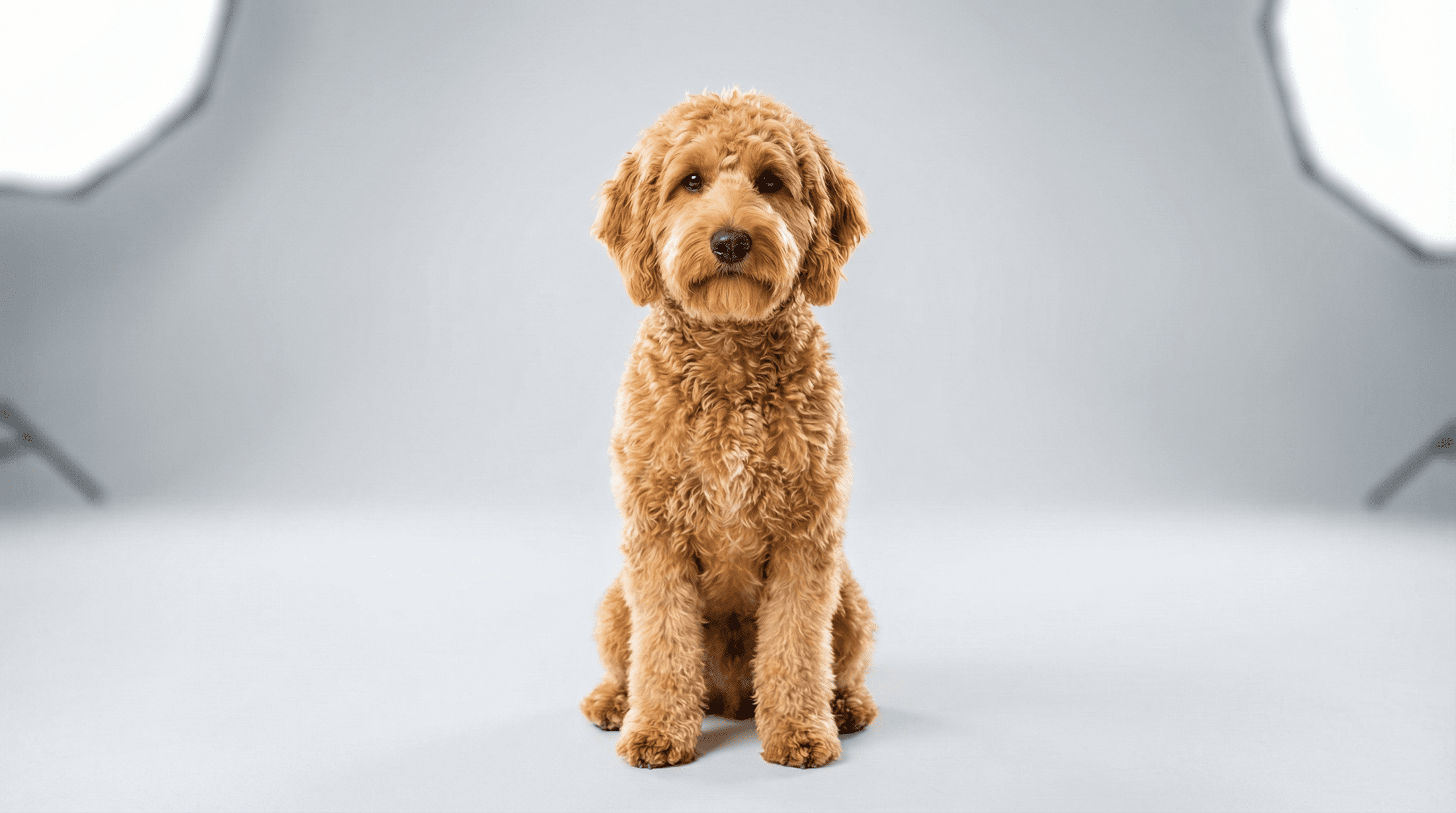
Groodle at a glance
| What it is |
A Golden Retriever crossed with a Poodle, called a Goldendoodle outside Australia |
| Lifespan |
12 to 15 years |
| Adult weight |
18 to 30 kg for a standard Groodle. Miniature and medium Groodles are smaller |
| Fully grown |
Full height at around 12 months; standard Groodles fill out until about 18 months |
| Main health risks |
Hip and elbow dysplasia, ear infections, progressive retinal atrophy, and cancers such as haemangiosarcoma and lymphoma |
| Shedding |
Low, but not hypoallergenic |
How long do Groodles live?
Most Groodles live 12 to 15 years. The Poodle side tends to be long-lived; the Golden Retriever side brings a high rate of cancer, which is the main thing that shortens Golden Retriever lives. A Groodle from health-tested parents, kept lean and checked by a vet once a year (twice a year from about eight), has the best chance of reaching the upper end of that range.
How big do Groodles get?
A standard Groodle, bred from a Standard Poodle, usually weighs 18 to 30 kg as an adult. Breeders also sell miniature and medium Groodles, bred from a Miniature Poodle or from smaller Groodle parents. These are noticeably smaller, often under 15 kg, but there is no official size standard for any Groodle size. The most reliable guide to your puppy’s adult size is the weight of both parents, so ask the breeder for them.
Groodle health issues
| Condition |
Comes from |
Can the parents be screened? |
| Hip dysplasia |
Both |
Yes, by hip-scoring X-rays |
| Elbow dysplasia |
Golden Retriever |
Yes, by elbow X-rays |
| Progressive retinal atrophy (sight) |
Both |
Yes, DNA test |
| Haemangiosarcoma and lymphoma (cancers) |
Golden Retriever |
No. Regular vet checks help catch problems early |
| Ear infections |
Both (drop ears and hair in the canal) |
No. Managed with regular cleaning and drying |
Each condition is explained in more detail below.
Choosing between a Cavoodle and a Groodle? See our Cavoodle vs Groodle comparison of size, cost and health, or what popular breeds cost.
A Golden Retriever crossed with a Poodle — and why the size varies so much
The Groodle, known internationally as the Goldendoodle, is a cross between a Golden Retriever and a Poodle. Because Poodles come in Standard, Miniature and Toy, and because most Australian Groodles are first-generation or first-generation backcrosses rather than an established line, adult size is genuinely unpredictable. Our specification range of 18 to 30 kilograms reflects a Standard Poodle pairing; a Miniature cross produces a substantially smaller dog.
Ask the breeder directly which Poodle variety was used and what the sire weighs. That single question resolves most of the surprise people report about how large their Groodle became.
The health question that matters most
The Golden Retriever carries a cancer burden that is unusual even among large breeds. In the Morris Animal Foundation’s Golden Retriever Lifetime Study — a long-running cohort tracking thousands of dogs from puppyhood — roughly three-quarters of deaths recorded to date have been cancer-related, with haemangiosarcoma accounting for the large majority of those. Lymphoma, osteosarcoma and high-grade mast cell tumours make up most of the remainder.
A Groodle is not a Golden Retriever, and crossbreeding may moderate that risk. But it is half Golden, the risk is not eliminated by dilution, and no responsible profile of this dog should omit it. The practical implications are modest but real: know what a normal lump feels like on your dog, have anything new checked rather than watched, and treat sudden collapse, pale gums or unexplained abdominal swelling in a middle-aged Groodle as an emergency rather than something to observe overnight. Haemangiosarcoma characteristically presents with no warning at all.
Joints
Hip and elbow dysplasia sit on both sides of this cross. Screening exists and works: ask for the parents’ hip and elbow scores, and treat “the parents are healthy” as a non-answer. A dog that has not been radiographed and scored has not been screened.
The most useful thing an owner can do for a large dog’s joints is unglamorous — keep it lean. Excess body condition through the first two years, when the growth plates are still open, does more measurable damage than any supplement can undo.
Eyes and ears
Progressive retinal atrophy comes through the Poodle line and is DNA-testable, so ask for the parents’ prcd-PRA status. Ear infections come through both: drop ears, a hairy canal, and a dog that likes water. Dry the ears after every swim and have them examined at each groom.
Coat: the cost people underestimate
The Groodle’s coat sheds lightly, which is why it is marketed as allergy-friendly. It is not hypoallergenic — no dog is — and low shedding has a direct cost, because hair that does not fall out mats instead. On a 25-kilogram dog with a wavy coat, that is a large surface area to maintain.
Brush at home through the week, particularly behind the ears, under the collar and in the armpits, and expect a professional groom every six to eight weeks. Grooming, not food, is usually the largest recurring line item for this breed. Factor it in before you commit rather than after the first matting emergency.
Exercise, intelligence and what happens without a job
This is a moderate-to-high energy dog with two working parents behind it — a retriever and a water dog. An hour a day of genuine activity is a realistic baseline, and it should not all be walking. The Poodle side ranks at the very top of working-intelligence assessments, and the Golden is not far behind; a Groodle that gets its physical exercise but no mental work will find its own occupation, usually in your garden or your skirting boards.
Scent games, retrieve with rules, short training sessions and food puzzles are more effective per minute than extra distance. This is also, for the same reason, an outstandingly trainable dog for a first-time owner willing to put in the early months.
Ownership in Australia
In Victoria, microchipping and council registration are required from three months of age under the Domestic Animals Act 1994, with annual renewal on 10 April. Across the Victorian councils in our fee survey, desexed registration ranged from roughly $19.50 to $93.30 per year; entire dogs are charged several multiples of that in most municipalities.
A medium-to-large, water-loving, heat-sensitive dog also needs an Australian-specific summer routine: walk early or late, carry water, and check paw comfort on asphalt with the back of your hand before you set out. If it is too hot for your palm, it is too hot for the dog.
Registration is set by your local council. In Victoria, registering a desexed Groodle costs between $19.50 and $93.30 a year depending on where you live, and roughly three times that if the dog is not desexed. See every Victorian council’s 2026–27 fee, or compare registration costs in every state.
Large dogs carry more load through their joints for longer. If you are choosing gear for a Groodle, see our orthopaedic bed comparison for large breeds and our large-breed dog food comparison.
Related breeds
The Groodle, also known as the Goldendoodle, is a designer hybrid breed originating from Australia. This breed is classified under the hybrid/designer group and has a health complexity score of 1.8. Groodles weigh between 18 and 30 kg and possess a curly or wavy coat that is often low-shedding, hence partially hypoallergenic. Individuals considering this breed should note its moderate grooming needs, which include weekly brushing and professional grooming every 6-8 weeks. In terms of temperament, Groodles are characterized by high sociability, intelligence, and moderate-high energy levels, scoring a 4 in trainability. They require around 60 minutes of exercise daily. Known for their suitability with children is high and good compatibility with other pets, Groodles exhibit moderate separation anxiety and have a moderate risk of obesity. Key health issues include hip dysplasia, progressive retinal atrophy, and ear infections. Their average lifespan is between 12 and 15 years, making them a long-term commitment for Australian families. The breed ranks 6th in popularity in Australia.
Groodles are prone to specific hereditary conditions such as hip dysplasia, progressive retinal atrophy, and ear infections. Regular veterinary check-ups, including hip and eye exams, are recommended. Owners should also maintain good ear hygiene to prevent infections.
Daily care for a Groodle involves 60 minutes of exercise to manage its moderate-high energy levels. Weekly brushing and professional grooming every 6-8 weeks are essential for coat maintenance. This breed requires regular interaction to mitigate separation anxiety. Their diet should be monitored closely to reduce the risk of obesity.