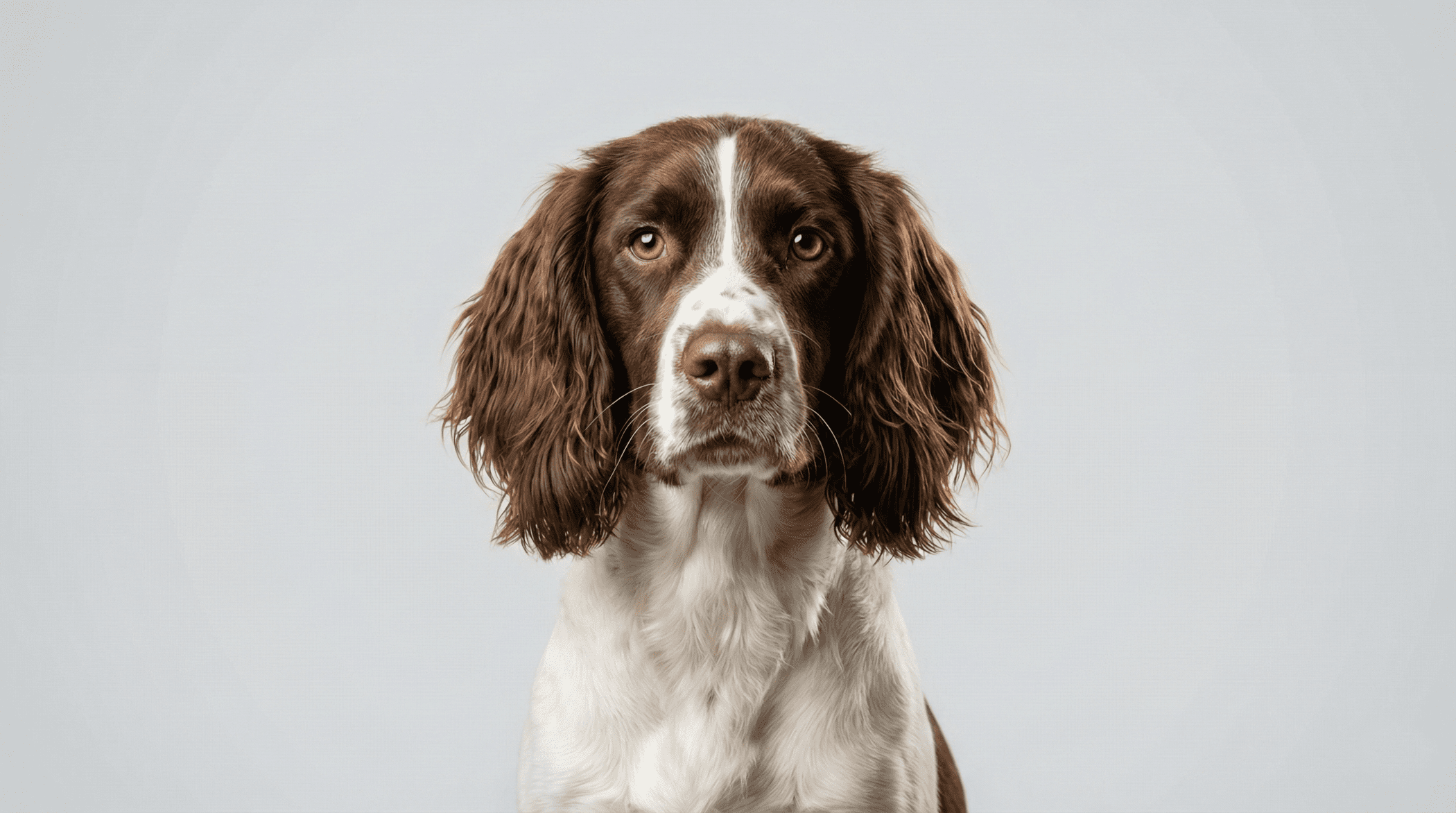
English Springer Spaniel at a glance
| Lifespan |
12 to 14 years |
| Adult weight |
20 to 25 kg |
| Exercise |
At least 60 minutes a day |
| Main health risks |
Hip and elbow dysplasia, progressive retinal atrophy, ear infections |
How long do English Springer Spaniels live?
Most live 12 to 14 years. A UK study of more than 30,000 dogs put the average life expectancy of a Springer Spaniel puppy at about 12 years (11.9), one of the longer figures among the breeds it measured (Teng et al., Scientific Reports, 2022).
Do male or female Springer Spaniels live longer?
There is no reliable breed-specific figure. Across all breeds in the same UK study, females lived slightly longer than males on average (11.4 against 11.1 years). Keeping a Springer lean and active, and treating ear infections early, matters far more than sex.
Two Springers, and the split matters
The English Springer Spaniel is a British flushing gundog, named for its job of springing game from cover. Like several working breeds it has diverged into two distinct populations: working (field) lines bred for shooting work, and show (bench) lines bred to a conformation standard.
The difference is not cosmetic. Field-bred Springers are typically lighter, shorter-coated and considerably higher-drive; show-bred dogs carry heavier coat and ear feathering and are generally steadier. Both are excellent dogs. But a field-bred Springer placed in a suburban home with an hour’s walking a day is a common and entirely avoidable mismatch, and it is the single most useful question to ask a breeder before anything else.
Either way this is a high-energy dog with a top-15 working-intelligence ranking and a trainability score of 4 — capable, willing and, in the right hands, a pleasure to train.
Ears: the routine that prevents most veterinary visits
The Springer’s long, heavily feathered ear leathers seal the canal and prevent airflow. Combined with a breed that will enter any body of water it encounters, that makes otitis externa the most common recurring problem in the breed.
The routine is simple and it works: check the ears weekly, dry them thoroughly after every swim and bath — not just a wipe, properly dry — and ask your groomer to keep the feathering practical rather than ornamental. Airflow around the canal is a health matter for this breed, not a style preference.
If infections recur despite good routine, the cause is usually an underlying allergy rather than the ear itself. Treating the ear repeatedly without investigating that is how owners end up in a cycle of medication.
Health
Eyes
Progressive retinal atrophy occurs in the breed and is DNA-testable — ask for both parents’ results. The breed is also predisposed to entropion and ectropion, where the eyelid rolls in or droops out, both of which irritate the cornea. Any persistent squinting, weeping or redness deserves an examination rather than a wait.
Joints
Hip and elbow dysplasia are both present and both screened by radiographic scoring. Ask for the parents’ actual scores rather than an assurance of good health. As with any active medium-sized dog, keeping body condition lean through the first two years while growth plates are open matters more than anything you can buy.
Autoimmune disease
The breed carries a predisposition to immune-mediated conditions, including autoimmune haemolytic anaemia, in which the immune system destroys the dog’s own red blood cells. There is no simple pre-purchase screening test, so what matters is recognition. Sudden lethargy, pale or yellow-tinged gums, rapid breathing, or dark urine warrants same-day veterinary attention. It moves quickly and it is treatable when caught early.
Phosphofructokinase deficiency
An inherited metabolic disorder documented in Springers, in which red blood cells break down under exertion or stress, producing episodes of dark urine, weakness and pallor. It is recessive and DNA-testable, so ask a breeder about it specifically — it is one of the conditions a serious Springer breeder will already have addressed.
Exercise and what this dog actually needs
An hour a day is the physical baseline, and for a field-bred dog it is genuinely a baseline. But volume alone will not settle a Springer. This is a dog bred to quarter ground methodically in front of a handler, using its nose and taking direction — a job with structure, not just movement.
Scent work is the highest-value activity you can offer and requires nothing but a garden. Retrieve with rules, gundog-style training, obedience and agility all suit the breed. An under-exercised, under-directed Springer becomes frantic rather than naughty, and the difference matters when you are deciding how to respond.
The nose also means recall needs real work. A Springer on a scent is not being defiant; it is doing what generations of selection built it to do.
Coat and Australian conditions
The medium double coat sheds moderately year-round and needs brushing a couple of times a week, with attention to the feathering on the ears, chest, legs and belly, where mats and grass seeds collect. In Australia, grass seeds are a genuine seasonal hazard for a feathered dog that works through long grass — check between the toes, in the armpits and inside the ear leathers after any walk in dry paddock country. A migrating grass seed is a surgical problem.
Professional grooming every eight to ten weeks keeps the feathering manageable. In summer, exercise early or late, carry water, and dry the ears every time the dog swims.
Ownership in Australia
In Victoria, microchipping and council registration are required from three months of age under the Domestic Animals Act 1994, renewing annually on 10 April. Desexed registration across the Victorian councils in our fee survey ranged from about $19.50 to $93.30 a year.
If you can give it structured work, the English Springer Spaniel is one of the most rewarding family dogs available — affectionate, robust, superb with children, and long-lived at 12 to 14 years. Just be honest with yourself about which line you are buying and what that line was built to do.
Registration is set by your local council. In Victoria, registering a desexed English Springer Spaniel costs between $19.50 and $93.30 a year depending on where you live, and roughly three times that if the dog is not desexed. See every Victorian council’s 2026–27 fee, or compare registration costs in every state.
Related breeds
The English Springer Spaniel is a purebred gundog originating from England. Classified as a medium-sized breed, its weight ranges from 20 to 25 kg. This breed has a medium-length, double coat that requires weekly maintenance and increased grooming during shedding seasons. It is not hypoallergenic and has a moderate shedding level. Known for its friendly and energetic disposition, the English Springer Spaniel scores a 4 on trainability and possesses a high energy level, necessitating at least 60 minutes of rigorous exercise daily. This breed is excellent with children and compatible with other pets, though it has a moderate propensity for separation anxiety and obesity. Notable health issues include Hip Dysplasia, Progressive Retinal Atrophy (PRA), Ear Infections, Elbow Dysplasia, and Autoimmune Diseases. With an average lifespan of 12 to 14 years, it ranks 13th in intelligence and is popular within the top 60 dog breeds in Australia. The estimated first-year puppy cost is $3000, and annual veterinary expenses are approximately $1530. A contingency fund of $1440 is advisable.
Given the breed's predisposition to Hip Dysplasia, PRA, and other health issues, regular veterinary checkups are essential. Genetic screening and early diagnosis increase the likelihood of effective management of hereditary conditions.
English Springer Spaniels require at least 60 minutes of rigorous daily exercise. Coat maintenance involves weekly brushing and increased frequency during shedding seasons. Feeding should be balanced to mitigate obesity risks, and mental stimulation is crucial to manage its high energy levels.