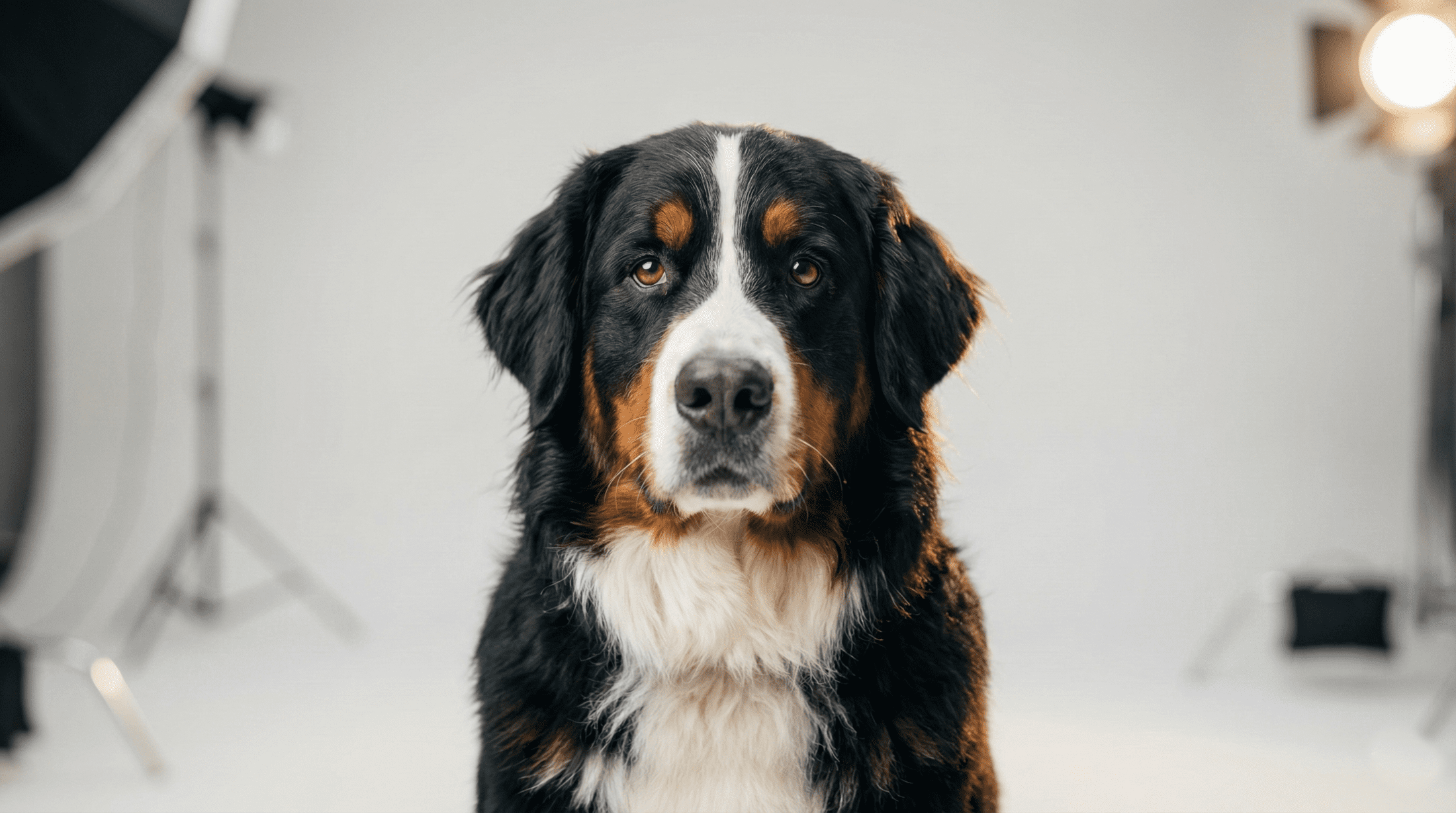
An exceptional temperament and a short life
The Bernese Mountain Dog is a Swiss farm dog from the canton of Bern, used for draught work, droving and general farm duty. The temperament that produced is close to ideal for a family: calm, good-natured, patient with children, strong without being pushy, and genuinely gentle. It is one of the most recommended large breeds for households with young children, and deservedly so.
The difficult part of this profile is the lifespan. Our specification table shows 7 to 10 years — one of the shortest of any breed on our register, and short even by giant-breed standards. Anyone choosing a Bernese should go in knowing that, because it is the defining fact of ownership and it is not something a good diet or careful exercise substantially changes.
Histiocytic sarcoma — the reason for that lifespan
Cancer is the leading cause of death in the breed, and one cancer in particular is disproportionately associated with it. Histiocytic sarcoma is an aggressive malignancy of histiocytes — a type of immune cell — and the Bernese Mountain Dog is the breed most strongly linked to it worldwide. Research into its genetic basis has focused heavily on this breed for exactly that reason.
It is aggressive and it can arise in several forms: as a localised mass, often around a joint or limb, or in a disseminated form affecting the spleen, liver, lungs and bone marrow. Presentations vary, which is why there is no single symptom to watch for. What owners can usefully do is treat vague, persistent unwellness in a middle-aged Bernese as worth investigating rather than waiting out — lethargy, weight loss, reduced appetite, lameness that does not resolve, or laboured breathing all warrant a proper work-up rather than a course of anti-inflammatories and a review in a fortnight.
Malignant lymphoma, mast cell tumours and osteosarcoma also occur at elevated rates. Get in the habit of running your hands over the dog so you know what is normal, and have any new lump checked rather than watched.
When choosing a breeder, ask about longevity and cause of death in their lines going back several generations. It is a direct question and a serious breeder will have the answer.
Joints
Hip and elbow dysplasia are both screened radiographically, and for a dog that may reach 50 kilograms the parents’ actual scores matter more than in almost any other breed. Ask for numbers, not assurances.
Two things owners control matter enormously here. Keep the dog lean through the first two years while growth plates are open — rapid growth on a rich diet is a documented risk factor for developmental joint disease in giant breeds, and a fat Bernese puppy is not a healthy one. And avoid forced repetitive exercise, stair work and jumping while the skeleton is still growing.
Bloat
As a large, deep-chested breed the Bernese is at real risk of gastric dilatation-volvulus. A hard distended abdomen with repeated unproductive retching, restlessness and rapid decline is a surgical emergency measured in hours — not overnight.
Know your nearest after-hours clinic before you need it, feed two smaller meals rather than one large one, avoid hard exercise immediately either side of eating, and raise preventive gastropexy with your vet at the time of desexing. For a giant deep-chested breed this is a conversation genuinely worth having.
The coat, and the Australian climate question
The Bernese carries a long, thick, tricolour double coat with feathering — built for Swiss alpine winters. It sheds heavily year-round and dramatically twice a year.
Brush several times a week as routine and daily during a moult, using an undercoat rake to lift the dead undercoat rather than a slicker alone. Pay attention to the feathering behind the ears, on the legs and around the tail, where mats form fastest. Professional grooming every eight to ten weeks helps.
Do not shave the coat for summer. A double coat insulates in both directions, and removing it exposes pale skin to sun while making the dog hotter rather than cooler. Thorough brushing out of the dead undercoat achieves what shaving appears to promise.
Heat is the honest constraint on this breed in Australia. A 50-kilogram alpine dog in a heavy coat has a poor surface-area-to-mass ratio for shedding heat. Exercise only in the early morning or after dusk through summer, provide deep shade, constant water and indoor airflow, and be conservative — the moderate energy level works in your favour here.
Exercise and temperament
Forty-five minutes of daily activity suits a moderate-energy dog of this size, and steady walking suits the structure better than explosive play. With a trainability score of 4 and a top-25 intelligence ranking, the Bernese is willing and pleasant to train — sensitive rather than stubborn, and it responds poorly to harsh handling.
Carting and draught work are traditional for the breed and available through some Australian clubs; they suit it exactly and provide the mental engagement a farm dog was built for.
Ownership in Australia
In Victoria, microchipping and council registration are required from three months of age under the Domestic Animals Act 1994, renewing annually on 10 April. Desexed registration across the Victorian councils in our fee survey ranged from about $19.50 to $93.30 a year.
The honest summary: the Bernese Mountain Dog is one of the finest family temperaments available in any breed, and you get fewer years of it than you would like. That is a fair trade for many people — but it should be a decision made with the number in front of you rather than discovered later.
Registration is set by your local council. In Victoria, registering a desexed Bernese Mountain Dog costs between $19.50 and $93.30 a year depending on where you live, and roughly three times that if the dog is not desexed. See every Victorian council’s 2026–27 fee, or compare registration costs in every state.
Large dogs carry more load through their joints for longer. If you are choosing gear for a Bernese Mountain Dog, see our orthopaedic bed comparison for large breeds and our large-breed dog food comparison.
Related breeds
The Bernese Mountain Dog is a purebred working breed from Switzerland, developed as a farm and draft dog. Adults weigh 32 to 50 kg and live 7 to 10 years — among the shortest lifespans of any common breed, and the single most important fact for a prospective owner to understand before committing. Cancer, particularly histiocytic sarcoma, accounts for a very high proportion of deaths and the breed is uniquely predisposed to it. The coat is long, thick and tricolour with feathering, requiring brushing several times weekly and daily attention during seasonal coat blows. Exercise needs are moderate at around 45 minutes daily, but high-impact activity should be avoided during growth to protect developing joints. Temperament is calm, good-natured and notably tolerant with children. Heat tolerance is poor: in the Australian climate, reliable indoor cooling is a welfare requirement rather than a comfort. Health monitoring should focus on histiocytic sarcoma, hip and elbow dysplasia, and gastric dilatation-volvulus.
Routine veterinary review should focus on early cancer detection, particularly histiocytic sarcoma, which is the leading cause of death in this breed. Report lethargy, appetite loss, unexplained weight loss or lameness promptly rather than monitoring at home. Screen for hip and elbow dysplasia — hip and elbow scoring of breeding parents is essential. Owners should also recognise the signs of gastric dilatation-volvulus, an emergency presentation in deep-chested breeds: unproductive retching and abdominal distension require immediate veterinary care.
Daily care for a Bernese Mountain Dog centres on coat, joints and temperature. Brush several times weekly, moving to daily during coat blows, and check ears and feet where feathering traps moisture. Provide around 45 minutes of daily low-impact activity; avoid repetitive high-impact exercise during the first 18 months to reduce orthopaedic strain. Feed measured portions across two meals and avoid vigorous exercise around feeding, given bloat risk. Provide air-conditioned or reliably cool indoor space through Australian summers.