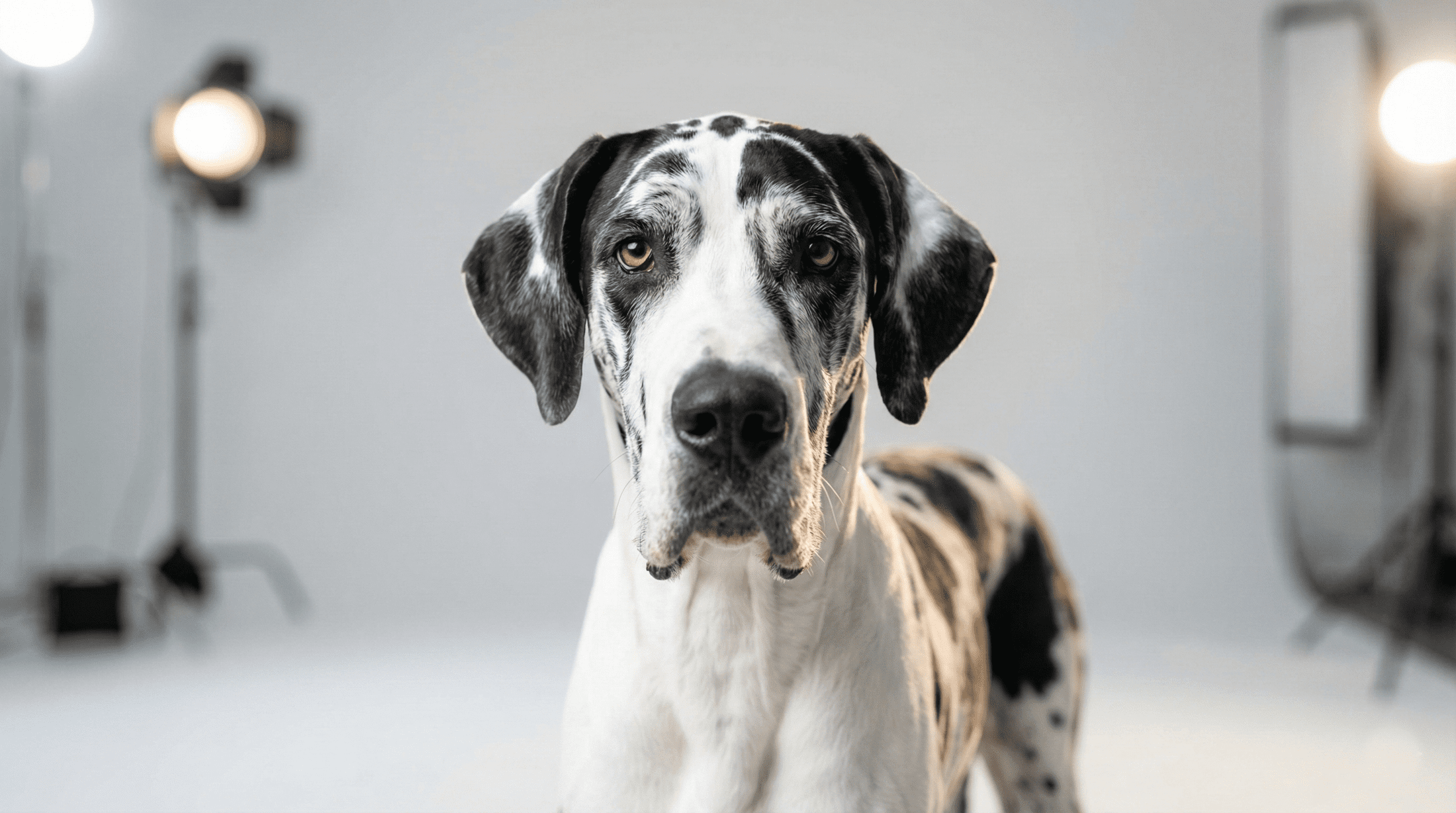
Great Danes are a giant, purebred working breed from Germany, known for their low-reactivity, suitability with children is high, and moderate exercise needs.
The total lifecycle cost of a Great Dane includes the initial estimated puppy cost of $3500 plus annual expenses, primarily veterinary costs estimated at $3150. Baseline scenarios assume minimal medical intervention, whereas extended scenarios account for chronic conditions and higher ongoing veterinary care.
// IS THIS BREED RIGHT FOR YOU?
ThinkPets ratings are our editorial judgement from the breed's size, energy, trainability, temperament and care needs. They are not measured outcomes or probabilities. How we rate
Apartment Living
Good
Families w/ Kids
Excellent
First-Time Owners
Good
Active Lifestyle
Fair
Interactive Suitability Assessment
Answer these questions to calculate your personal compatibility score with Great Danes.
How much time can you dedicate to exercise daily?
What size is your yard/living space?
Hours the dog will be alone daily?
Your Compatibility
—%
Select options to calculate your compatibility.
// BREED FACTS
Grooming
Coat Type
Short, smooth
Shedding Level
Moderate
Home Brushing
Weekly brushing
Professional Grooming
Every 12 weeks
~$168 per session
Exercise
Energy Level
Moderate
Daily Requirement
60+ minutes
Activity Type
Walks, play sessions
Mental Stimulation
Moderate
Diet
Daily Intake
4.5+ cups
Split into 2 meals
Obesity Risk
Moderate
Monthly Food Cost
$165 - $215
Premium dry food
Special Considerations
Standard diet
The largest dog most Australians will ever own
The Great Dane is a German breed — the name is misleading — developed to hunt wild boar and later kept as an estate guardian. At 50 to 90 kilograms it is genuinely giant, and almost every practical consideration of ownership flows from that mass.
The temperament is the reason people love the breed: friendly, patient, dependable and famously tolerant, often called a gentle giant with justification. But a dog that outweighs many of its owners requires early training as a matter of safety rather than manners. A Great Dane that pulls on lead, jumps up in greeting or refuses to move is not a nuisance the way a Beagle is — it is an immovable object. Teach loose-lead walking, a reliable settle and a solid recall in the first year while the dog is still liftable.
Sixty minutes of moderate daily activity suits an adult, and that word adult matters. Great Danes grow at an extraordinary rate and their skeletons are not mature until around eighteen months to two years. Forced exercise, long runs, stair work and jumping during that period cause real damage. Free play on soft ground and short walks are appropriate for a growing Dane; distance work is not.
Bloat: the emergency that defines this breed
Gastric dilatation-volvulus is the single most important thing a Great Dane owner needs to understand, because the breed is at higher risk than almost any other. The deep, narrow chest allows the stomach to distend with gas and then rotate on its own axis, cutting off its blood supply.
It is fatal within hours untreated, and it moves fast. Learn the presentation now, before you need it:
A hard, distended, drum-like abdomen
Repeated retching that brings nothing up
Restlessness, pacing, inability to settle
Excessive drooling
Rapid deterioration into weakness and collapse
Know which emergency clinic near you opens after hours before the night it happens. Do not wait to see whether it settles.
Risk reduction is worth doing: feed two or three smaller meals rather than one large one, avoid hard exercise in the hour either side of eating, and slow down fast eaters with a puzzle bowl. Most importantly, discuss preventive gastropexy with your vet — a procedure that tacks the stomach to the abdominal wall so it cannot rotate, commonly done at the time of desexing. For a giant deep-chested breed this is a genuinely worthwhile conversation, not an upsell.
The rest of the health picture
Dilated cardiomyopathy
The heart muscle thins and the chambers enlarge, reducing pumping efficiency. Great Danes are among the breeds most affected. It can be silent until well advanced, then present as exercise intolerance, coughing, laboured breathing or fainting. Annual cardiac assessment from middle age is sensible, and any fainting or collapse should be treated as cardiac until proven otherwise.
Osteosarcoma
Bone cancer occurs disproportionately in large, long-limbed breeds and the Great Dane is squarely among them. It typically presents as persistent lameness with localised swelling. Lameness in an adult Great Dane that does not resolve within a couple of weeks warrants imaging, not an assumption about a strain.
Wobbler syndrome
Cervical spondylomyelopathy involves compression of the spinal cord in the neck, and giant breeds are predisposed. The name describes the presentation: an unsteady, wobbly, high-stepping gait, usually worse in the hind limbs, sometimes with neck pain or reluctance to lower the head. Any gait abnormality in a Great Dane deserves proper neurological assessment rather than being attributed to clumsiness or growth.
Hip dysplasia
Screened radiographically — ask for the parents’ actual scores. And keep the dog lean; on a 70-kilogram frame, excess weight is not a cosmetic issue.
Practicalities of a giant dog
A few things owners consistently underestimate:
Cost scales with size. Food, medication dosed by weight, anaesthesia, and boarding are all substantially more expensive than for a medium dog.
Bedding matters medically. Bony points over a thin-coated frame develop pressure sores and calluses on hard floors. Proper orthopaedic bedding is not a luxury.
Transport needs planning. Not every car accommodates a Great Dane, and lifting an injured one is a two-person job.
Counter-surfing is effortless. A Great Dane can reach a bench without trying. Adjust the kitchen rather than the dog.
Grooming, at least, is easy: a short smooth coat and a weekly rubber curry. They shed moderately and constantly.
Australian conditions and ownership
Large dogs cool less efficiently than small ones because of their surface-area-to-mass ratio, and the Great Dane also has minimal coat and little body fat. That means it feels the cold genuinely — a coat on cold mornings is practical — and it also struggles in real heat. Exercise early or late in summer, provide deep shade and constant water, and check pavement temperature with the back of your hand.
In Victoria, microchipping and council registration are required from three months of age under the Domestic Animals Act 1994, renewing annually on 10 April. Desexed registration across the Victorian councils in our fee survey ranged from about $19.50 to $93.30 a year.
At 7 to 10 years this is a short-lived breed, which is typical for giants and worth accepting honestly before you commit. What you get in exchange is one of the best temperaments in dogs, in the largest package available.
The Great Dane, originating from Germany, is classified as a purebred working dog within the giant mass category, with an average lifespan of 7 to 10 years. Weighing between 50 to 90 kilograms, they possess a short, smooth coat requiring weekly brushing. Though shedding is moderate, their grooming needs are low. Great Danes are distinguished by their friendly, patient, and dependable temperament, yielding high sociability and suitability with children. With a trainability score of 3 and an energy level classified as moderate, they require an estimated 60 minutes of daily exercise. Known health concerns include Gastric Dilatation-Volvulus (Bloat), Hip Dysplasia, Cardiomyopathy, Osteosarcoma, and Wobbler Syndrome. These giant dogs, ranked 48th in intelligence and one of Australia's top 30 breeds, present moderate risks for separation anxiety and obesity. Initial costs for a Great Dane puppy can average around $3500, with an estimated annual veterinary expense of $3150 and a contingency fund recommendation of $1680.
// 02 Health Considerations
Given the breed's susceptibility to Gastric Dilatation-Volvulus (Bloat), Hip Dysplasia, Cardiomyopathy, Osteosarcoma, and Wobbler Syndrome, biannual veterinary check-ups are advisable. Regular monitoring of weight and mobility helps to manage obesity and joint issues effectively. Orthopaedic beds for large dogs with joint problems are compared in our guide to orthopaedic dog beds.
// 03 Care Requirements
Daily care for a Great Dane includes 60 minutes of exercise to meet their moderate energy requirements. Weekly coat maintenance is essential due to their short, smooth coat. Given their large size, ample space is necessary for movement. Weekly nail trims and ear cleaning are recommended. Foods suited to large, heavy dogs are compared in our guide to the best dog food for large breeds.
// 04 FAQs
The Great Dane originates from Germany. Bred initially for hunting large game and guarding estates, they are now primarily companion animals.
The average lifespan of a Great Dane is 7 to 10 years. The breed's susceptibility to certain health issues can impact longevity.
A Great Dane typically weighs between 50 and 90 kilograms, placing them in the giant mass category.
No, the Great Dane is not hypoallergenic. They have a short, smooth coat that sheds moderately.
Key health concerns for Great Danes include Gastric Dilatation-Volvulus (Bloat), Hip Dysplasia, Cardiomyopathy, Osteosarcoma, and Wobbler Syndrome.
The estimated first-year cost for a Great Dane puppy is around $3500. This includes the initial purchase, vaccinations, and basic necessities.
A Great Dane requires approximately 60 minutes of daily exercise. Their energy level is classified as moderate, necessitating regular physical activity.
A Great Dane's coat should be brushed weekly. Despite moderate shedding, their grooming needs are relatively low.
Yes, Great Danes are very good with children. Their temperament is generally friendly, patient, and dependable.
Great Danes exhibit low reactivity and high sociability. They are friendly, patient, and dependable, making them suitable for various household dynamics.