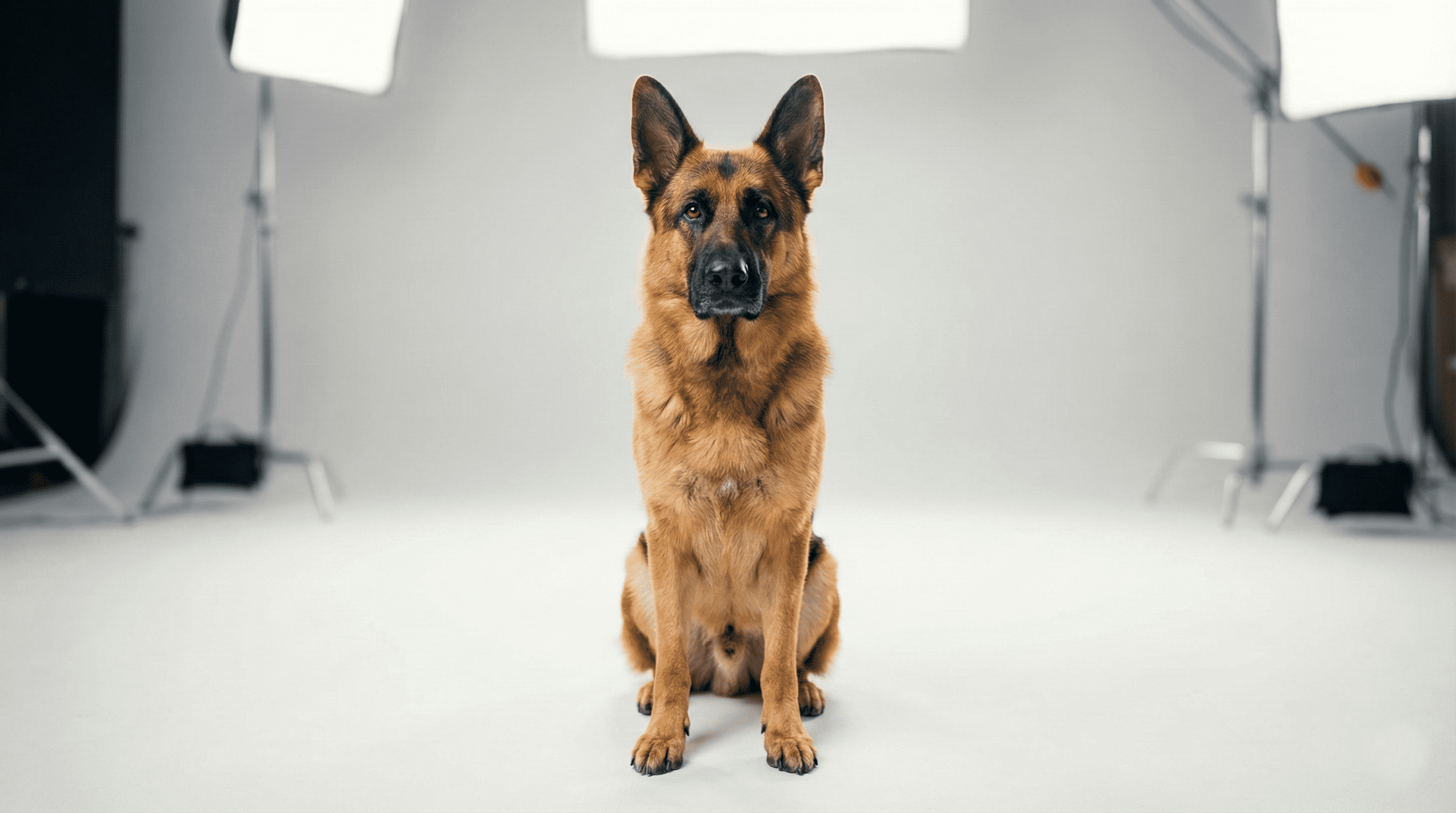
German Shepherd at a glance
| Lifespan |
9 to 13 years |
| Adult weight |
22 to 40 kg; males are noticeably larger |
| Height (breed standard) |
About 63 cm for males and 58 cm for females at the shoulder |
| Exercise |
At least an hour a day, plus training |
| Lifetime cost |
About $24,200 to $33,200 over 9 years (calculator below) |
| Main health risks |
Hip and elbow dysplasia, degenerative myelopathy, bloat, skin allergies |
How long do German Shepherds live?
The average German Shepherd lives about 9 to 13 years. The conditions that most often shorten that are joint disease, degenerative myelopathy (a spinal disease that causes gradual weakness in the back legs in older dogs) and bloat. Choosing a puppy from hip- and elbow-scored parents, keeping your dog lean and knowing the signs of bloat make the biggest difference.
Health tests to ask a breeder for
| Condition |
Test |
| Hip and elbow dysplasia |
Hip and elbow X-rays |
| Degenerative myelopathy |
DNA test for the main risk gene (a positive result raises risk, but does not mean the dog will be affected) |
The working standard — and a breed split worth understanding
The German Shepherd was developed by Max von Stephanitz from the 1890s as a herding and utility dog, and it became the template for modern working dogs: police, military, search and rescue, and assistance work worldwide. With an intelligence ranking of 3 and the maximum trainability score on our scale, that reputation is earned rather than inherited.
What buyers in Australia should understand first is that the breed has diverged into distinct populations. Working lines — typically German or Czech in origin — are bred for drive, nerve strength and stamina, and generally have straighter backs and more moderate angulation. Show lines are bred to a conformation standard that, in some interpretations, favours a sloping topline and more extreme rear angulation.
That conformation question has been the subject of sustained veterinary and welfare debate, particularly in relation to hip and hindquarter soundness. You do not need to take a side in it to act on it: ask which lines a litter comes from, look at the parents standing and moving, and ask for hip and elbow scores in numbers.
The practical mismatch to avoid is buying a high-drive working-line dog for a suburban family home. A working-line German Shepherd needs a job, and if you do not supply one it will invent something — usually perimeter patrolling, barking at the fence, and escalating reactivity toward passers-by.
Health
Hips and elbows
Hip and elbow dysplasia are the conditions most associated with the breed and both are screened radiographically. Ask for the parents’ actual scores rather than an assurance that they are healthy — a dog that has not been scored has not been screened, and this is the single most important question you will ask a breeder.
Two things owners control matter almost as much as genetics. Keep the dog lean, particularly through the first two years while growth plates are open. And avoid forced repetitive exercise in a growing puppy — long runs, stair work and jumping should wait until the skeleton has finished.
Degenerative myelopathy
A progressive spinal cord disease associated with a mutation in the SOD1 gene, and DNA-testable. The German Shepherd is among the affected breeds.
What makes it clinically distinctive is that it is painless. It usually begins after eight years with subtle hind-limb weakness — scuffing the nails of one back foot, difficulty on smooth floors, crossing the back legs on a turn — and progresses over months to hind-limb paralysis. Because there is no pain, it is routinely dismissed as arthritis or age, which delays diagnosis.
There is no cure, but the diagnosis changes what you plan for and, importantly, distinguishes it from hip arthritis and from spinal disc disease, both of which are painful and often treatable. Physiotherapy and controlled exercise slow functional decline. Ask breeders for both parents’ SOD1 results.
Bloat
As a large, deep-chested breed the German Shepherd is at real risk of gastric dilatation-volvulus. The stomach fills with gas and can rotate on itself, cutting off its own blood supply. The presentation is a hard distended abdomen, repeated retching that produces nothing, restlessness, drooling and rapid collapse — and it is fatal within hours untreated.
Learn it now and know your nearest after-hours clinic before you need it. Feeding two smaller meals rather than one large one, and avoiding hard exercise immediately either side of eating, are sensible precautions. Preventive gastropexy, often done at the time of desexing, is worth raising with your vet.
Exocrine pancreatic insufficiency
The German Shepherd is the breed most associated with EPI, in which the pancreas fails to produce enough digestive enzymes. The presentation is striking and frequently misread: a dog with a ravenous appetite that steadily loses weight, passing large volumes of pale, greasy, foul-smelling stool.
It is diagnosed on a blood test (serum TLI) and managed with enzyme replacement in every meal. Dogs treated properly do very well. A young adult German Shepherd that is eating everything and getting thinner does not need more food — it needs that blood test.
The breed is also predisposed to chronic diarrhoea and inflammatory bowel disease more generally, so persistent digestive upset is worth investigating properly rather than managing indefinitely with diet changes.
Coat and shedding
German Shepherds shed heavily, year-round, and then spectacularly twice a year. This is the most common complaint from new owners and it is entirely predictable — a double coat is doing exactly what a double coat does.
Brush weekly as routine and daily through a moult, with an undercoat rake rather than a slicker. Do not clip the coat: it insulates against heat as well as cold, and clipping removes that protection without reducing shedding.
Exercise, temperament and Australian conditions
An hour of daily activity is a floor, and the mental half is the harder half. This is a top-three working intelligence, and physical exercise alone produces a fitter dog with the same unmet need. Obedience, scent work, tracking, agility and structured retrieve all suit the breed; so does simply teaching it complicated things for the sake of it.
Temperament deserves honesty. A well-bred German Shepherd is confident, stable and discriminating — aloof with strangers rather than aggressive, and devoted to its own people. Nervous, reactive or unstable temperament is a serious fault, not a breed trait, and it is worth walking away from a litter where you see it in the parents. Early, structured socialisation through the first six months does more for this breed than anything you do later.
In summer, the double coat and the drive combine badly — a German Shepherd will keep working past the point at which it should stop. Exercise early or late, carry water, and impose the break yourself.
Ownership in Australia
In Victoria, microchipping and council registration are required from three months of age under the Domestic Animals Act 1994, renewing annually on 10 April. Desexed registration across the Victorian councils in our fee survey ranged from about $19.50 to $93.30 a year.
The German Shepherd is not a restricted breed anywhere in Australia. It is, however, a large, powerful, protective dog, and some rental agreements and owners corporations treat it as a special case. Secure fencing is essential, and it is worth checking your own council’s conditions if the dog will be kept anywhere other than a standard residence — at least one Victorian council automatically deems a guard dog to be a dangerous dog.
Registration is set by your local council. In Victoria, registering a desexed German Shepherd costs between $19.50 and $93.30 a year depending on where you live, and roughly three times that if the dog is not desexed. See every Victorian council’s 2026–27 fee, or compare registration costs in every state.
Large dogs carry more load through their joints for longer. If you are choosing gear for a German Shepherd, see our orthopaedic bed comparison for large breeds and our large-breed dog food comparison.
Related breeds
The German Shepherd Dog (GSD) is a large, working breed originating from Germany and classified as purebred. It typically weighs between 22 to 40 kg and has a double coat, contributing to a high shedding level, necessitating weekly home grooming. With an average lifespan of 9 to 13 years, GSDs are prone to conditions such as Hip Dysplasia, Elbow Dysplasia, and Degenerative Myelopathy. They exhibit high levels of intelligence, loyalty, and courage, making them highly trainable (trainability score: 5) and suitable for working roles. However, they show moderate separation anxiety and suitability with children, indicating that they can integrate well into family settings but do require attention. These dogs are not hypoallergenic and have high energy levels, which makes daily exercise of around 60 minutes crucial for their well-being. In terms of overall health, preventive measures are essential to monitor predisposed ailments. Prospective owners should budget for significant veterinary costs, approximately $1800 annually, excluding other ownership expenses such as food and coat maintenance.
Given their hereditary predisposition, German Shepherd Dogs should have routine screenings for Hip and Elbow Dysplasia, as well as regular check-ups for Degenerative Myelopathy and Gastric Dilatation-Volvulus. Annual veterinary visits for vaccinations, dental check-ups, and general health assessments are recommended. The Hill’s Science Diet Large Breed dry food lists its joint-support levels, which helps for large breeds prone to joint problems. Orthopaedic beds for large dogs with joint problems are compared in our guide to orthopaedic dog beds.
Daily care for a German Shepherd Dog involves approximately 60 minutes of high-intensity exercise to prevent obesity and ensure overall health. Weekly coat maintenance is necessary due to their high shedding levels. Owners should monitor food intake to control obesity risks and provide mental stimulation through training and activities. Foods suited to large, heavy dogs are compared in our guide to the best dog food for large breeds.