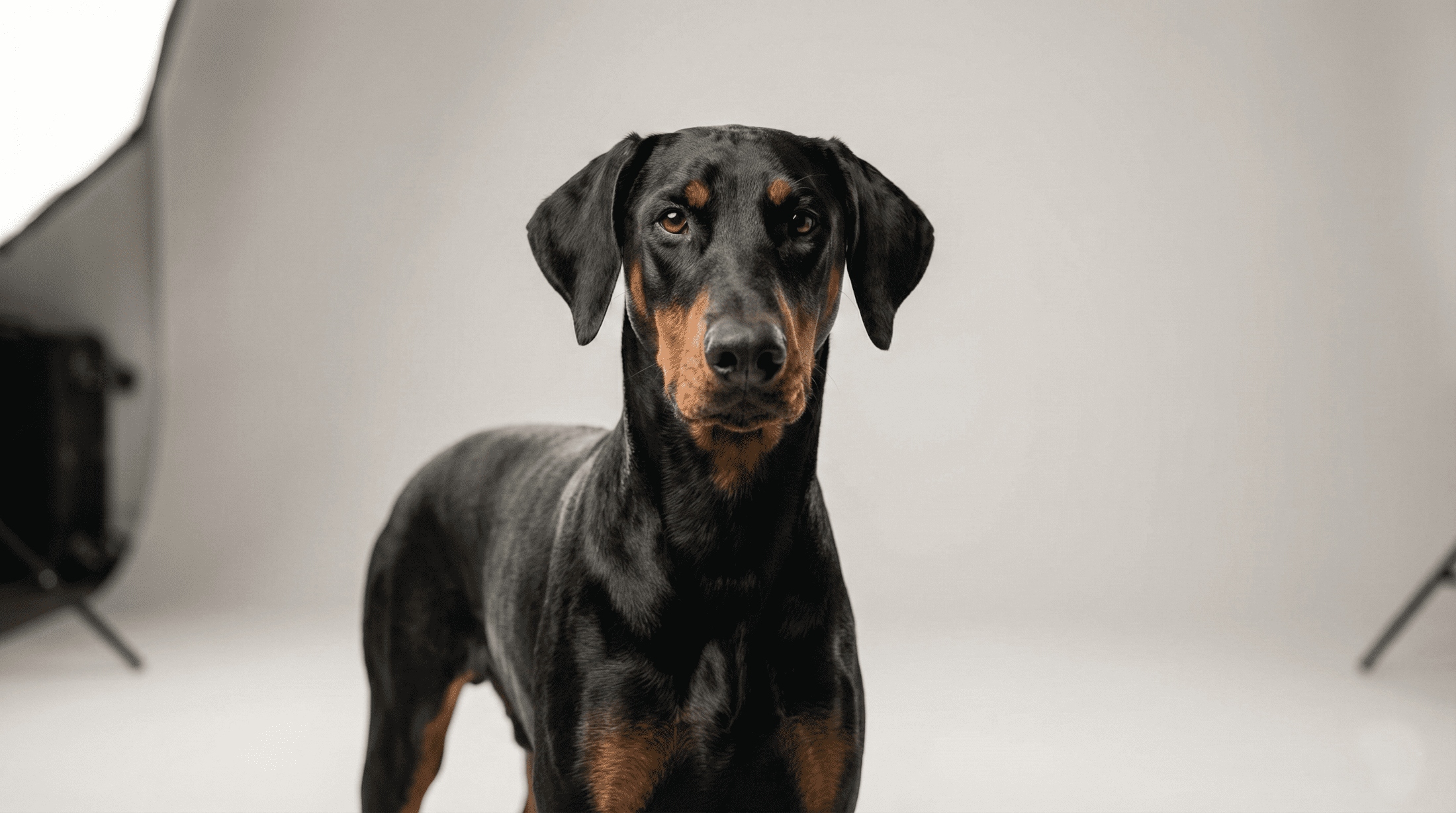
A deliberately designed dog
The Dobermann is unusual in having a known creator and a known purpose. Karl Friedrich Louis Dobermann was a tax collector and night watchman in Apolda, Thuringia, in the 1880s, and he set out to build a protection dog that would accompany him on his rounds. He succeeded, and the result is one of the most capable working breeds ever produced — ranked fifth for working intelligence with the maximum trainability score on our scale.
The modern Dobermann is more moderate than its reputation. A correct one is confident, alert and discriminating rather than aggressive, and it is deeply, almost inconveniently attached to its people — the breed is often described as velcro-like. It does not do well isolated in a yard; it wants to be in the room.
Ninety minutes of daily activity is the baseline, and the mental half is not optional for a dog of this intelligence. Obedience, tracking, scent work, agility and protection sports all suit it. What does not suit it is a suburban routine with nothing to think about, which produces exactly what you would expect from a bored, powerful, highly capable dog.
Dilated cardiomyopathy — the defining health issue
This deserves to be stated plainly, because it is the single most important thing to understand about the breed.
Dilated cardiomyopathy is a disease in which the heart muscle thins and the chambers enlarge, progressively reducing pumping efficiency. In the Dobermann it is unusually common and unusually aggressive, and it is the leading cause of death in the breed.
What makes it dangerous is a long occult phase — a period, often years, during which the disease is developing but the dog appears entirely healthy and the heart sounds normal on a stethoscope. Some dogs die suddenly during this phase, before any clinical sign has appeared. By the time an owner notices coughing, exercise intolerance, laboured breathing or fainting, the disease is well advanced.
What screening actually involves
Routine auscultation is not adequate screening for DCM in a Dobermann. Meaningful screening combines a Holter monitor — a 24-hour continuous recording of the heart rhythm, which detects the arrhythmias that often appear first — with echocardiography to assess chamber size and function.
Ask any breeder whether both parents have been Holter-tested and echocardiographed, at what age, and by whom. This is the question that separates a serious Dobermann breeder from a casual one, and it is not an unreasonable thing to ask.
As an owner, discuss annual cardiac screening with your vet from about three years of age. Detection during the occult phase allows medication that has been shown to delay the onset of congestive heart failure. That window is the entire reason screening matters.
Any fainting, collapse, sudden weakness or unexplained exercise intolerance in a Dobermann should be treated as cardiac until proven otherwise.
The rest of the health picture
Von Willebrand disease is an inherited bleeding disorder that is common in the breed. It matters most at moments you can plan for — desexing, dental work, any surgery. It is DNA-testable, so ask for the parents’ results and have your own dog tested if its status is unknown. A vet who knows in advance can prepare; one who finds out mid-procedure cannot.
Hypothyroidism is common and usually autoimmune, presenting as weight gain, lethargy, coat thinning and recurrent skin infections. Straightforward blood test, inexpensive lifelong treatment.
Cervical spondylomyelopathy, often called wobbler syndrome, involves compression of the spinal cord in the neck. It presents as an unsteady, wobbly, high-stepping gait, usually worse in the hind limbs, and sometimes neck pain. Any gait abnormality in a Dobermann deserves proper neurological assessment.
Bloat. As a deep-chested breed, gastric dilatation-volvulus is a real risk — a hard distended abdomen with unproductive retching and rapid decline is a surgical emergency measured in hours. Feed two smaller meals rather than one, and raise preventive gastropexy with your vet at the time of desexing.
Coat and Australian conditions
Grooming is the easiest part of owning this breed: a short smooth coat, a weekly rubber curry, nothing else. Dobermanns shed moderately and the fine dark hairs are conspicuous.
The short coat and minimal body fat cut both ways. Dobermanns feel the cold acutely and genuinely benefit from a coat on cold mornings. They also have little sun protection and, being dark, absorb heat efficiently — so in an Australian summer, exercise early or late, carry water, and provide deep shade. A high-drive dog will not stop when it should; that decision is yours.
Ownership in Australia
In Victoria, microchipping and council registration are required from three months of age under the Domestic Animals Act 1994, renewing annually on 10 April. Desexed registration across the Victorian councils in our fee survey ranged from about $19.50 to $93.30 a year.
The Dobermann is not a restricted breed anywhere in Australia. Like other large guardian breeds it can attract attention on rental applications and owners corporation approvals, and your council registration is the document that settles it. Note also that some Victorian councils apply additional conditions to guard dogs and to dogs kept on non-residential property.
Ear cropping and tail docking for cosmetic reasons are prohibited in Australia, which is why Australian Dobermanns carry natural ears and, in most cases, natural tails — a visible difference from images you may see from overseas.
The honest summary: an exceptional dog for an owner who will train it and screen its heart. The cardiac question is not a footnote to owning a Dobermann — it is the central one.
Registration is set by your local council. In Victoria, registering a desexed Dobermann costs between $19.50 and $93.30 a year depending on where you live, and roughly three times that if the dog is not desexed. See every Victorian council’s 2026–27 fee, or compare registration costs in every state.
Large dogs carry more load through their joints for longer. If you are choosing gear for a Dobermann, see our orthopaedic bed comparison for large breeds and our large-breed dog food comparison.
Related breeds
The Dobermann is a large, purebred dog first developed in Germany. Classified under the Working Dogs group, it has a health complexity score of 1.8. The breed's average weight ranges from 32 to 45 kg and it typically lives for 10 to 13 years. Dobermanns possess short, smooth coats that require weekly grooming. They are moderate shedders and are not hypoallergenic. Known for their alertness, fearlessness, loyalty, obedience, and high energy levels, they are exceptionally intelligent, ranking 5th in trainability. Daily exercise of at least 90 minutes is essential. While good with children, they exhibit moderate compatibility with other pets and have a moderate risk of separation anxiety. The breed has a moderate risk of obesity and is prone to several key health issues like dilated cardiomyopathy, hypothyroidism, hip dysplasia, von Willebrand's disease, and gastric torsion (bloat). In Australia, they are within the Top 30 most popular breeds, with an estimated first-year puppy cost of $3,500 and an annual veterinary cost of $1,890. A contingency fund of $1,440 is recommended for unexpected expenses.
Dobermanns have a moderate health complexity. Regular check-ups for heart conditions, thyroid function tests, and hip evaluations are essential. Annual vaccinations and routine bloodwork can prevent and manage common hereditary conditions. Monitor for signs of gastric torsion and seek immediate veterinary advice if symptoms occur.
Daily care for a Dobermann includes 90 minutes of exercise, mental stimulation, and a balanced diet to prevent obesity. Weekly coat maintenance is required due to moderate shedding. In the Australian environment, ensure protection against heat and hydration during warmer months. Early socialisation and training are essential for behavioural well-being. Foods suited to large, heavy dogs are compared in our guide to the best dog food for large breeds.