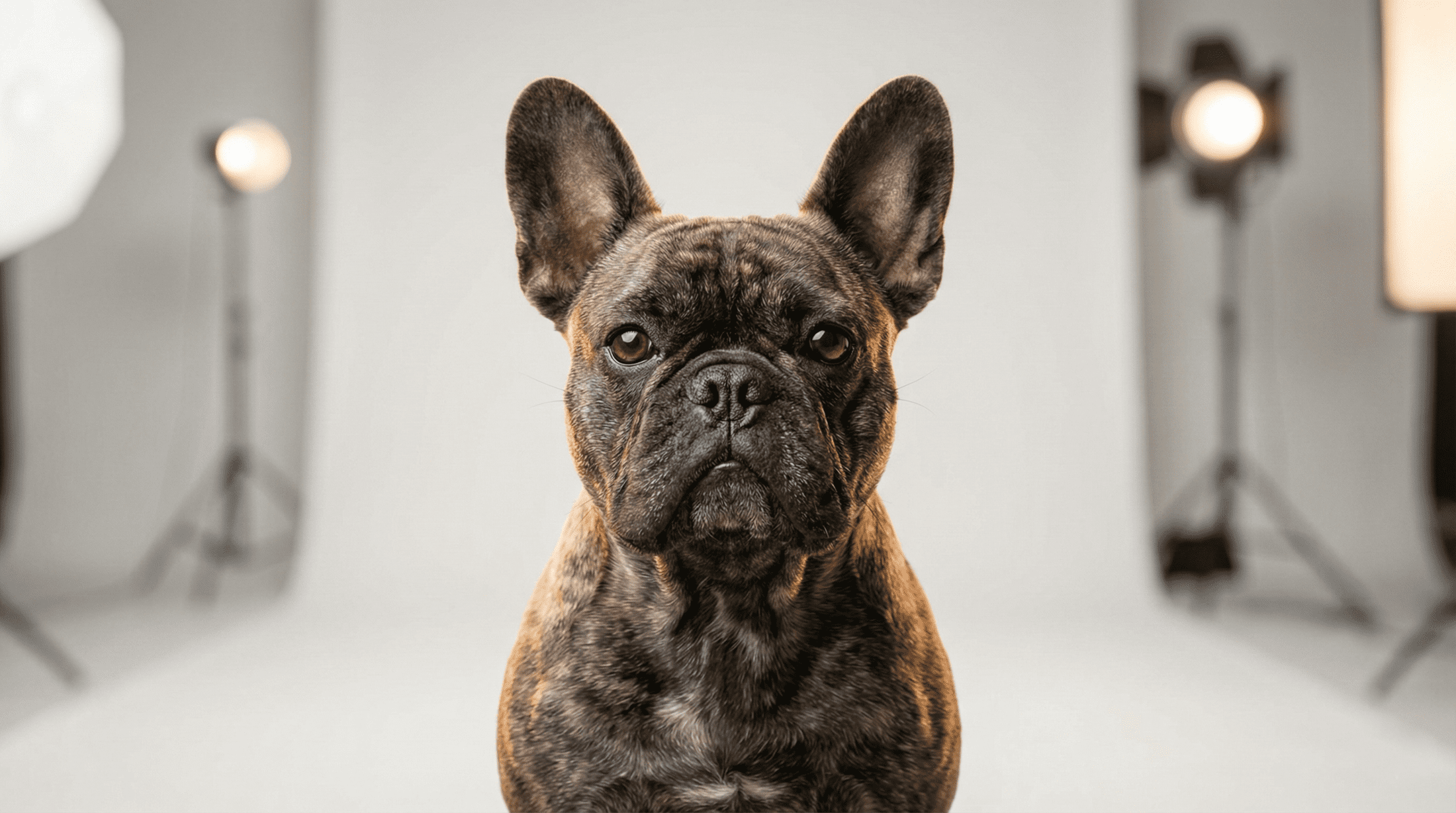
French Bulldog at a glance
| Lifespan |
10 to 12 years in most breed guides (see below) |
| Adult weight |
8 to 14 kg |
| Exercise |
About 30 minutes a day, avoiding heat |
| Lifetime cost |
About $21,300 to $30,900 over 10 years (calculator below) |
| Main health risks |
Breathing problems (BOAS), back problems (IVDD), skin allergies, kneecap problems, hip dysplasia |
How long do French Bulldogs live?
Breed guides usually give 10 to 12 years. A 2022 UK study of more than 30,000 dogs that died between 2016 and 2020 found a much lower life expectancy at birth for French Bulldogs, about 4.5 years. The authors noted that the breed’s population is unusually young because its popularity rose so quickly, which pulls that figure down, but the breed’s health problems are real. Breathing difficulty is the main one.
Choosing a healthier Frenchie
Look for a puppy whose parents have open nostrils, a visible muzzle and quiet breathing at rest and after a short walk. Ask whether they have had a breathing assessment. Keep your Frenchie lean, use a harness rather than a collar, and avoid exercise in hot weather.
Comparing breeds? See French Bulldog vs Pug, compared side by side on size, cost and health, or what popular breeds cost.
The most popular dog in Australia, and the most documented health profile
The French Bulldog is affectionate, funny, genuinely good with children and small enough for apartment living. Its popularity is not a mystery and it is not undeserved — this is a delightful companion animal.
It is also the breed with the clearest published evidence of health risk, and anyone buying one deserves to see the numbers rather than a general caution. The VetCompass programme at the Royal Veterinary College analysed French Bulldogs against the wider UK dog population and found sharply elevated odds for a specific cluster of conditions:
- Stenotic nares (narrowed nostrils) — odds ratio 42.14
- Brachycephalic obstructive airway syndrome — odds ratio 30.89
- Aural discharge (ear disease) — odds ratio 14.40
- Skin fold dermatitis — odds ratio 11.18
- Dystocia (difficult birth) — odds ratio 9.13
At a grouped level, French Bulldogs showed increased adjusted odds for 12 of 32 disorder categories, and reduced odds for 6 — so the picture is not uniformly bad. But the pattern is unambiguous, and every condition at the top of that list traces back to the shape of the head.
Breathing: the thing to assess in the actual puppy
Brachycephalic obstructive airway syndrome is not a disease the dog catches. It is a consequence of fitting normal soft tissue into a shortened skull, and the severity varies enormously between individual French Bulldogs.
Research into conformational risk has repeatedly found stenotic nostrils to be the strongest visible predictor across pugs, French bulldogs and bulldogs. Higher body condition score independently increases risk — which means weight is one of the few factors entirely within an owner’s control.
So when you look at a puppy, look at the nostrils first. Are they open, or pinched to slits? Listen to the dog at rest, then again after two minutes of play. Snorting, snuffling, rattling and snoring are not breed charm; they are the sound of a dog working hard to move air. Choosing the puppy with the more open face is the single kindest decision available to you, and it is also the cheapest over twelve years — corrective airway surgery is common in this breed and it is not a minor procedure.
Heat — the Australian-specific risk
This is where the Australian context matters more than anywhere else in this profile. UK research into heat-related illness found French Bulldogs at significantly elevated risk, with substantially higher odds of environmental heat-related illness than a Labrador Retriever. Those findings come from a temperate British climate.
Australian summers are not a temperate British climate.
The rules are firm and not negotiable. Exercise only in the early morning or after dusk through the warmer months. Never leave the dog in a stationary vehicle, not even for two minutes with the window down. Carry water. Provide deep shade and airflow, and consider cooling mats indoors. And know the emergency presentation: laboured noisy breathing that does not settle within a few minutes of stopping, brick-red or blue-tinged gums, staggering, vomiting or collapse. That is a veterinary emergency — cool the dog with room-temperature water and get to a clinic immediately.
The spine
The French Bulldog is chondrodystrophic, and the characteristic screw tail is a marker for hemivertebrae — malformed vertebrae that can compress the spinal cord. Combined with early disc degeneration, that makes intervertebral disc disease a real risk.
The household rules are the same as for any short-legged, long-backed breed: no jumping down from lounges, beds or car boots; support both ends when lifting; use a harness rather than a collar; and above all keep the dog lean. Sudden reluctance to move, a hunched back, yelping when handled, or hind-limb weakness or dragging is urgent, not something to watch over a weekend.
Ears, skin and eyes
Those upright bat ears look well ventilated, but French Bulldogs have unusually narrow ear canals — hence the 14-fold odds of aural discharge. Check weekly, dry thoroughly after any bath, and have them examined at the vet rather than treated repeatedly at home, because recurrent infection usually signals underlying allergic skin disease.
Skin fold dermatitis follows the same logic: the facial folds and the pocket under a screw tail trap moisture. Wipe them and, importantly, dry them — wiping alone leaves the fold damp, which is the actual problem. Weekly as routine, daily in humid weather.
The prominent eyes are exposed and prone to corneal ulceration. Squinting, weeping or a held-shut eye needs same-day attention.
Breeding, and what it means for buyers
The 9-fold odds of dystocia reflect a straightforward mismatch: broad shoulders and a large head against a narrow pelvis. Most French Bulldog litters are delivered by caesarean section, and many are conceived by artificial insemination.
The practical consequence for a buyer is that breeding this dog is expensive, which attracts operations that cut costs elsewhere — on health screening, on socialisation, on the welfare of the dam. Ask to meet the mother with the litter. Ask what airway assessment the parents have had. A breeder who cannot or will not answer is telling you something useful.
Exercise, temperament and ownership
Thirty minutes of gentle daily activity is appropriate, split into short sessions and timed around the heat. This is a moderate-energy companion dog, not an athlete, and pushing it is genuinely dangerous rather than merely unkind.
Temperamentally it is affectionate, sociable, playful and strongly attached to its people. It does not cope well with long days alone. The trainability score of 3 reflects a stubborn streak rather than a lack of ability — short, food-motivated sessions work well.
In Victoria, microchipping and council registration are required from three months of age under the Domestic Animals Act 1994, renewing annually on 10 April. Desexed registration across the Victorian councils in our fee survey ranged from about $19.50 to $93.30 a year.
Budget honestly. Between airway assessment, skin and ear management, and the realistic possibility of surgery, the French Bulldog is one of the more expensive small dogs to own well. None of that makes it a bad choice — it makes it a choice worth going into with the evidence in front of you.
Registration is set by your local council. In Victoria, registering a desexed French Bulldog costs between $19.50 and $93.30 a year depending on where you live, and roughly three times that if the dog is not desexed. See every Victorian council’s 2026–27 fee, or compare registration costs in every state.
Related breeds
Considering a larger flat-faced breed? Our British Bulldog guide covers the same breathing, skin and heat problems in a heavier dog.
The French Bulldog is classified as a Non-Sporting, purebred breed originating from France. Its small mass classification (8-14 kg) and short, smooth coat make it suitable for indoor environments. Rated 58th in intelligence ranking, the breed displays moderate trainability and energy levels, necessitating about 30 minutes of daily exercise. While it has low-reactivity and high sociability, it is prone to separation anxiety and has a suitability with children is high. Major health concerns include Brachycephalic Obstructive Airway Syndrome (BOAS), Intervertebral Disc Disease (IVDD), Hip Dysplasia, Patellar Luxation, and various allergies. The breed's grooming needs are moderate, requiring weekly brushing. The estimated first-year puppy cost is $4000, and the estimated annual veterinary cost is $1628, excluding additional expenses for food and coat maintenance. A contingency fund of $1760 is recommended for unforeseen health issues.
French Bulldogs require frequent veterinary checkups to monitor hereditary conditions such as BOAS and IVDD. Proactive health screening can identify issues early, improving overall lifespan and quality of life. Regular vaccinations and dental care are also important.
Daily care for a French Bulldog involves a balanced diet and around 30 minutes of exercise. Weekly coat maintenance includes brushing to manage their moderate shedding. Additionally, regular ear cleaning and nail trimming are crucial. Given their high separation anxiety, consistent companionship or training is essential.