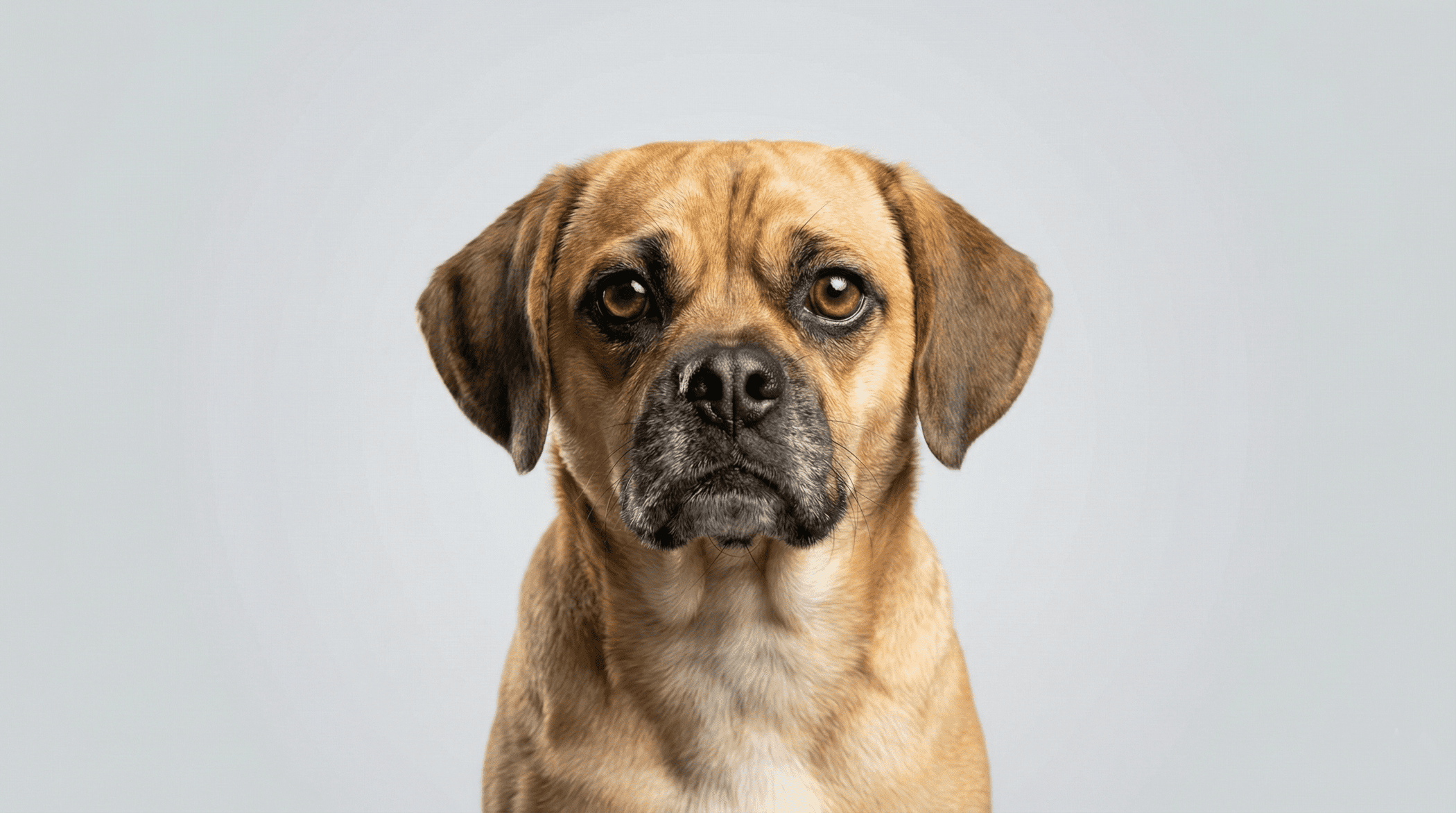
Puggle at a glance
| What it is |
A Pug crossed with a Beagle |
| Lifespan |
10 to 15 years |
| Adult weight |
7 to 14 kg |
| Exercise |
About an hour a day |
| Lifetime cost |
About $18,300 to $26,500 over 10 years (calculator below) |
| Main health risks |
Obesity, hip dysplasia, breathing problems, eye injuries, kneecap problems, ear infections |
What is a Puggle?
A Puggle is a cross between a Pug and a Beagle. Most have a longer muzzle than a Pug, which usually means easier breathing, and the Beagle’s nose and love of food. It is a crossbreed, so Dogs Australia does not register it as a breed, and looks and temperament vary between puppies, even in the same litter.
Puggle health issues
Weight is the biggest everyday risk: both parent breeds are food-driven, and extra weight makes breathing, joint and back problems worse. Puggles with a shorter, more Pug-like face can have breathing difficulty in heat. Their prominent eyes are prone to scratches and ulcers, and their drop ears to infections. Ask the breeder for hip X-ray results for both parents, and choose a puppy with open nostrils and a visible muzzle.
Puggle puppies: what to check
Ask to meet at least the mother, check that the puppy is microchipped and vaccinated, and in Victoria make sure the advertisement shows a source number. Puggle prices vary widely between breeders, so compare several and use the calculator below to see the full first-year cost.
What the Puggle was actually created to solve
The Puggle is a Pug crossed with a Beagle. It exists largely because of one problem: the Pug’s extremely shortened skull causes serious breathing difficulty, and crossing to a longer-muzzled breed was intended to lengthen the face and relieve it.
That premise is sound in principle. The critical caveat is that a first-generation cross does not produce a predictable average — it produces a spread. Some Puggles inherit a usefully longer muzzle. Others inherit something much closer to the Pug. Buying the dog without assessing the individual puppy’s face is the mistake that undoes the entire rationale for the cross.
Assessing airway risk in the actual puppy in front of you
Brachycephalic obstructive airway syndrome is a conformation-driven disorder: shortened skulls compress soft tissue into a smaller space, obstructing airflow. The signs are noisy breathing, exercise intolerance, disturbed sleep, and poor tolerance of heat and stress.
Research across brachycephalic breeds has identified specific, visible conformational risk factors rather than a single measurement. Stenotic (narrowed) nostrils were associated with BOAS across pugs, French bulldogs and bulldogs in every model tested. Facial foreshortening, visible white around the eye, and a high neck-to-chest girth ratio also carry increased risk. Notably, higher body condition score independently raised BOAS risk in pugs and bulldogs — meaning weight is one of the few risk factors an owner can directly control.
So when you look at a Puggle puppy: look at the nostrils. Are they open slits or pinched shut? Listen when it is calm and again after two minutes of play. A dog that snorts, snores and rattles at rest is telling you something. And whatever the conformation, keeping this dog lean is the highest-value thing you will do for its breathing for its entire life.
What else the Pug side brings
Prominent, shallow-set eyes are exposed and prone to corneal ulceration — a squinting or weeping eye in a Puggle is an urgent veterinary matter, not a wait-and-see. Facial skin folds, where present, need drying and cleaning to prevent dermatitis. Hemivertebrae, a malformation of the spine associated with the screw tail, also occurs in Pug lines.
What the Beagle side brings
Long drop ears with poor airflow make otitis externa a recurring theme; check and dry them routinely. Beagles are also strongly predisposed to obesity, which compounds the airway problem directly.
And then there is the nose. The Beagle is a scent hound bred to follow a trail regardless of what its handler wants, and that drive is fully present in most Puggles. In practice this means recall is unreliable when a scent takes over, off-leash freedom needs to be earned in secure areas rather than assumed, and fencing must be checked properly. It also means the breed bays — a carrying, hound-type howl that is not a barking problem to be trained away but a normal vocalisation. In an apartment or a townhouse with shared walls, this is worth knowing before you buy rather than after the first complaint.
Exercise in Australian conditions — the combination to plan for
The Puggle is a moderate-to-high energy dog and needs around an hour of daily activity, plus mental work: scent games suit it exceptionally well and exploit the Beagle inheritance productively.
But this is the specific risk profile to understand about this cross in Australia. A dog with a scent hound’s enthusiasm and a brachycephalic dog’s cooling capacity is a genuinely dangerous combination in summer, because the drive to keep going outlasts the ability to shed heat. A dog with a compromised airway cannot cool itself efficiently by panting, which is a dog’s primary cooling mechanism.
The rules that follow are firm. Exercise early morning or after dusk in the warmer months. Never leave the dog in a stationary vehicle, not even briefly. Carry water. And treat noisy, laboured breathing that does not settle within a few minutes of stopping, along with brick-red or blue-tinged gums, as an emergency requiring immediate veterinary attention.
Ownership in Australia
In Victoria, microchipping and council registration are required from three months of age under the Domestic Animals Act 1994, with annual renewal on 10 April. Desexed registration across the Victorian councils in our fee survey ranged from about $19.50 to $93.30 a year, with entire dogs charged several times that.
One planning note specific to this cross: airway surgery to correct stenotic nostrils or an elongated soft palate is common in brachycephalic dogs and is not a minor procedure financially. If you are choosing a Puggle, choosing the puppy with the more open face and the longer muzzle is both the kinder decision and the cheaper one over fifteen years.
Registration is set by your local council. In Victoria, registering a desexed Puggle costs between $19.50 and $93.30 a year depending on where you live, and roughly three times that if the dog is not desexed. See every Victorian council’s 2026–27 fee, or compare registration costs in every state.
Related breeds
The Puggle, a hybrid breed emerging from the United States, reflects a blend of traits from the Pug and Beagle. Classification within the Designer Hybrid category reflects a niche development focused on combined desirable characteristics. The breed typically weighs between 7-14 kg and is classified as a small mass breed. A short coat characterizes the Puggle, necessitating weekly brushing to manage moderate shedding. No hypoallergenic properties are observed. Temperamentally, the Puggle often manifests as friendly, playful, and gentle. Ideal for environments with moderate activity levels, the breed demands approximately 60 minutes of daily exercise. paediatric and multi-pet compatibility is high. Health monitoring should prioritize conditions like Hip Dysplasia, Brachycephalic Syndrome, and Patellar Luxation. The annual veterinary cost is estimated at $1332, necessitating considerations for moderate obesity risk and moderate separation anxiety. Training is feasible with a trainability score of 3. Popularity in Australia places the breed in the Top 60.
Puggles require regular health screenings for Hip Dysplasia, Brachycephalic Syndrome, and Patellar Luxation. Bi-annual veterinary checkups are recommended to monitor and manage potential hereditary conditions. Vaccinations, dental care, and flea, tick, and worm preventatives should be part of their standard care routine.
Daily care for a Puggle involves 60 minutes of exercise, which can include walks and playtime. Coat maintenance involves weekly brushing to manage moderate shedding. Their diet should be portion-controlled to mitigate moderate obesity risk. Ensure regular hydration and monitor for signs of separation anxiety. Maintain a structured routine to support their moderate-high energy requirements.