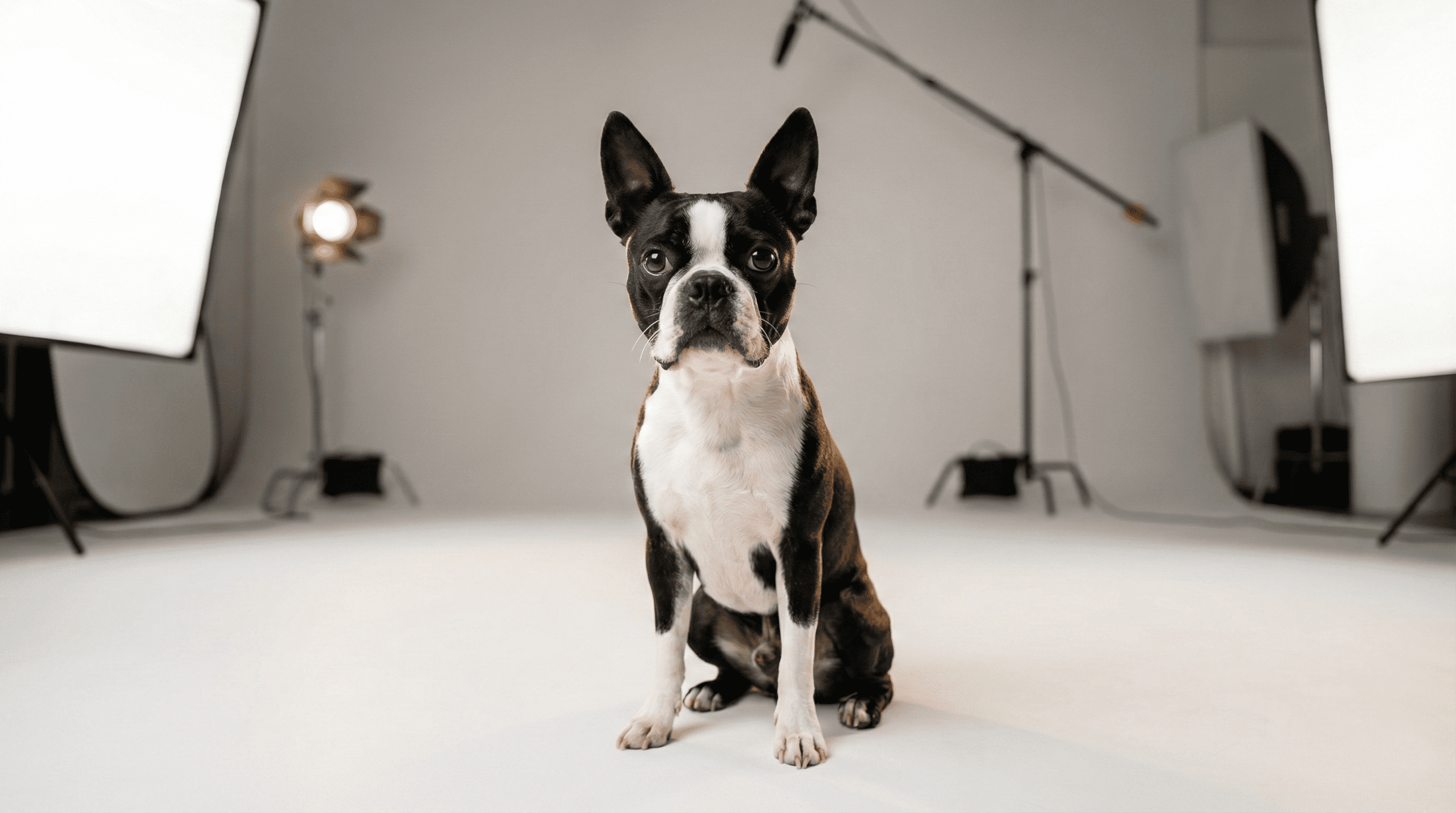
The Boston Terrier is a small, low-shedding breed originating from the United States. Known for its friendly and lively temperament, this breed is moderately trainable and suitable for families.
The total lifecycle cost of owning a Boston Terrier varies. The Baseline scenario assumes minimal veterinary intervention and standard health, while the Extended scenario accounts for chronic conditions such as Brachycephalic Syndrome, leading to higher veterinary costs over time.
// IS THIS BREED RIGHT FOR YOU?
ThinkPets ratings are our editorial judgement from the breed's size, energy, trainability, temperament and care needs. They are not measured outcomes or probabilities. How we rate
Apartment Living
Excellent
Families w/ Kids
Excellent
First-Time Owners
Excellent
Active Lifestyle
Fair
Interactive Suitability Assessment
Answer these questions to calculate your personal compatibility score with Boston Terriers.
How much time can you dedicate to exercise daily?
What size is your yard/living space?
Hours the dog will be alone daily?
Your Compatibility
—%
Select options to calculate your compatibility.
// BREED FACTS
Grooming
Coat Type
Short, Smooth
Shedding Level
Low
Home Brushing
Weekly brushing
Professional Grooming
Every 12 weeks
~$73 per session
Exercise
Energy Level
Moderate
Daily Requirement
30+ minutes
Activity Type
Walks, play sessions
Mental Stimulation
High (puzzles, training)
Diet
Daily Intake
1.5 to 2.5 cups
Split into 2 meals
Obesity Risk
Moderate
Monthly Food Cost
$47 - $97
Premium dry food
Special Considerations
Standard diet
A brachycephalic breed at the milder end — but still brachycephalic
The Boston Terrier is an American breed, developed in Massachusetts from bulldog and terrier stock, and it has a genuinely good reputation as a companion: friendly, funny, gentle with children and small enough for apartment life at 4.5 to 11 kilograms.
It is also a short-faced dog, and that is the fact everything else has to be read against. Research across brachycephalic breeds has found that the Boston Terrier sits at the milder end of the spectrum for airway compromise compared with the most extreme flat-faced breeds — but “milder” is a relative term, and the variation between individual dogs is wide.
Studies of conformational risk have consistently identified stenotic (narrowed) nostrils as the strongest visible predictor of brachycephalic obstructive airway syndrome, along with facial foreshortening and higher body condition score. That last one is the one you control. Keeping a Boston Terrier lean is the single most effective thing an owner can do for its breathing across its entire life.
When you look at a puppy: check whether the nostrils are open or pinched. Listen to the dog at rest and again after a few minutes of play. Snorting, snuffling and snoring at rest are not endearing quirks — they are the dog telling you how much work breathing is.
What this means in Australian summers
A dog that cannot cool efficiently by panting cannot cool efficiently at all. The rules are firm: exercise early morning or after dusk through the warmer months; never leave the dog in a stationary vehicle, not even briefly; carry water; and treat noisy, laboured breathing that does not settle within a few minutes of stopping — especially with brick-red or blue-tinged gums — as an emergency requiring immediate veterinary attention.
Hearing: ask whether the litter was BAER tested
Congenital deafness occurs in the Boston Terrier and is associated with the white markings that define the breed’s appearance — the same pigment-related genetics that produce the tuxedo pattern also affect the development of the inner ear.
Unilateral (one-sided) deafness is particularly easy to miss without testing, because the dog compensates well and simply seems inattentive or poor at locating sound. The screening tool is a BAER test, performed on puppies from about five to six weeks.
Ask the breeder whether the litter was BAER tested and what the results were. A bilaterally deaf Boston can live a very good life with hand-signal training and secure fencing — but that is a decision to make knowingly at eight weeks rather than to discover at eight months.
Eyes
The large, prominent, shallow-set eyes that give the breed its expression are also exposed and poorly protected. Corneal ulceration is common and often follows a minor knock, a scratch or a grass seed. A Boston Terrier that squints, weeps, or holds an eye closed needs same-day veterinary attention — corneal injuries deteriorate quickly and are far easier to treat early.
Cataracts also occur in the breed, including a juvenile hereditary form. Ask a breeder about eye certification for both parents.
Patellar luxation
A dislocating kneecap, graded I to IV, common across small breeds. Grades II and above often require surgery; grade I is generally managed with lean condition and controlled exercise. Discourage jumping down from furniture.
Skin
Allergic skin disease is common and, in Australia, usually seasonal and grass-pollen driven. Identify which months affect your dog and treat ahead of the flare. Watch the facial folds and the skin under the tail — screw tails can conceal a tight, moist pocket that needs cleaning and drying.
Temperament, exercise and training
Thirty minutes of daily activity meets the requirement, with the caveat above about heat and duration. The Boston is moderate-energy and adapts well to apartments, but it is bright — trainability score 4 — and enjoys short training sessions, trick work and food puzzles far more than distance walking.
It is also a properly social dog that does not do well isolated for long periods. This is a breed that wants to be in the room with you.
Grooming is genuinely low: a short smooth coat, a weekly rubber curry, and attention to the facial folds and ears. Boston Terriers do shed, despite the short coat, and the fine hairs are conspicuous on fabric.
Ownership in Australia
In Victoria, microchipping and council registration are required from three months of age under the Domestic Animals Act 1994, renewing annually on 10 April. Desexed registration across the Victorian councils in our fee survey ranged from about $19.50 to $93.30 a year.
One financial note worth planning for: airway surgery to widen stenotic nostrils or shorten an elongated soft palate is common in short-faced breeds and is not a minor procedure. Choosing the puppy with the more open face — and keeping it lean for life — is both the kinder decision and the cheaper one over twelve years.
The Boston Terrier, originating from the United States, is classified as a purebred in the Non-Sporting group. With an average lifespan of 11 to 13 years, they weigh between 4.5 and 11 kg, categorised as a small breed. Their short, smooth coat necessitates weekly brushing, embracing a low-shedding and low-maintenance grooming protocol. Boston Terriers exhibit high sociability, being friendly, intelligent, lively, and gentle. Their trainability is rated at 4, making them fairly easy to train. They have a moderate energy level requiring approximately 30 minutes of daily exercise. Known for suitability with children is excellent and good interaction with other pets, they are moderately prone to separation anxiety and obesity. Key health issues include Brachycephalic Syndrome, Patellar Luxation, Deafness, Allergies, and Cataracts. In Australia, they rank in the top 60 in popularity and incur an estimated annual veterinary cost of $1278 (medical only) and a contingency fund of $1440. First-year puppy cost is about $3000.
// 02 Health Considerations
Given the breed's health complexity, regular veterinary checkups are important to screen for common hereditary conditions such as Brachycephalic Syndrome and Patellar Luxation. Annual screening for cataracts and regular hearing tests are advised to maintain overall health.
// 03 Care Requirements
Daily care for Boston Terriers includes 30 minutes of exercise to maintain cardiovascular health and manage calorie intake. Weekly brushing is recommended to manage their short, smooth coat, which sheds minimally. Due to their moderate propensity towards separation anxiety, mental stimulation and socialisation are crucial.
// 04 FAQs
Boston Terriers have a life expectancy of 11 to 13 years, contingent upon proper veterinary care and a balanced diet.
Boston Terriers require moderate exercise, approximately 30 minutes daily. This helps maintain an optimal energy level and weight.
Yes, Boston Terriers are very good with children, making them excellent for families with children.
Grooming should be conducted weekly. Their short, smooth coat has low shedding, requiring minimal maintenance.
No, Boston Terriers are not hypoallergenic, despite their low shedding levels.
Common health issues include Brachycephalic Syndrome, Patellar Luxation, Deafness, Allergies, and Cataracts.
Boston Terriers can exhibit moderate levels of separation anxiety, necessitating early behavioural training and socialisation.
The estimated annual veterinary cost for a Boston Terrier is $1278 (medical only).
Boston Terriers have a moderate risk of obesity, necessitating proper diet management and regular exercise.
Boston Terriers have a trainability score of 4, indicating they are relatively easy to train.