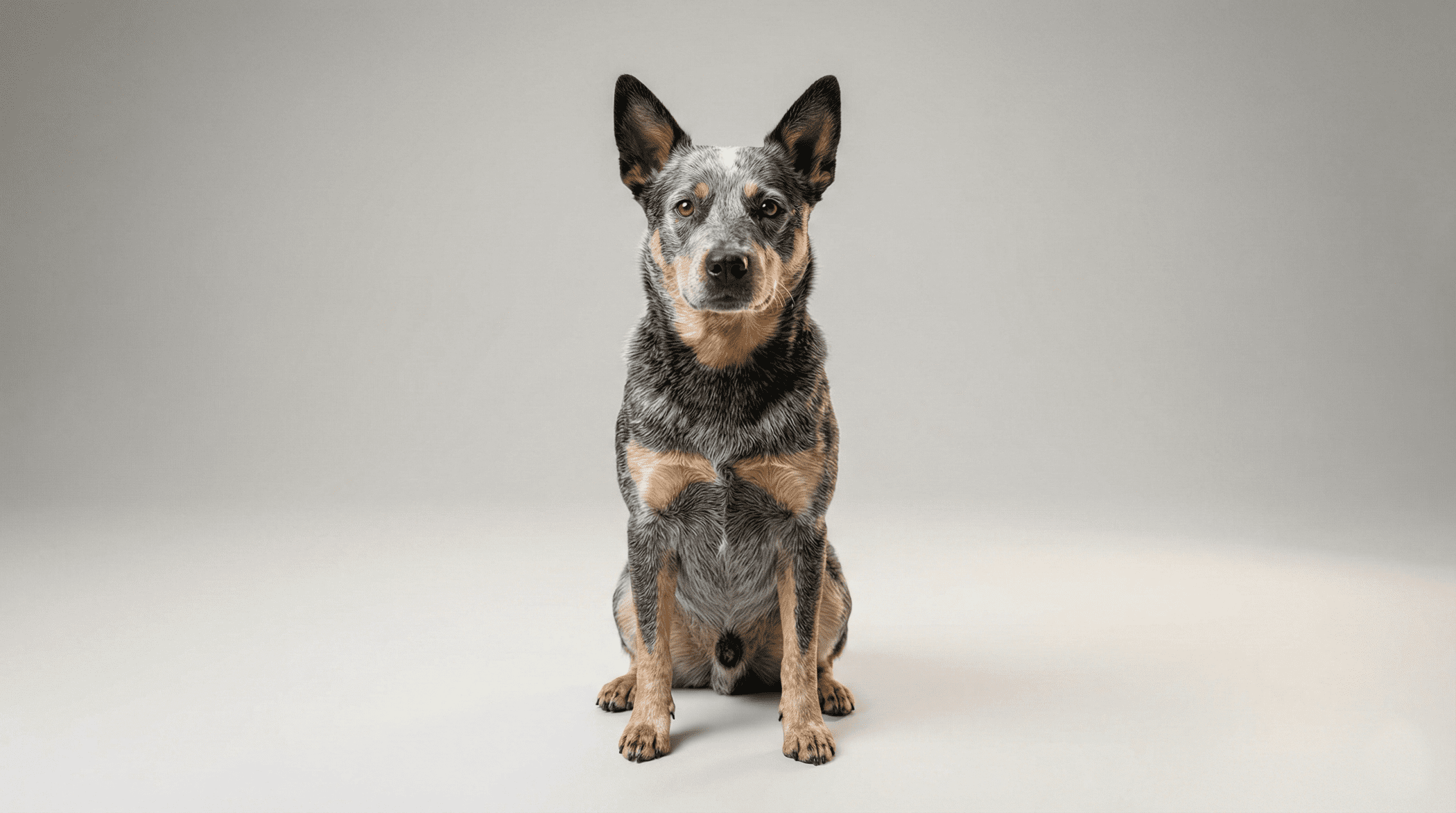
Australian Cattle Dog at a glance
| Lifespan |
12 to 15 years |
| Adult weight |
14 to 22 kg |
| Exercise |
At least 90 minutes a day, plus training or work |
| Food cost |
About $63 to $113 a month |
| Lifetime cost |
About $25,800 to $36,600 over 12 years (calculator below) |
| Main health risks |
Hip and elbow dysplasia, deafness, lens luxation, progressive retinal atrophy |
How much does an Australian Cattle Dog cost?
Our cost model puts the lifetime cost of a Cattle Dog at about $25,800 in a low-cost scenario and about $36,600 in our standard scenario, over a 12-year life. Food runs about $63 to $113 a month. The coat is short and only needs a professional groom occasionally, so ongoing costs are lower than for many breeds. Puppy prices vary between breeders; enter your own figure in the calculator below.
How long do Cattle Dogs live?
Most live 12 to 15 years. The breed also holds a famous record: Bluey, an Australian Cattle Dog from Victoria, lived to 29, and is often cited as one of the oldest dogs reliably recorded.
Health tests to ask a breeder for
| Condition |
Test |
| Hip and elbow dysplasia |
Hip and elbow X-rays |
| Congenital deafness |
BAER hearing test of puppies and parents |
| Primary lens luxation |
DNA test |
| Progressive retinal atrophy |
DNA test |
A dog built for a job that most owners cannot supply
The Australian Cattle Dog — Blue Heeler, Red Heeler, Queensland Heeler, all the same breed — was developed to move cattle across long distances in hard country, working independently, at pace, in heat, with minimal direction. That history produces a dog with exceptional stamina, real problem-solving capacity, and a working method that involves nipping at heels.
None of that is negotiable by decision. It is a very-high-energy breed with a top-ten working-intelligence ranking, and the heeling instinct is hardware, not habit. In a suburban home it typically presents as herding children, chasing bicycles and cars, and mouthing at ankles during excitement. That behaviour is redirectable with early, consistent work; it is not trainable out of existence, and a household with young children should go in understanding that.
Deafness: the screening question to ask first
Congenital hereditary sensorineural deafness is the health issue most specific to this breed, and it is measurable. In a study of 899 Australian Cattle Dogs (Sommerlad et al., BMC Veterinary Research, 2012), overall prevalence was 10.8% — 7.5% deaf in one ear and 3.3% deaf in both. Among puppies from completely tested litters the figures were near-identical at 11.1%.
Roughly one dog in nine, then, has some degree of congenital hearing loss, and unilateral deafness in particular is easy to miss without testing. The screening tool is a BAER test (brainstem auditory evoked response), performed on puppies from about five to six weeks of age. Breeders who BAER-test whole litters will say so without being asked; the question to put to anyone who does not is simply whether the litter was tested and what the results were.
A bilaterally deaf Cattle Dog can live a good life with a hand-signal-based training approach and a securely fenced property, but it is a decision to make knowingly rather than discover at six months.
Eyes
Two distinct DNA-testable eye conditions run in the breed. rcd4 progressive retinal atrophy is late-onset: affected dogs typically begin to lose vision between five and twelve years, averaging around ten. Primary lens luxation is also DNA-testable and is an acute, painful, sight-threatening emergency when it occurs — a suddenly cloudy, red or painful eye in an adult Cattle Dog needs same-day veterinary attention, not a next-week appointment.
Both tests are inexpensive and definitive. Ask for the parents’ certificates by name.
Joints
Hip and elbow dysplasia are screened by radiographic scoring rather than DNA; request the actual scores. For a dog that will spend its life turning hard at speed, keeping body condition lean through the growth period does more for long-term joint health than anything bought in a bottle.
Exercise, and the difference between tired and satisfied
Ninety minutes of daily activity is a realistic floor, and physical distance alone will not produce a settled dog. A Cattle Dog that runs ten kilometres and then has nothing to think about becomes a fitter dog with the same problem.
What works is structured work with rules: herding trials or treibball, scent work, agility, obedience, long-line retrieve with a formal start and finish. Twenty focused minutes of that will settle this breed more reliably than an hour of loose walking. Puzzle feeders and scatter-feeding are cheap daily additions.
The failure mode is predictable and well documented in surrender records: fence-running, compulsive chasing of moving objects, destructive digging, and escalating reactivity toward passing bikes and cars. These are the symptoms of an unemployed working dog.
Australian conditions and ownership
This is one of the few breeds genuinely engineered for Australian heat, with a weather-resistant double coat and real endurance. That creates its own risk: a Cattle Dog will work well past the point at which it should stop, so heat management is entirely the owner’s responsibility. Impose the break, carry water, and do the hard work early or late in summer.
The double coat sheds heavily twice a year and is otherwise low-maintenance — weekly brushing outside those periods, daily during them. Do not clip it; the coat is insulating in both directions.
In Victoria, microchipping and council registration are required from three months of age under the Domestic Animals Act 1994, renewing annually on 10 April. Desexed registration across the Victorian councils in our fee survey ranged from about $19.50 to $93.30 a year. If your dog is a genuine working dog on rural property, several Victorian councils offer a reduced rate on proof — check your own council’s concession list rather than assuming.
Registration is set by your local council. In Victoria, registering a desexed Australian Cattle Dog costs between $19.50 and $93.30 a year depending on where you live, and roughly three times that if the dog is not desexed. See every Victorian council’s 2026–27 fee, or compare registration costs in every state.
Related breeds
The Australian Cattle Dog, originating from Australia, is a purebred working dog classified as medium in mass. Weighing between 14 to 22 kg, this breed is characterised by a short, dense, and weather-resistant coat. It is non-hypoallergenic and has a moderate shedding level, necessitating weekly coat maintenance. With a lifespan of 12 to 15 years, it has a high energy level and requires at least 90 minutes of daily exercise. Known for its alertness, intelligence, protective nature, and independence, it scores a 4 in trainability. However, it has moderate reactivity towards other pets and potential separation anxiety. Key health issues include Progressive Retinal Atrophy, Hip Dysplasia, Deafness, Elbow Dysplasia, and Patellar Luxation. First-year costs for a puppy average $3500, and annual veterinary costs are $1476 with a contingency fund of $1440. This breed ranks in the top 30 in Australian popularity and holds an intelligence ranking of 10.
Australian Cattle Dogs should undergo regular veterinary checkups to monitor for hereditary conditions like Progressive Retinal Atrophy, Hip Dysplasia, and Deafness. Owners should maintain up-to-date vaccinations and parasite prevention. Early detection and intervention in health issues are crucial for long-term well-being.
Daily care for the Australian Cattle Dog involves meeting its high exercise needs with a minimum of 90 minutes of physical activity, including both physical and mental stimulation. Weekly coat maintenance is necessary to manage shedding and maintain coat health. Socialisation and training sessions should be consistent to ensure behavioural stability. The Black Hawk Original Large Breed dry food is an Australian-made option that suits active working dogs.