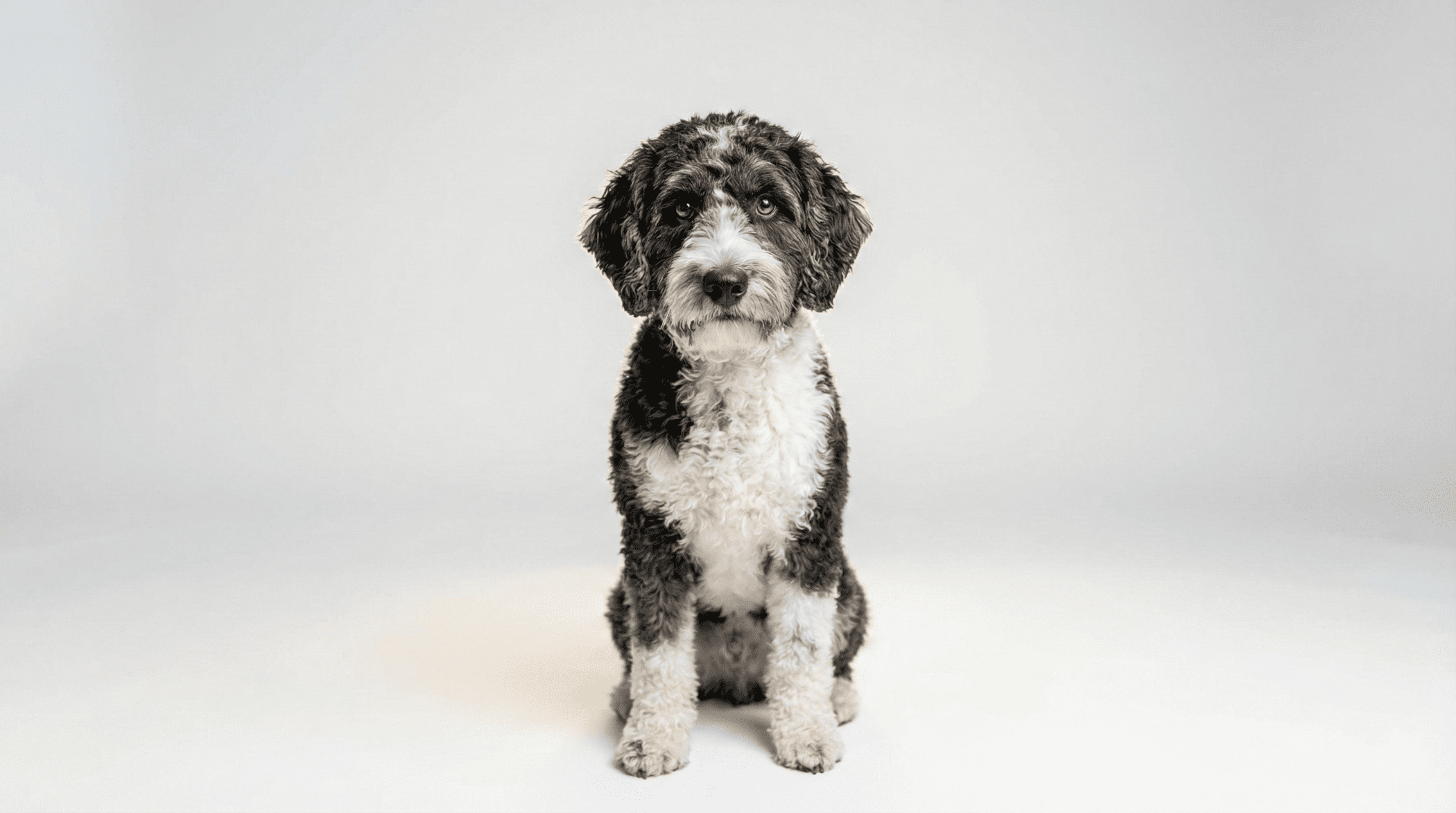
Bordoodle at a glance
| What it is |
A Border Collie crossed with a Poodle, also called a Borderdoodle |
| Lifespan |
12 to 15 years |
| Adult weight |
13 to 20 kg for a standard Bordoodle. Miniature Poodle crosses are smaller |
| Energy |
High: at least an hour of exercise a day, plus training or puzzle games |
| Main health risks |
Hip dysplasia, collie eye anomaly, MDR1 drug sensitivity, trapped neutrophil syndrome, neuronal ceroid lipofuscinosis, progressive retinal atrophy |
| Shedding |
Low to moderate, and not hypoallergenic |
What is a Bordoodle?
A Bordoodle is a cross between a Border Collie and a Poodle. Both parents rank among the most trainable breeds, and the cross usually has a wavy or curly coat that sheds less than a Border Collie’s. It is a crossbreed, so Dogs Australia does not register it as a breed, and size, coat and temperament vary more than in a purebred.
Bordoodle temperament
Bordoodles are clever, eager to work and very people-focused. That makes them quick to train, but a bored Bordoodle will invent its own jobs: barking, chewing, or herding children and other pets by circling and nipping. They suit active households that will give them daily exercise and something to think about, such as training, scent games or dog sports. They are usually gentle with family but can be sensitive to noise and harsh handling, so reward-based training works best.
How big do Bordoodles get?
A standard Bordoodle, bred from a Standard Poodle, usually weighs 13 to 20 kg. Crosses with a Miniature Poodle are smaller. As with any crossbreed, the best guide to adult size is the weight of both parents, so ask the breeder.
Bordoodle health issues
Several of the conditions this cross can inherit can be ruled out by DNA-testing the parents before breeding. Ask the breeder for results for both parents.
| Condition |
Comes from |
Can the parents be screened? |
| Hip dysplasia |
Both |
Yes, by hip-scoring X-rays |
| Collie eye anomaly |
Border Collie |
Yes, DNA test |
| MDR1 drug sensitivity |
Border Collie |
Yes, DNA test. Affected dogs react badly to some common medicines |
| Trapped neutrophil syndrome (immune system) |
Border Collie |
Yes, DNA test |
| Neuronal ceroid lipofuscinosis (nervous system) |
Border Collie |
Yes, DNA test |
| Progressive retinal atrophy |
Both |
Yes, DNA test |
The highest-drive dog on the doodle shelf
The Bordoodle crosses a Border Collie with a Poodle. It is frequently marketed the same way as every other doodle — low-shedding, clever, family-friendly — and two of those three claims deserve qualification.
“Clever” understates it considerably. The Border Collie sits at the top of working-intelligence rankings and the Poodle immediately behind it. Crossing them produces a dog with a top-two ranking on our own scale and the maximum trainability score, and that capacity is not optional equipment. A Border Collie was bred to make continuous independent judgements about moving livestock, and a Bordoodle that is given a walk and a chew toy will apply that machinery to something else — usually your household routine, your other pets, or your children’s movement through the house.
This is an outstanding dog for an owner who wants to train. It is a poor match for a household that wants a low-effort family pet, and the gap between those two expectations is where most Bordoodle rehoming happens.
Four DNA tests to ask about, by name
The Border Collie is unusually well served by genetic screening, and every one of the following has a commercially available DNA test. Ask for the parents’ results specifically.
Collie eye anomaly (CEA/CH)
A developmental defect of the choroid, the vascular layer supplying the retina. Severity ranges from mild and non-progressive to retinal detachment and blindness. Recessive and testable.
Trapped neutrophil syndrome (TNS)
An immune defect in which the bone marrow produces neutrophils but cannot release them into the bloodstream, leaving affected puppies vulnerable to repeated infection and failure to thrive. It is autosomal recessive, it occurs across all Border Collie lines rather than being confined to one, and in an Australian study of 6,439 Border Collies tested for TNS, about 22 per cent were carriers (Soh et al., Scientific Reports, 2021). That is high enough that DNA testing the Border Collie parent is not optional.
Neuronal ceroid lipofuscinosis (NCL5)
A lysosomal storage disorder causing progressive degeneration of the brain and eyes, severe impairment and early death. The causative mutation in Border Collies is a nonsense mutation in exon 4 of the CLN5 gene on chromosome 22. Rare, recessive, and entirely avoidable through testing.
MDR1 drug sensitivity
The multidrug resistance mutation impairs the transport of certain drugs out of the brain, allowing toxic accumulation. It affects ivermectin-class parasiticides and a range of other common medications including some sedatives, anti-diarrhoeals and chemotherapy agents. It is semi-dominant, meaning a single copy confers clinical sensitivity — so unlike the recessive conditions above, one carrier parent is enough to matter.
If your Bordoodle’s MDR1 status is unknown, test the dog itself. It is inexpensive, it is a one-off, and it changes what your vet can safely prescribe for the rest of the dog’s life. Put the result in the dog’s file and tell every vet who treats it.
What the Poodle side adds
Progressive retinal atrophy is DNA-testable via prcd-PRA. Addison’s disease appears in Poodle lines and presents vaguely — intermittent lethargy, poor appetite, a dog repeatedly and unaccountably unwell — so it is worth raising with a vet rather than accepting a pattern of off-days. Hip dysplasia is screened radiographically on both sides; ask for the scores.
Exercise, and what actually settles this dog
An hour of daily activity is the physical baseline, but for a Bordoodle the physical component is the easier half. Distance alone produces a fitter dog with the same unmet need, and a very fit Border Collie cross with nothing to think about is a harder animal to live with, not an easier one.
What works is structured problem-solving: agility, obedience, scent work, trick training, herding or treibball where available, and retrieve with a formal start and stop. Fifteen to twenty focused minutes of that will settle this dog more reliably than an hour of loose-lead walking. Food puzzles and scatter feeding are cheap daily additions.
The failure modes are consistent and well documented in the Border Collie population: obsessive chasing of shadows, reflections, water and moving vehicles; fence-running; compulsive herding of children and other pets; and noise sensitivity that can develop into genuine phobia. Several of these are compulsive behaviours rather than disobedience, and they are far easier to prevent than to resolve.
Coat and Australian conditions
Bordoodle coats vary from wavy to curly and shed lightly. This is not a hypoallergenic dog — no dog is — and the low-shedding coat mats rather than drops, so brush through the week and budget for a professional groom every six to eight weeks.
In Victoria, microchipping and council registration are required from three months of age under the Domestic Animals Act 1994, renewing annually on 10 April. Desexed registration across the Victorian councils in our fee survey ranged from about $19.50 to $93.30 a year.
For summer, treat this as a heat-sensitive working dog: exercise early or late, carry water, and be aware that like its Border Collie parent, a Bordoodle in drive will not stop when it should. The break is the owner’s decision to make.
Registration is set by your local council. In Victoria, registering a desexed Bordoodle costs between $19.50 and $93.30 a year depending on where you live, and roughly three times that if the dog is not desexed. See every Victorian council’s 2026–27 fee, or compare registration costs in every state.
Related breeds
The Bordoodle, originating in Australia, is a hybrid breed classified under the Designer Hybrid group. With an average lifespan of 12 to 15 years, they weigh between 13 to 20 kg, categorising them as medium-sized dogs. Boasting a wavy or curly coat of medium length, they are partially hypoallergenic with low to moderate shedding levels. Weekly brushing, intensified during shedding seasons, is recommended for coat maintenance. Their temperament is characterised by high intelligence, friendliness, loyalty, and high sociability, making them excellent for families with children and compatible with other pets. Bordoodles exhibit a high energy level, requiring at least 60 minutes of daily exercise. Trainability is rated high due to their estimated intelligence rank (#2, based on its parent breeds; Coren did not rank crossbreeds). Owners should be aware of moderate separation anxiety and obesity risks. Key health issues include Hip Dysplasia, Progressive Retinal Atrophy, and Atopy. The estimated first-year puppy cost is $3000, with an annual veterinary cost, excluding other expenses, standing at $1440. Contingency funds should also be maintained at $1440.
Given the Bordoodle's health complexity, owners should monitor for Hip Dysplasia, Progressive Retinal Atrophy, and Atopy. Regular veterinary checkups, ideally bi-annually, can help with early detection and management of these hereditary conditions, ensuring optimal health over the dog's lifespan.
Daily care for a Bordoodle involves a minimum of 60 minutes of exercise to manage their high energy levels. Weekly brushing is necessary to maintain the wavy or curly coat, and more frequent grooming is advised during shedding seasons. Consistent training and mental stimulation are crucial due to their intelligence and activity levels.