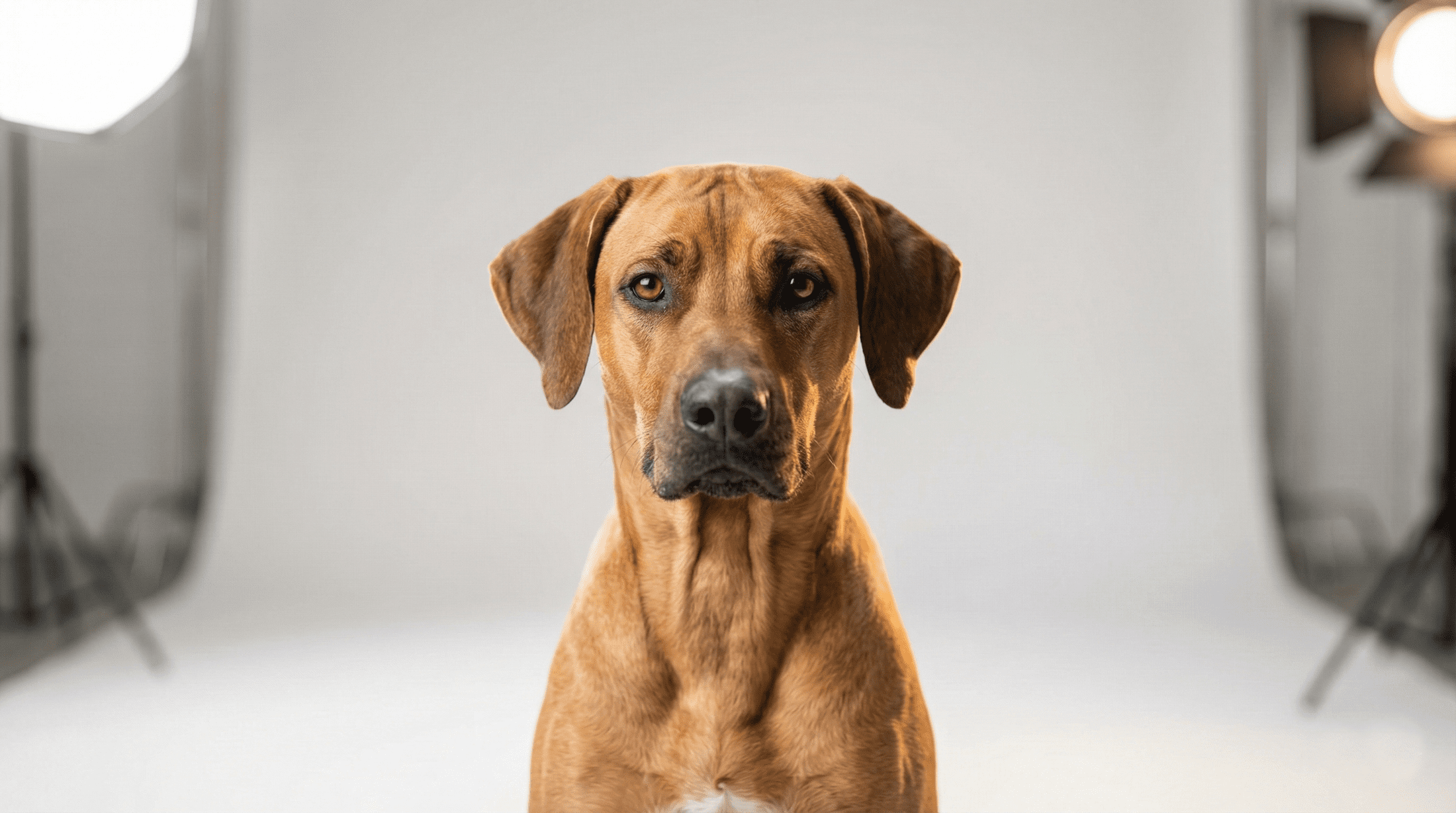
Rhodesian Ridgeback at a glance
| Lifespan |
10 to 12 years |
| Adult weight |
29 to 41 kg |
| Exercise |
About 60 minutes a day |
| Main health risks |
Hip and elbow dysplasia, dermoid sinus, bloat |
How much does a Rhodesian Ridgeback cost in Australia?
Budget about $3,000 to buy a puppy and set up in the first year, then about $2,902 a year for food, grooming and routine vet care. Over a 10-year life that comes to roughly $36,343 in our standard estimate. Breeder prices vary widely, and a serious health problem can push the total well beyond this. The full breakdown is in the cost section below.
What is the life expectancy of a Rhodesian Ridgeback?
Most live 10 to 12 years, typical for a large breed. Hip and elbow dysplasia and bloat are the main risks, so ask for hip and elbow scores for both parents and learn the warning signs of bloat.
The ridge, and the condition that comes with it
The Rhodesian Ridgeback was developed in southern Africa by European settlers crossing European breeds with the ridged Khoikhoi dogs of the region, producing a hound that could track and hold large game and guard a homestead. The defining feature — a ridge of hair growing forward along the spine, against the direction of the rest of the coat — comes from that indigenous stock.
That ridge is not merely cosmetic, and this is the single most important thing an owner should understand about the breed.
Dermoid sinus
The ridge is caused by a genetic variant affecting how the skin develops along the back, and the same developmental process is associated with dermoid sinus — a tube-like tract of skin that extends inward from the surface, sometimes as far as the spinal cord. It is a neural tube defect, and it occurs disproportionately in ridged dogs.
An open sinus can become infected, and where the tract reaches the spinal cord that infection can cause serious neurological disease including meningitis. Treatment is surgical excision, and outcomes are good when it is done early.
Practically: responsible breeders examine every puppy at birth by palpating along the midline for the characteristic cord-like tract, most commonly at the neck or over the rump. Ask any breeder directly whether the litter was checked and by whom. And if you notice a small hole or a tuft of hair in a pit along your Ridgeback’s midline, with or without discharge, have it examined rather than watched — it is not a wound and it will not heal on its own.
Temperament: a guardian, not a Labrador
The Ridgeback is loyal, dignified, affectionate with its own household and notably reserved with strangers. It is independent, strong-willed and physically powerful at 29 to 41 kilograms, with a trainability score of 4 that reflects genuine ability paired with genuine opinion.
This is not a beginner’s dog. It was bred to make decisions alone in front of dangerous game, and it will make decisions in your household too. Early, structured, patient training and broad socialisation through the first eighteen months are what produce a confident, discriminating adult. Harsh handling produces a resentful one — Ridgebacks are sensitive to unfairness and they remember.
The prey drive is substantial and the breed is a capable, silent hunter. Secure fencing is essential, cats and small animals need managing, and recall should never be assumed once a chase begins.
An hour of daily activity is the baseline, and it should include mental work. An under-occupied Ridgeback is 40 kilograms of bored, capable dog, which is a different proposition from a bored terrier.
The rest of the health picture
Bloat
As a large, deep-chested breed the Ridgeback is at real risk of gastric dilatation-volvulus. A hard distended abdomen with repeated unproductive retching, restlessness and rapid decline is a surgical emergency measured in hours. Know your nearest after-hours clinic before you need it, feed two smaller meals rather than one, and raise preventive gastropexy with your vet at the time of desexing.
Joints
Hip and elbow dysplasia are both screened radiographically — ask for the parents’ actual scores rather than an assurance of health. Keep the dog lean through the first two years while growth plates are open, and avoid forced repetitive exercise, long runs and stair work in a growing puppy.
Hypothyroidism
Usually autoimmune, presenting as weight gain, lethargy, coat thinning and recurrent skin infections. A straightforward blood test and inexpensive lifelong medication.
Degenerative myelopathy
Associated with the SOD1 mutation and DNA-testable. It is painless, typically begins after eight years with subtle hind-limb weakness, and progresses over months — which is exactly why it gets mistaken for arthritis in a big dog. Ask breeders for both parents’ SOD1 results.
Coat and Australian conditions
Grooming is straightforward: a short dense coat and a weekly rubber curry. Ridgebacks shed moderately and constantly, and the coarse hairs are conspicuous.
This is one of the better-adapted large breeds for Australian conditions — it was developed for African heat, and the short coat and efficient build handle warmth better than most. That said, “better adapted” is not “immune”: a large dog still cools less efficiently than a small one, and a hunting hound in drive will not stop when it should. Exercise early or late through summer, carry water, provide shade, and impose the break yourself.
Sun protection is worth noting for lighter wheaten dogs on the nose and thinly covered belly.
Ownership in Australia
In Victoria, microchipping and council registration are required from three months of age under the Domestic Animals Act 1994, renewing annually on 10 April. Desexed registration across the Victorian councils in our fee survey ranged from about $19.50 to $93.30 a year.
The Rhodesian Ridgeback is not a restricted breed anywhere in Australia. Like other large guardian breeds it can attract attention on rental applications and owners corporation approvals, and your council registration is the document that settles it. Some Victorian councils apply additional conditions to guard dogs and to dogs kept on non-residential property, so check your own council if the dog will live outside a standard residence.
Registration is set by your local council. In Victoria, registering a desexed Rhodesian Ridgeback costs between $19.50 and $93.30 a year depending on where you live, and roughly three times that if the dog is not desexed. See every Victorian council’s 2026–27 fee, or compare registration costs in every state.
Large dogs carry more load through their joints for longer. If you are choosing gear for a Rhodesian Ridgeback, see our orthopaedic bed comparison for large breeds and our large-breed dog food comparison.
Related breeds
The Rhodesian Ridgeback, originating from South Africa, is a large-sized hound dog known for its distinct ridge along the back. Classified as purebred, this breed typically weighs between 29 and 41 kg and lives for 10 to 12 years. They have a short and dense coat requiring moderate grooming with weekly brushing. Rhodesian Ridgebacks have a temperament marked by loyalty, dignity, and intelligence, with an energy level ranging from moderate to high. Daily exercise requirements stand at 60 minutes. They are very good with children and moderate sociability with other pets. The breed’s health complexity includes a moderate risk of separation anxiety, moderate obesity risk, and susceptibility to specific health issues like hip dysplasia, dermoid sinus, elbow dysplasia, hypothyroidism, and bloat. Notably, the breed is not hypoallergenic and has moderate shedding levels. Popular in Australia, Rhodesian Ridgebacks rank among the Top 60 breeds and hold an intelligence ranking of 52. Financially, an estimated first-year puppy cost is $3000, with annual veterinary costs precisely calculated at $1818. Additionally, budgeting for a contingency fund of $1440 annually is advisable.
Due to the breed's susceptibility to hip dysplasia, dermoid sinus, elbow dysplasia, hypothyroidism, and bloat, regular veterinary checkups are essential. Early diagnosis and treatment can mitigate the impact of these conditions. Routine health assessments, including joint evaluation and thyroid function tests, are advisable.
Daily care for a Rhodesian Ridgeback includes 60 minutes of varied exercise such as walking and running. Weekly brushing is recommended for coat maintenance. Given their moderate shedding, routine cleaning can help manage loose hair. Diet should be balanced to prevent obesity and support overall health. Foods suited to large, heavy dogs are compared in our guide to the best dog food for large breeds.