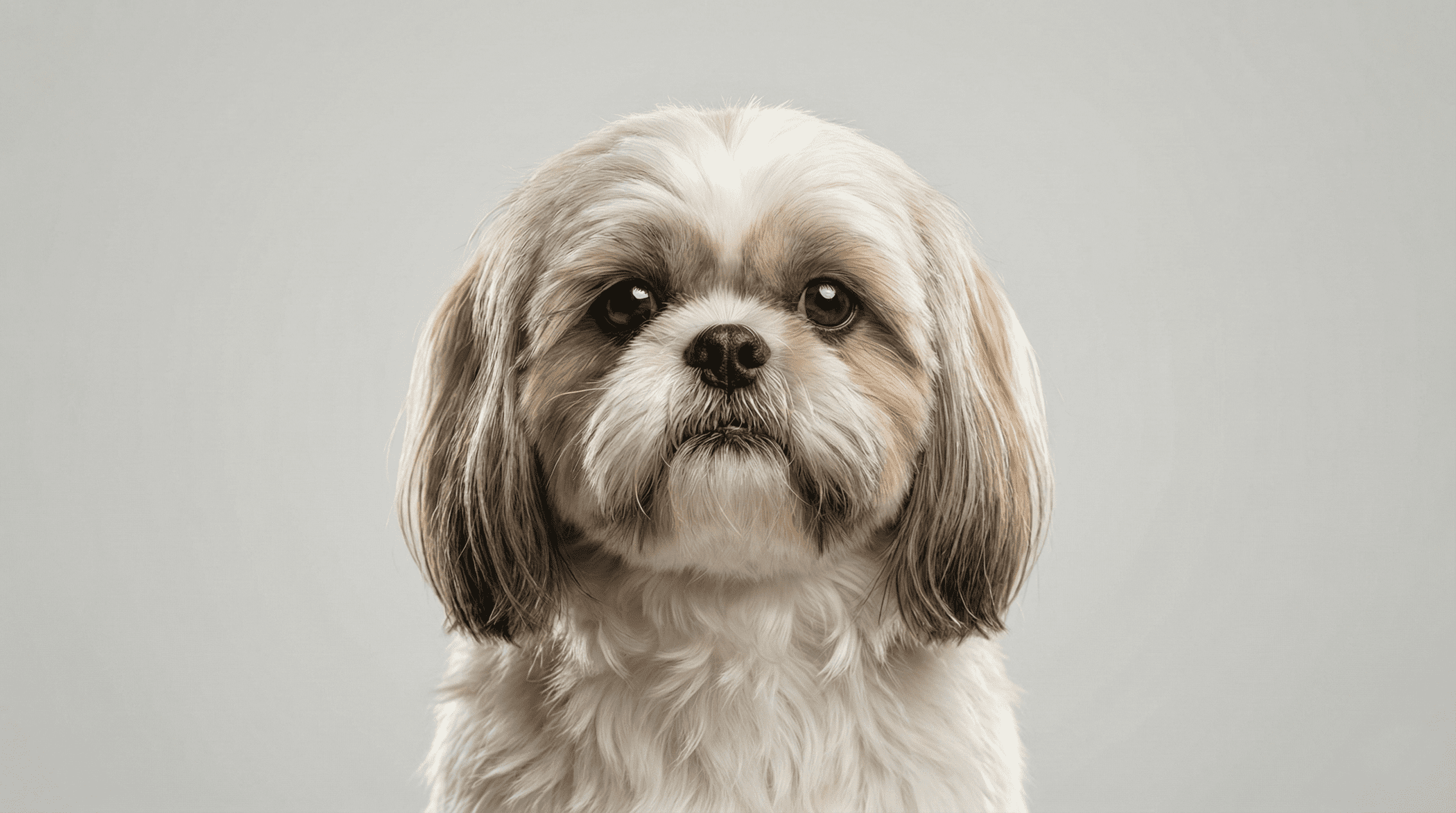
A palace companion with a working owner’s workload
The Shih Tzu was bred in the Chinese and Tibetan imperial courts purely as a companion — there is no working history at all. It shows in the temperament: affectionate, outgoing, playful without being demanding, and genuinely content in an apartment on thirty minutes of daily activity. It is one of the better small breeds for first-time owners and for older owners.
What it is not is low maintenance. Our specification table rates grooming very high, which is the highest on our register, and that rating is the single most important practical fact about this dog.
The coat is a daily commitment, and you have a choice to make
The Shih Tzu carries a long, dense, flowing double coat that grows continuously rather than shedding out. That is why shedding is low — and precisely why it mats. Hair that would otherwise drop out stays in place and tangles, particularly behind the ears, in the armpits, around the collar and on the belly.
A full-length coat needs daily brushing, right down to the skin rather than over the surface. A brush that only smooths the top leaves a felted mat forming underneath, which is painful and can only be resolved by clipping off.
Most Australian owners keep their Shih Tzu in a short “puppy clip”, which reduces daily maintenance to a few manageable minutes and is entirely reasonable — particularly in a warm climate. Either way, expect professional grooming every six to eight weeks for the dog’s whole life. Over a sixteen-year lifespan that is the defining recurring cost of the breed, and it comfortably exceeds what you will spend on food.
Two daily jobs beyond brushing: the face, and the eyes. Hair grows into the eyes and needs tying up or trimming, and the facial folds and beard collect food and moisture and need wiping and drying.
The face: a brachycephalic breed
The Shih Tzu has a shortened muzzle, and that carries the usual consequences at a moderate rather than extreme level.
Breathing. Snorting, snuffling and snoring at rest are signs of airway effort rather than breed charm. Look at the nostrils on a puppy — open or pinched? — and listen to the dog at rest and after play. Keeping the dog lean is one of the few risk factors an owner controls, and it matters.
Heat. A shortened muzzle limits cooling by panting, and panting is a dog’s primary cooling mechanism. In Australian summers: exercise early morning or after dusk, never leave the dog in a stationary vehicle, carry water. Treat laboured breathing that will not settle within a few minutes of stopping — especially with brick-red or blue-tinged gums — as an emergency.
Eyes. The large, prominent, shallow-set eyes are exposed and prone to corneal ulceration, often after something minor — a scratch, a grass seed, hair rubbing the surface. A Shih Tzu that squints, weeps or holds an eye closed needs same-day veterinary attention. Corneal injuries deteriorate quickly and are far easier to treat early.
Spine, knees and teeth
The Shih Tzu is chondrodystrophic — a long body on short legs — and intervertebral disc disease occurs in the breed. Discourage jumping down from lounges and beds, provide steps or a ramp, support both ends when lifting, and use a harness rather than a collar. Sudden reluctance to move, a hunched back, yelping when handled or hind-limb weakness is urgent.
Patellar luxation is graded I to IV, with grades II and above often requiring surgery.
Dental disease deserves emphasis (our dog dental care guide covers brushing and which chews actually work). A shortened jaw crowds a full set of teeth into very little space, and periodontal disease is close to universal without active management. Daily toothbrushing from puppyhood does more for this dog’s long-term comfort than anything else, and retained baby teeth around five to seven months should be checked rather than left.
Portosystemic liver shunt also occurs in the breed. In a small puppy the signs are easily mistaken for simply being small: poor growth, weak muscle development, and disorientation or lethargy an hour or two after eating. Bile acid testing diagnoses it, and it is worth raising at the first puppy consultation.
On the hypoallergenic question
The Shih Tzu is frequently described as hypoallergenic. It is not, and no dog is. The proteins people react to are found in dander, saliva and urine rather than in hair, so a low-shedding coat only reduces how much of that material circulates through a home. Some allergy sufferers do genuinely cope better with this breed — but that is a difference of degree, not a guarantee, and it cannot be predicted in advance. If allergies are your reason for choosing a Shih Tzu, spend real time with the individual dog before committing.
Ownership in Australia
In Victoria, microchipping and council registration are required from three months of age under the Domestic Animals Act 1994, renewing annually on 10 April. Desexed registration across the Victorian councils in our fee survey ranged from about $19.50 to $93.30 a year.
At 10 to 16 years this is a long commitment. The honest summary: an easy dog to live with and a demanding dog to maintain. Decide before you buy whether you will keep the full coat or clip it, and budget for a groomer either way.
Registration is set by your local council. In Victoria, registering a desexed Shih Tzu costs between $19.50 and $93.30 a year depending on where you live, and roughly three times that if the dog is not desexed. See every Victorian council’s 2026–27 fee, or compare registration costs in every state.
Related breeds
The Shih Tzu, originating from China, is a purebred toy breed known for its long, dense coat and low-shedding qualities. With a health complexity score of 1.5, the breed weighs between 4 kg to 7.25 kg, classified as small. The average lifespan ranges from 10 to 16 years. Shih Tzus have moderate energy levels requiring approximately 30 minutes of exercise daily. They exhibit high sociability, making them highly compatible with both children and other pets. The breed requires daily to every other day coat maintenance due to its very high grooming needs. Health risks include brachycephalic syndrome, intervertebral disc disease, patellar luxation, and dental disease. Trainability is moderate with an intelligence ranking of 70. Annual veterinary costs are $1008.75, excluding a $1200 contingency fund. The breed ranks among the top 30 most popular in Australia.
Shih Tzus require vigilant monitoring for hereditary conditions such as brachycephalic syndrome, intervertebral disc disease, patellar luxation, and dental disease. Regular veterinary check-ups, including dental evaluations, are essential. Early diagnosis and proactive treatment plans may enhance longevity and quality of life.
Daily care for Shih Tzus involves 30 minutes of exercise, including walks and interactive play. Their long, dense coat requires daily to every other day maintenance to prevent matting. Regular dental care is also essential due to the breed's predisposition to dental issues. Consistent training using positive reinforcement will benefit their moderate trainability.