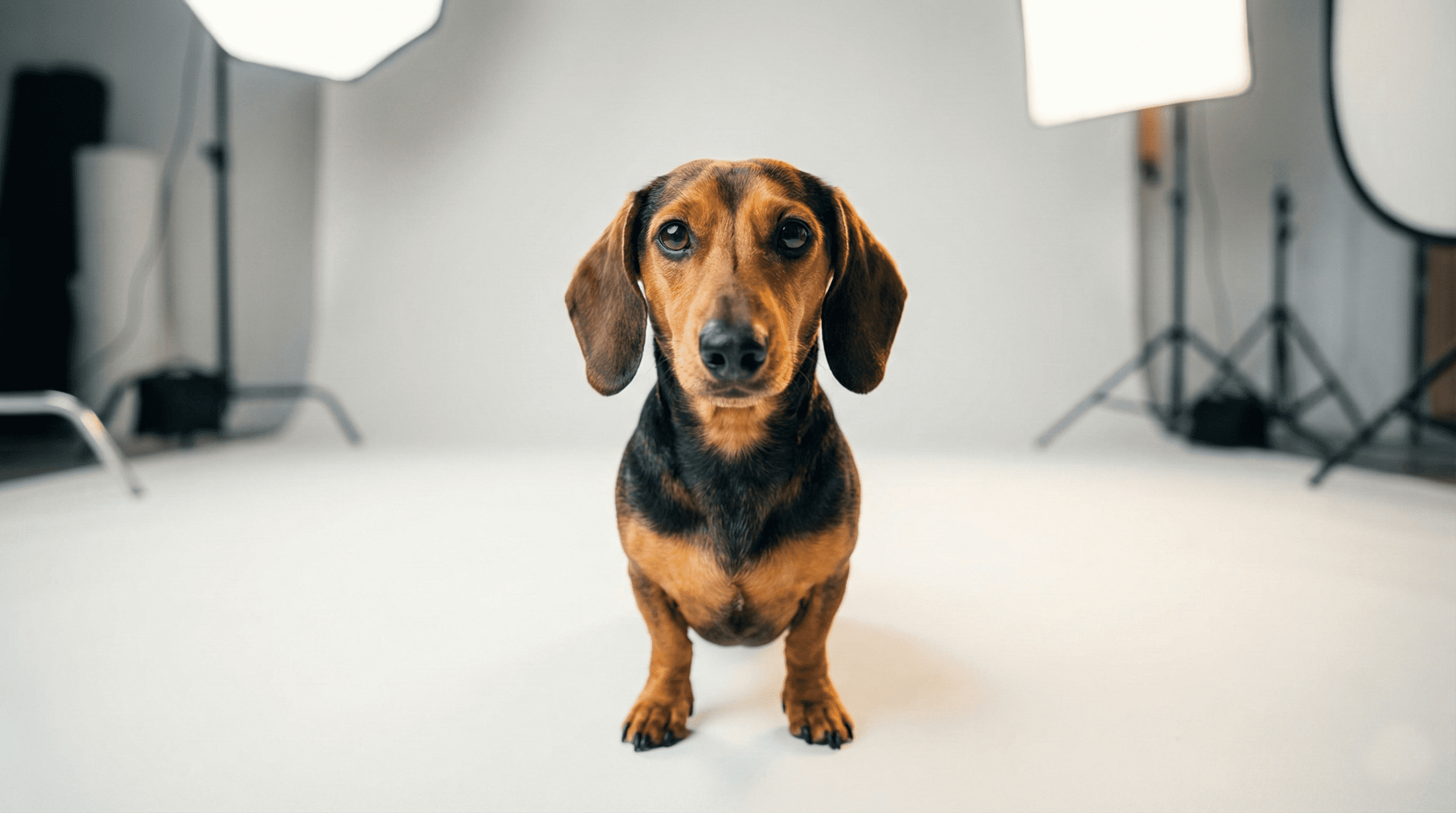
A working earth dog scaled down for rabbit
The Miniature Dachshund is not simply a small version of the Standard. It was bred deliberately in Germany to go to ground after rabbit, where the Standard was sized for badger and fox. At 4 to 5.5 kilograms it is a genuinely small dog with an entirely intact working temperament: courageous, clever, vocal and famously stubborn.
That stubbornness is a working requirement rather than a defect. A dog that gives up when a rabbit objects in a burrow is no use, and the trainability score of 3 reflects a dog that weighs your instruction against its own judgement. Short, varied, food-motivated sessions work; repetition and pressure do not. House-training in particular takes longer with this breed than most and benefits from patience and consistency rather than escalation.
The spine — and why it matters more in the Miniature
Intervertebral disc disease is the defining health risk of all Dachshunds, and the Miniature is not spared. The chondrodystrophic build means the discs degenerate and calcify early, and a degenerated disc can herniate into the spinal canal causing pain, hind-limb weakness and, in severe cases, paralysis.
The critical point for owners of the Miniature is that its small size makes people more casual, not less. A 5-kilogram dog is picked up constantly, carried on one arm, allowed onto high furniture because it seems harmless, and lifted by the front end. Each of those is a spinal risk.
The household rules, from day one:
- No jumping down from lounges, beds or car boots. Ramps or pet steps are spinal protection, and a Miniature Dachshund will learn to use them readily if introduced as a puppy.
- Support both ends when lifting — one hand under the chest, one under the hindquarters, keeping the back level. Never lift by the front end and let the rear hang.
- Keep the dog lean. This is the highest-value thing you control. Miniature Dachshunds gain weight extremely easily, and on a 5-kilogram frame even half a kilogram is proportionally enormous. You should be able to feel the ribs easily under a thin layer.
- Harness rather than collar for all lead work.
- Limit stairs and repetitive jumping. Steady walking is excellent; launching off furniture is not.
Act the same day on: sudden reluctance to move, a hunched or arched back, trembling, yelping when picked up, dragging a back foot, or wobbliness in the hindquarters. Spinal cases treated early have a substantially better prognosis.
Weight, diabetes and the food question
Obesity is listed as a health issue in its own right for this breed, and it deserves the listing. Dachshunds are hounds — food-driven, persuasive, and very good at convincing people they have not been fed.
Excess weight multiplies every spinal risk above, and the breed is also predisposed to diabetes mellitus. The early signs are easy to check and easy to miss: drinking noticeably more, urinating more, and weight loss despite a good appetite. Mention any of those to your vet rather than waiting for the next annual visit.
Weigh food rather than estimating it, count treats within the daily total, and use portions of the dinner ration for training rather than adding to it.
The rest of the health picture
Progressive retinal atrophy occurs and is DNA-testable — ask a breeder for both parents’ results. Patellar luxation is graded I to IV, with grades II and above often needing surgery. Dental disease is common in small jaws, so daily toothbrushing from puppyhood is worth establishing early.
One breeding note: the double dapple pattern, produced by mating two dapple (merle) dogs together, is associated with serious eye defects and deafness. Reputable breeders do not make that pairing. If you are offered a strikingly patterned puppy with extensive white and blue eyes, ask directly whether both parents were dapple — and treat the answer as informative.
Exercise, noise and Australian conditions
Thirty minutes of daily activity keeps a Miniature Dachshund fit, and it should be steady rather than explosive. Long lead walks suit the structure far better than ball-chasing with hard turns and landings.
Scent games are the single best enrichment for this breed and cost nothing — a scattered handful of kibble in the grass will occupy it more thoroughly than a kilometre of walking. A designated digging area saves the garden.
Dachshunds are loud. The voice was selected so a handler could locate the dog underground, and it has not diminished with size. Early work on a settle cue is far easier than retraining an established barker, and it matters in a townhouse or apartment.
In summer, a low-slung dog walks with its chest and belly close to hot ground. Walk early or late, test the pavement with the back of your hand, and check between the toes and inside the ears for grass seeds after walks in dry paddock country.
Ownership in Australia
In Victoria, microchipping and council registration are required from three months of age under the Domestic Animals Act 1994, renewing annually on 10 April. Desexed registration across the Victorian councils in our fee survey ranged from about $19.50 to $93.30 a year.
At 12 to 16 years this is a long commitment with modest routine costs and one expensive risk. Ramps, a harness and disciplined feeding cost almost nothing, and they are the difference between an easy fifteen years and a difficult one.
Registration is set by your local council. In Victoria, registering a desexed Miniature Dachshund costs between $19.50 and $93.30 a year depending on where you live, and roughly three times that if the dog is not desexed. See every Victorian council’s 2026–27 fee, or compare registration costs in every state.
Related breeds
The Miniature Dachshund, a purebred hound with origins in Germany, is characterized by its smooth, longhaired, or wirehaired coat. Weighing between 4 to 5.5 kg, they exhibit moderate shedding and grooming needs, requiring weekly to more frequent coat maintenance. Known for their courageous and lively temperament, they are moderately trainable (score: 3) and possess an intelligence ranking of 49. These dogs have a moderate energy level necessitating 30 minutes of daily exercise. They are very good with children, though they exhibit only moderate sociability with other pets. Prone to high separation anxiety and obesity, their key health issues include intervertebral disk disease, progressive retinal atrophy, obesity, diabetes, and patellar luxation. The average lifespan ranges from 12 to 16 years, and they are highly popular in Australia.
Given their health complexity, regular check-ups are crucial to monitor for IVDD, PRA, obesity, and diabetes. Semi-annual veterinary visits for thorough physical exams, blood tests, and eye exams are recommended. Preventive measures can significantly improve their quality of life and longevity.
Daily care includes moderate exercise, approximately 30 minutes to prevent obesity and maintain musculoskeletal health. Coat maintenance varies with type; smooth coats need weekly brushing, while longhaired and wirehaired need more frequent grooming. Regular grooming helps prevent matting and skin issues. Heavy Australian weather may necessitate additional grooming to manage shedding.