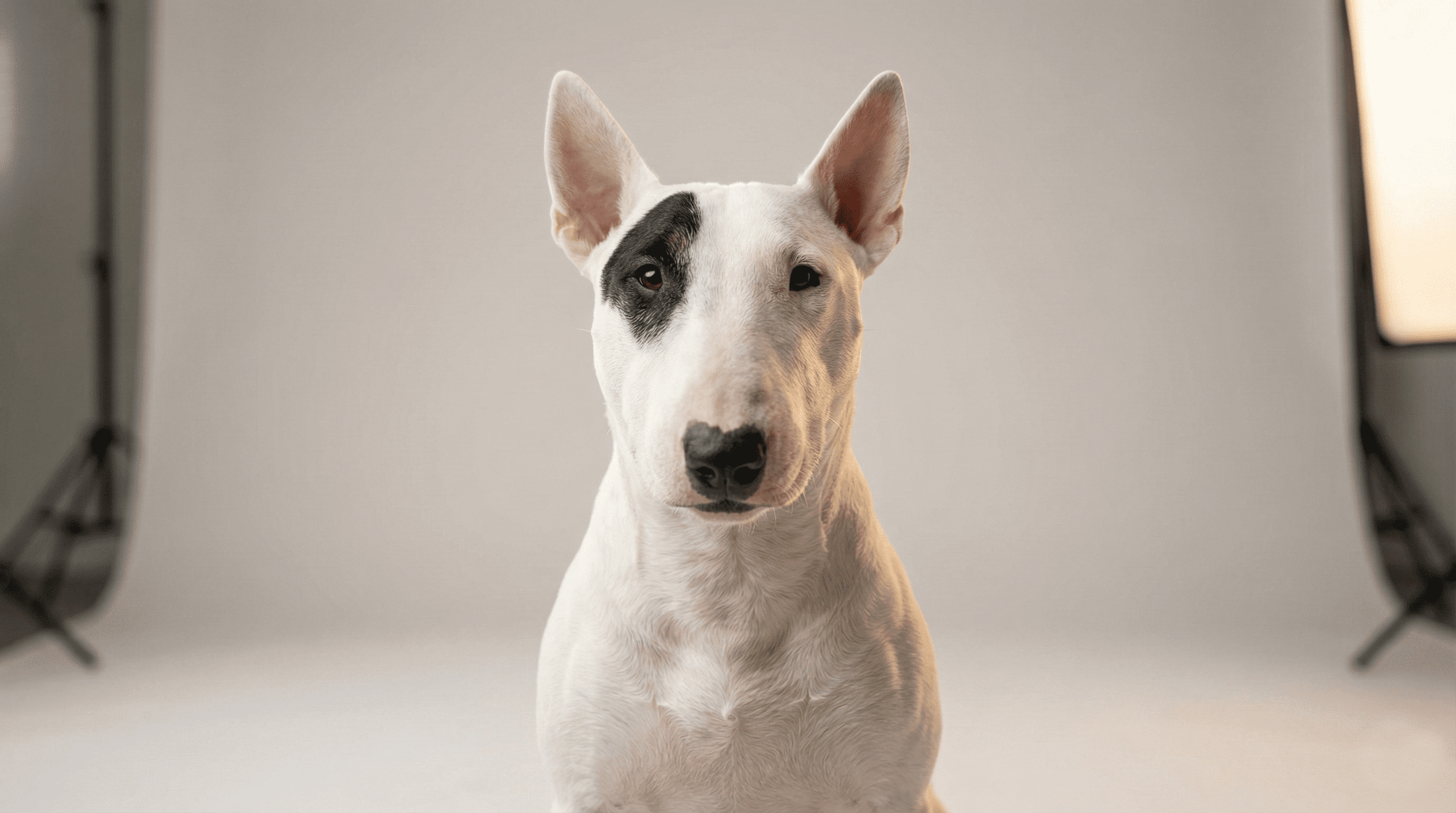
The egg-shaped head, and what comes with it
The Bull Terrier is instantly recognisable: the only breed with a genuinely convex, egg-shaped skull and small triangular eyes. That head was deliberately developed in the nineteenth century, and it is the visible marker of a breed that has been shaped more heavily by selective breeding than most.
It is not a restricted breed anywhere in Australia. The breeds actually restricted under Australian law are the American Pit Bull Terrier (or Pit Bull Terrier), Dogo Argentino, Japanese Tosa, Fila Brasileiro and Perro de Presa Canario. The Bull Terrier is on none of those lists and is a Dogs Australia recognised breed with a published standard — a distinction worth having your council registration handy for when a rental application or owners corporation form asks.
Temperamentally, a correct Bull Terrier is comic, affectionate, exuberant and unusually attached to its people. The breed is often described as a clown, and that is accurate. It is also physically powerful, stubborn, and slow to mature, with an intelligence ranking of 66 and a trainability score of 3 that together mean training needs to be interesting, short and reward-based rather than repetitive.
Same-sex dog intolerance is common, as it is across terrier breeds, and needs planning around rather than hoping about.
Kidney disease — the test to ask for by name
Hereditary nephritis and polycystic kidney disease both occur in Bull Terriers, and kidney disease is a leading cause of death in the breed. What makes it dangerous is that it is silent for a long time: kidneys have substantial reserve capacity, and by the time a dog drinks more, urinates more and loses weight, function is already well reduced.
The practical response is specific and it is the thing most Bull Terrier owners do not know. There is a simple, inexpensive screening test — the urine protein to creatinine ratio (UPC) — which detects protein loss through the kidneys long before any clinical sign appears.
Ask your vet to run a UPC as part of routine health checks, and ask any breeder whether the parents have been UPC screened and, where relevant, ultrasounded for polycystic kidney disease. Early detection allows dietary and medical management that meaningfully slows progression. Late detection does not.
Deafness
Congenital deafness occurs in the breed and is associated with the white coat genetics — the same pigment-related pathways that produce a white dog also affect inner ear development. White Bull Terriers are at notably higher risk than coloured ones.
Unilateral deafness is easy to miss without testing; the dog compensates and simply seems inattentive. The screening tool is a BAER test, done on puppies from about five to six weeks. Ask whether the litter was tested and what the results were.
The rest of the health picture
Primary lens luxation occurs in the breed. The lens slips out of position, and if it moves forward it blocks fluid drainage and causes acute glaucoma — a suddenly cloudy, red or painful eye is a same-day emergency, not a next-week appointment. Vision can often be saved with prompt treatment.
Mitral valve dysplasia is a congenital heart valve defect found in Bull Terriers. It is detected as a murmur on auscultation, which makes a puppy’s first veterinary examination genuinely important. A murmur in a Bull Terrier puppy warrants echocardiography rather than observation.
Patellar luxation is graded I to IV, with grades II and above often requiring surgery.
Skin is a recurring theme: allergic and contact dermatitis are common, and in Australia usually seasonal and grass-pollen driven. White dogs also sunburn readily on the nose, ear tips and thinly covered belly, so shade matters genuinely.
Compulsive behaviours including tail-chasing and trance-like staring occur in Bull Terriers at elevated rates and can become true compulsive disorders. Persistent, intense, hard-to-interrupt tail-chasing is a veterinary matter rather than a funny habit, and it responds far better to early intervention than late.
Exercise, coat and Australian conditions
An hour of daily activity, with a real mental component. Bull Terriers are strong, enthusiastic and easily bored, and a bored one is destructive on a scale that matches its jaw strength. Robust toys, scent games, short training sessions and structured play work well.
Grooming is genuinely low: a short dense coat and a weekly rubber curry. They shed more than the coat suggests.
In summer, the combination of a mostly white coat, pink skin and a moderately shortened muzzle means both sunburn and heat need managing. Walk early or late, provide shade, carry water, and use pet-safe sunscreen on the nose and ear tips for a dog that spends time outdoors.
Ownership in Australia
In Victoria, microchipping and council registration are required from three months of age under the Domestic Animals Act 1994, renewing annually on 10 April. Desexed registration across the Victorian councils in our fee survey ranged from about $19.50 to $93.30 a year.
Two things separate a good Bull Terrier experience from a difficult one, and both are decided early: buy from a breeder who BAER tests and screens kidneys, and put in the socialisation and training work through the first two years while the dog is still forming its view of the world. Neither is expensive. Both are hard to retrofit.
Registration is set by your local council. In Victoria, registering a desexed Bull Terrier costs between $19.50 and $93.30 a year depending on where you live, and roughly three times that if the dog is not desexed. See every Victorian council’s 2026–27 fee, or compare registration costs in every state.
Related breeds
The Bull Terrier, a purebred terrier from England, is marked by its medium size and mass classification, with a weight range of 22-38 kg. The breed's short and dense coat requires weekly grooming, falling under low grooming needs. Given a health complexity score of 1.6, the breed is moderately active, demanding 60 minutes of daily exercise to maintain optimal health. Bull Terriers are characterised by high sociability and moderate separation anxiety, necessitating fairly constant interaction. While they demonstrate suitability with children is high, they show cautious behaviour toward other pets. Health concerns primarily include patellar luxation, deafness, mitral valve dysplasia, lens luxation, and kidney disease, necessitating routine veterinary checkups. The breed's average lifespan is 11 to 14 years, with an estimated annual veterinary cost of $1,568 and puppy costs in the first year around $3,000. Australian owners should also anticipate a contingency fund of $1,280 for unexpected medical conditions.
Given the specific hereditary issues in Bull Terriers, including patellar luxation, deafness, and kidney disease, routine veterinary checkups are crucial. Annual wellness exams and early genetic screenings help manage potential health risks. Focusing on dental care and a balanced diet also enhances overall health.
Daily care for a Bull Terrier includes 60 minutes of diverse exercise to match their moderate-high energy levels. Weekly coat maintenance involves brushing their short, dense coat to manage shedding. Mental stimulation through training and puzzles is beneficial due to their moderate trainability. High sociability necessitates regular interaction to prevent behavioural issues.