The King of Terriers — and what that title actually means for an owner
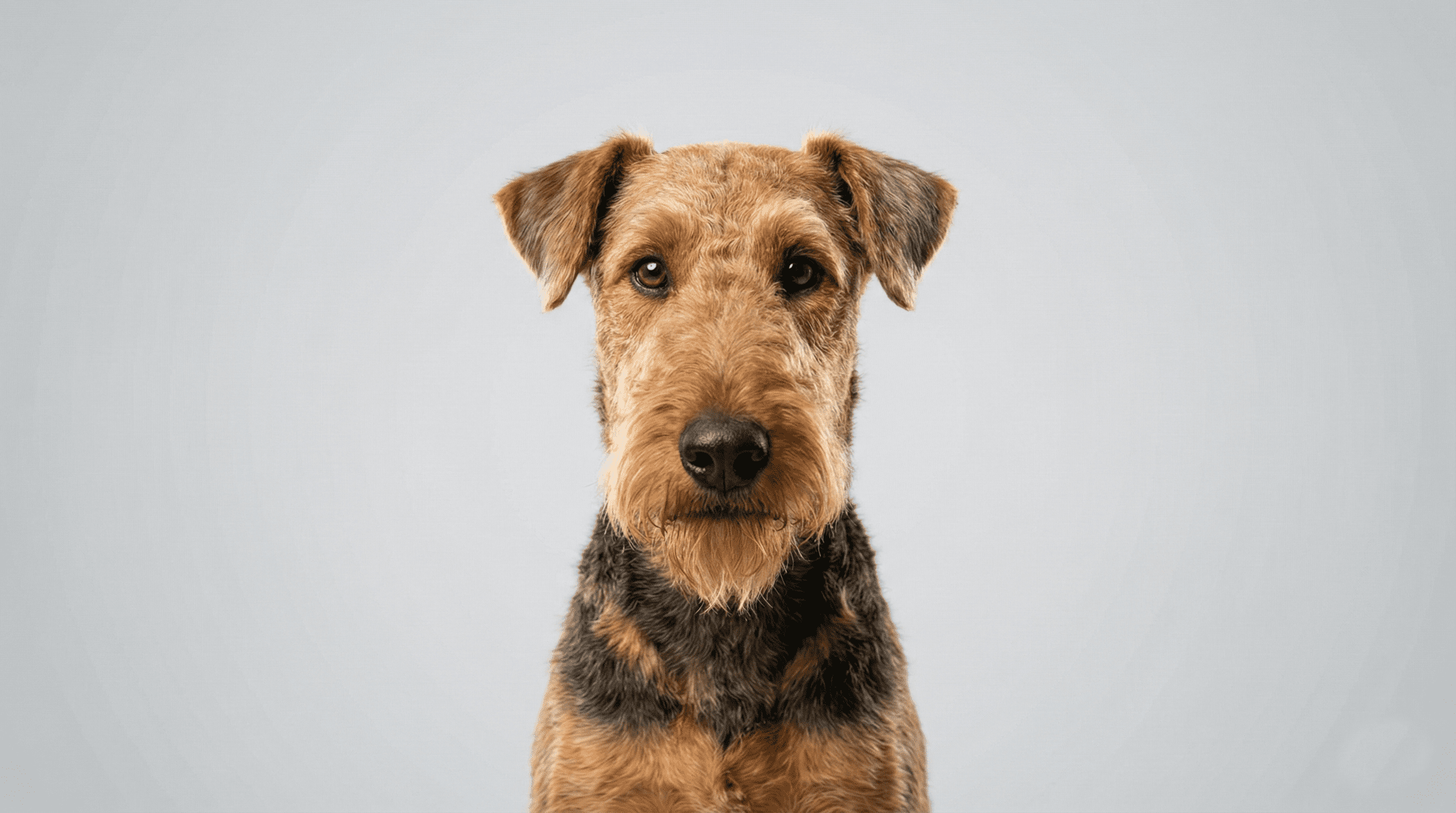
The Airedale is the largest of the terriers, developed in the Aire Valley of Yorkshire to hunt otter and rat along the river and later used as a wartime messenger and police dog. At 20 to 23 kilograms it is a genuinely versatile working animal, and it has a terrier’s temperament scaled up to a size where that temperament has consequences.
An Airedale is confident, funny, independent-minded and quick to make its own decisions. With a trainability score of 4 and an intelligence ranking in the high twenties, the raw capacity is excellent — but this is a dog that asks “why” rather than simply complying, and it becomes bored with drilling faster than most breeds. Short, varied, reward-based sessions work; repetition does not.
The terrier inheritance also means a real prey drive and a tendency toward same-sex dog intolerance. Secure fencing and early, structured socialisation are the two investments that determine how easy the next twelve years will be.
The coat: hand-stripping versus clipping
This is the practical decision most new Airedale owners are never told about, and it changes the dog’s appearance permanently.
The Airedale carries a dense, wiry, hard outer coat over a softer undercoat. That harsh texture is functional — it repels water and dirt — and it is maintained by hand-stripping, in which dead hairs are plucked out at the root so a new harsh coat grows in. Clipping cuts the hair off instead, leaving the dead undercoat in place. The result is a coat that grows back softer, paler and woollier with each clip, mats more readily, and loses much of its weather resistance.
Neither choice is wrong. A pet Airedale that is clipped every eight weeks lives a perfectly good life with a softer coat. But it is a one-way decision in practical terms, and it is worth making deliberately rather than by default because a groomer reached for the clippers. If you want the true wire jacket, find a groomer who hand-strips and book early — they are not on every corner in Australia.
Either way, brush weekly to keep the leg furnishings and beard free of mats, and clean the beard after meals. Shedding is genuinely low, which is why the breed suits some households with mild allergies — though no dog is truly hypoallergenic.
Health: the two conditions to know in detail
Gastric dilatation-volvulus
The Airedale is deep-chested, and bloat is the emergency that kills deep-chested dogs. The stomach distends with gas and can rotate, cutting off its own blood supply. The presentation is distinctive: a swollen, hard abdomen, repeated unproductive retching that brings nothing up, restlessness, drooling and rapid deterioration.
This is measured in hours, not overnight. Know the signs before you need them, and know which emergency clinic near you is open after hours — deciding that at 2am is the wrong time to be looking it up.
Dilated cardiomyopathy
The heart muscle thins and the chambers enlarge, reducing pumping efficiency. It can be silent until well advanced, then present as exercise intolerance, coughing, laboured breathing or fainting. Annual auscultation from middle age, and prompt investigation of a new cough or reduced exercise tolerance, are the practical responses.
Hypothyroidism and skin
Hypothyroidism in dogs is usually autoimmune and shows up as unexplained weight gain, lethargy, coat thinning and recurrent skin or ear infections. It is a straightforward blood test and inexpensive lifelong medication.
Atopic dermatitis is separately common in the breed and, in Australia, is typically seasonal and grass-pollen driven. Identify which months trigger your dog and treat ahead of the flare rather than after it. A dog that is itchy every spring does not have bad luck; it has a manageable diagnosis.
Hip dysplasia is screened radiographically — ask any breeder for the parents’ actual scores rather than an assurance that they are healthy.
Exercise and Australian conditions
An hour a day is the baseline, and this is a high-energy dog that needs the mental half as much as the physical. Scent work suits the breed exceptionally well and exploits its original job. Retrieve with rules, trick training and food puzzles all work. An under-occupied Airedale digs, chews and barks — and at this size, it can dismantle a good deal.
The wiry double coat handles Australian heat better than a heavy woolly coat, but it is still insulation on a 20-kilogram black-and-tan dog. Exercise early or late in summer, carry water, and check the pavement with the back of your hand before you set out.
Ownership in Australia
In Victoria, microchipping and council registration are required from three months of age under the Domestic Animals Act 1994, renewing annually on 10 April. Desexed registration across the Victorian councils in our fee survey ranged from about $19.50 to $93.30 a year.
Budget realistically for grooming. Whether you hand-strip or clip, an Airedale needs professional attention every six to eight weeks for its whole life, and hand-stripping costs more than clipping because it takes considerably longer. That recurring cost, not food, is the line item people underestimate with this breed.
Registration is set by your local council. In Victoria, registering a desexed Airedale Terrier costs between $19.50 and $93.30 a year depending on where you live, and roughly three times that if the dog is not desexed. See every Victorian council’s 2026–27 fee, or compare registration costs in every state.
Related breeds
The Airedale Terrier, originating from the United Kingdom, is a medium-sized, purebred member of the Terriers group. With a health complexity score of 2.0, this breed features a dense, wiry, and hard coat type and has a low shedding level. Average weight ranges from 20 to 23 kilograms. This breed requires weekly brushing, with professional grooming recommended every 6 to 8 weeks. Exhibiting traits such as confidence, intelligence, friendliness, and courage, the Airedale Terrier has a trainability score of 4 out of 5. It holds an intelligence ranking of 29 and enjoys high energy levels, necessitating around 60 minutes of daily exercise. They are generally good with children but only moderately so with other pets. Potential health concerns include hip dysplasia, dilated cardiomyopathy, hypothyroidism, atopy, and gastric torsion (bloat). Specific to Australia, the breed is among the top 60 in popularity. Estimated initial puppy costs are $3000, with annual veterinary expenses (medical only) at $1660. Contingency funds should be calculated at $1600. This breed is prone to moderate separation anxiety and carries a moderate risk of obesity.
Due to their moderate health complexity, Airedale Terriers should undergo regular veterinary checkups to monitor for hereditary conditions such as hip dysplasia, dilated cardiomyopathy, and hypothyroidism. Preventative measures include a balanced diet, appropriate exercise, and prophylactic treatments for common issues like gastric torsion.
Airedale Terriers require substantial daily exercise, ideally 60 minutes of high-intensity activities like running and fetching. Weekly coat brushing is essential, coupled with professional grooming every 6 to 8 weeks. Regular obedience training and mental stimulation help address their high intelligence and energy levels.